
Shopping online is entering its next major phase. But this time, it’s not about faster websites, better UX, or smarter ads.
It’s about AI agents doing the shopping for us.
With the launch of Google’s Universal Commerce Protocol (UCP), AI shopping is shifting away from traditional web pages and toward machine-readable commerce systems that AI assistants can understand, compare, and transact with—without ever needing to visit a website.
This shift has massive implications for brands, retailers, SEO teams, and the future of online shopping.
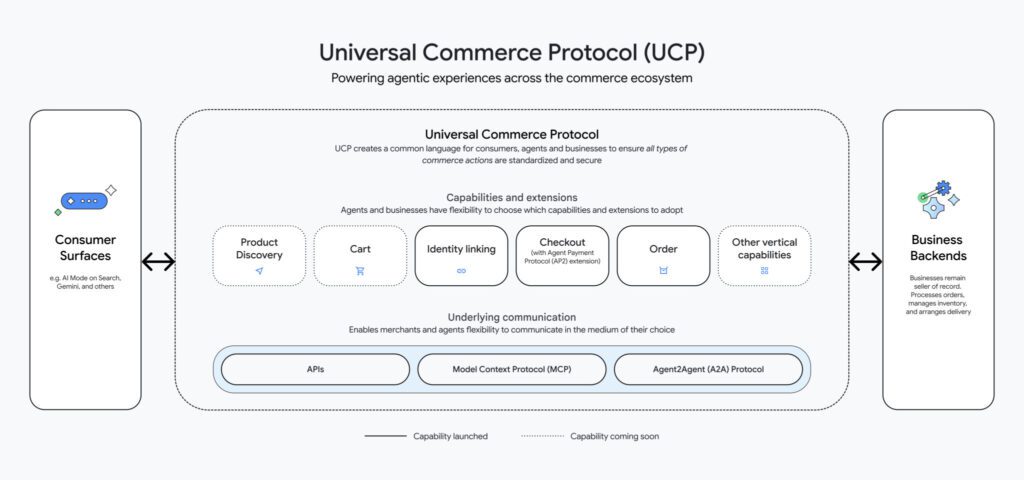
What Is Universal Commerce Protocol (UCP)?
The Universal Commerce Protocol (or UCP) is an open-source standard introduced by Google and announced publicly in January 2026 to enable AI commerce across the entire shopping journey—from product discovery to checkout and even post-purchase support.
In simple terms, UCP creates a common language that allows AI agents to interact directly with retailers, payment providers, and commerce platforms without relying on traditional webpages.
With UCP, AI systems can:
- Discover products
- Check real-time inventory and pricing
- Understand variants, shipping, and availability
- Complete checkout securely
All without scraping or ranking websites.
If Schema.org helped Google understand web pages, UCP helps AI systems understand commerce.
From Browsing to Delegating: The Rise of Agentic Shopping
This shift is often described as agentic shopping.
In traditional ecommerce, users manually:
- Search Google
- Visit multiple sites
- Compare products
- Add items to carts
- Abandon carts (often)
With AI agents shopping on a user’s behalf, the flow changes completely:
- The user describes what they want
- The AI agent compares options across retailers
- The user confirms
- The AI completes the purchase
This is where shopping AI becomes the interface, and humans step out of the operational work. The AI doesn’t just recommend; it acts.
AI Shopping Without Websites: How UCP Changes Discovery
One of the biggest shifts introduced by UCP is AI shopping without websites being the primary discovery layer.
Instead of ranking pages, AI systems query brands directly using structured commerce data. They ask:
- Is this product in stock?
- What’s the price?
- What variants are available?
- Can this be purchased right now?
The brands that respond clearly and accurately win the sale—not because of better landing pages, but because they expose the best machine-readable commerce layer.
This is product discovery without search engines as we know them today.
Why Google Built UCP — And Who’s Involved
Google launched UCP on January 11, 2026, as a way to standardize next‑generation ecommerce for AI shopping. But this wasn’t a solo effort — industry leaders helped shape the protocol.
Key partners include:
- Retailers & platforms: Shopify, Target, Walmart, Wayfair, Best Buy, Etsy, Macy’s, The Home Depot, Flipkart, Zalando
- Payments and infrastructure: Visa, Mastercard, American Express, Stripe, Adyen
This broad backing signals that UCP isn’t just experimental — it’s becoming the backbone of AI‑powered shopping experiences globally.
Google Shopping AI vs Other AI Commerce Protocols
UCP isn’t the only game in town. OpenAI + Stripe launched their own Agentic Commerce Protocol in late 2025, enabling purchases directly in ChatGPT. Meanwhile:
- Amazon’s Alexa is already shopping‑enabled, but it’s a closed ecosystem.
- Meta is trying shopping on WhatsApp and Instagram with AI features.
The big difference? UCP and similar standards are open protocols. Retailers don’t have to choose one platform and get locked in. A Shopify merchant, for example, could enable both UCP and OpenAI’s protocol, reaching customers across Google, ChatGPT, and more.
What UCP Means for Retailers, Brands, and SEO Teams
UCP fundamentally changes how brands should think about visibility and optimization.
For retailers
- Reduced cart abandonment through AI-driven checkout
- Access to high-intent AI discovery channels
- No marketplace commissions
- Retailers remain the merchant of record and own the customer relationship
For SEOs and e-commerce teams
This is where SEO becomes strategic again.
Instead of only optimizing pages, teams must focus on:
- Product and inventory data quality
- Structured, machine-readable commerce feeds
- Clear exposure of “buy-ability” to AI systems
In an AI shopping world, brands must be:
- Crawlable and queryable
- Discoverable and transactable
This is the emerging reality of E-commerce SEO vs UCP.
Winners, Losers, and Early Adopters
In a world where AI chooses what to recommend and where to buy:
Early adopters win because:
- Clean commerce protocols make them the default suppliers
- AI agents favor accuracy, availability, and trust
- Smaller brands can compete on quality, not brand size
Late adopters risk:
- Reduced visibility in AI shopping assistants
- Price-only competition
- Becoming invisible in AI-driven product discovery
The future of online shopping will reward brands that expose capabilities, not just content.
Preparing for AI-Powered Shopping Experiences
You don’t need to implement UCP manually today—but you do need to prepare for AI-powered shopping experiences.
Here’s where brands should focus now:
1. Optimize Product Content for AI Discovery
AI systems rely on clarity and specificity.
- Detailed descriptions
- Exact specs and attributes
- Clear differentiation
This directly impacts AI and product discovery.
2. Strengthen Structured Commerce Data
- Clean product feeds
- Accurate variants and GTINs
- Real-time inventory
This is the backbone of AI shopping checkout success.
3. Build Trust Signals
AI agents evaluate:
- Reviews
- Return policies
- Shipping clarity
- Certifications
Trust influences recommendations as much as price.
AI Shopping Trends 2026 and Beyond
Looking at AI shopping trends 2026, adoption will be gradual but decisive:
- Early rollout among large retailers
- Platform-level integrations (Shopify, WooCommerce)
- Broader consumer adoption over the next few years
The winners won’t be those who react late—but those who quietly prepare their data, systems, and content today.
The Bigger Shift: The Future of Online Shopping
The future of online shopping isn’t about killing websites. Websites still matter—but they’re no longer the only door.
With Universal Commerce Protocol, AI now has a back entrance.
In this new world:
- Brands don’t compete on pages
- They compete on capabilities exposed to AI
- Visibility comes from being queryable, not just crawlable
This is the next evolution of AI commerce—and it’s already underway.
Final Takeaway
UCP doesn’t replace ecommerce—it rewires it.
As AI shopping assistants become the default way people research and buy products, brands that invest in structured data, clean inventory systems, and AI-readable content will become the default suppliers.
Not because they ranked first.
But because the AI chose them.