Most marketing teams do not struggle because they lack automation.
They struggle because their automation exists in fragments.
A CRM sends emails.
A chatbot captures leads.
A workflow tool moves data.
A reporting system updates dashboards.
An AI tool generates content.
Everything technically works.
Yet the team still feels operationally heavy.
Common operational issues include:
- Manual follow-ups continue
- Lead routing breaks
- Campaign context disappears between platforms
- Reporting becomes reactive instead of operational
- Teams spend hours coordinating systems that were meant to reduce coordination
This is where marketing automation becomes misunderstood.
For years, automation was treated like a collection of individual features:
- Email automation
- CRM automation
- Workflow automation
Modern marketing operations are no longer isolated enough for automation to stay inside a single platform.
Today, customer journeys move across multiple systems, including:
- CRM systems
- ad platforms
- forms
- sales conversations
- onboarding systems
- reporting tools
- AI workflows
- communication environments
That complexity changes the role of automation entirely.
The strongest teams today are not simply automating campaigns.
They are designing operational systems where information moves with less friction.
That is why tools like Zapier, Make, n8n, ActiveCampaign, Customer.io, and HubSpot have become increasingly important.
Not because businesses want more software.
Because operational handoffs became too expensive.
This guide is not a list of “best automation tools.”
It is a breakdown of how modern marketing workflows actually operate and where different automation systems fit operationally.
Because the important question is no longer:
“What can we automate?”
It is:
“Where is operational friction slowing growth?”
HubSpot Changed CRM Automation. But Marketing Operations Expanded Beyond CRM.
HubSpot helped normalize the idea that marketing automation should feel connected.
It allowed businesses to:
- Move leads through automated workflows
- Trigger emails based on customer behaviour
- Give sales and marketing teams shared visibility into customer journeys
That shift was important.
But something else happened as businesses matured.
Operations expanded faster than CRM systems.
Modern workflows now involve:
- AI-generated content
- cross-platform reporting
- enrichment systems
- async collaboration
- multi-channel communication
- automated onboarding
- internal approvals
- campaign orchestration
HubSpot still sits at the center for many organizations.
But increasingly, automation happens around the CRM rather than entirely inside it.
This is why workflow infrastructure has become its own operational layer.
The strongest marketing teams today usually think in systems instead of channels.
And systems require orchestration.
Many organizations are now building an AI-powered agency operating system that connects project management, team communication, and automation into one workflow instead of relying on disconnected tools.
What Marketing Teams Actually Struggle With
If you spend enough time reading discussions from operations managers, marketers, RevOps teams, and agency operators, the complaints become surprisingly similar.
Not because everyone uses the same software.
Because operational friction repeats itself across organizations.
1. Disconnected Tools
Teams adopt new platforms quickly.
But the workflows connecting those platforms remain fragile.
Common issues include:
- Partial data synchronization
- Failed notifications
- Unclear ownership
- Broken integrations
2. Repetitive Manual Coordination
Many teams still perform the same repetitive tasks every day.
Examples include:
- Downloading leads from one platform
- Uploading them into another
- Updating CRM statuses manually
- Sending identical onboarding emails
- Creating recurring tasks
None of these activities are strategically valuable.
Collectively, however, they create significant operational drag.
3. Limited Workflow Visibility
Many organizations know automation exists.
Few fully understand it.
Questions that often remain unanswered include:
- What triggers each workflow?
- Which automations are business-critical?
- Where do failures occur?
- Who owns maintenance?
This creates an unusual situation where automation technically reduces work while operational uncertainty increases.
The strongest systems prioritize clarity before complexity.
The Five Layers of Modern Marketing Automation
Before selecting automation tools, define the operational job.
Most high-functioning marketing automation systems operate across five layers.
Lead Movement
How contacts enter and move through systems.
Communication
How messaging responds to behaviour.
Workflow Coordination
How repetitive operational actions disappear.
Data Synchronization
How platforms stay aligned.
Operational Visibility
How teams understand what automation is actually doing.
Different tools solve different layers.
The mistake many organizations make is expecting one platform to own all five perfectly.
Workflow Coordination: Where Modern Automation Actually Starts
Most operational inefficiency doesn’t come from strategic decisions.
It comes from repeated administrative work such as:
- Status updates
- Notifications
- Task creation
- Data transfers
- Approval routing
The strongest automation systems eliminate these repetitive coordination tasks first.
1. Zapier
Zapier became foundational because it removed one of the biggest operational bottlenecks inside marketing teams.
Waiting for technical implementation.
Instead of relying on developers for every integration, marketing teams could connect systems themselves.
Typical workflows include:
- Form submission → CRM contact creation
- CRM update → Customer onboarding
- Signed proposal → Project task creation
- Webinar registration → Audience segmentation
Best suited for
- Small and mid-sized teams
- Cross-platform automation
- Quick implementation
- Lightweight operational workflows
Key takeaway
Automation delivers the most value when the underlying process is already well-defined.
Automating an unclear workflow simply creates faster confusion.
2. Make
Make approaches to workflow automation differently.
Instead of prioritizing simplicity first, it provides more visibility and flexibility across workflow logic.
It performs especially well when workflows include:
- Branching logic
- Conditional actions
- Multi-step processes
- Complex reporting
- Layered automations
Its visual workflow builder helps larger teams understand increasingly complex automation environments.
Best suited for
- RevOps teams
- Agencies
- Cross-system orchestration
- Advanced workflow design
The strongest organizations use Make to reduce operational fragmentation rather than simply increasing automation volume.
3. n8n
n8n has gained attention because some organizations increasingly want more control over automation infrastructure itself.
Especially among technically capable teams, there is growing interest in owning workflow environments rather than depending entirely on SaaS abstraction layers.
What makes n8n operationally interesting is flexibility.
Teams can build highly customized automation environments while maintaining stronger infrastructure ownership.
This tends to appeal particularly to:
- engineering-heavy teams
- AI workflow experimentation
- custom operational environments
- privacy-sensitive organizations
The key difference is philosophical as much as technical.
Some teams want convenience.
Others want control.
Communication Automation: Where Behaviour Becomes Operational Intelligence
Marketing automation is no longer just about sending emails automatically.
Modern communication systems increasingly respond to:
- behaviour
- timing
- engagement
- customer stage
- operational signals
That changes communication from broadcasting into orchestration.
4. ActiveCampaign
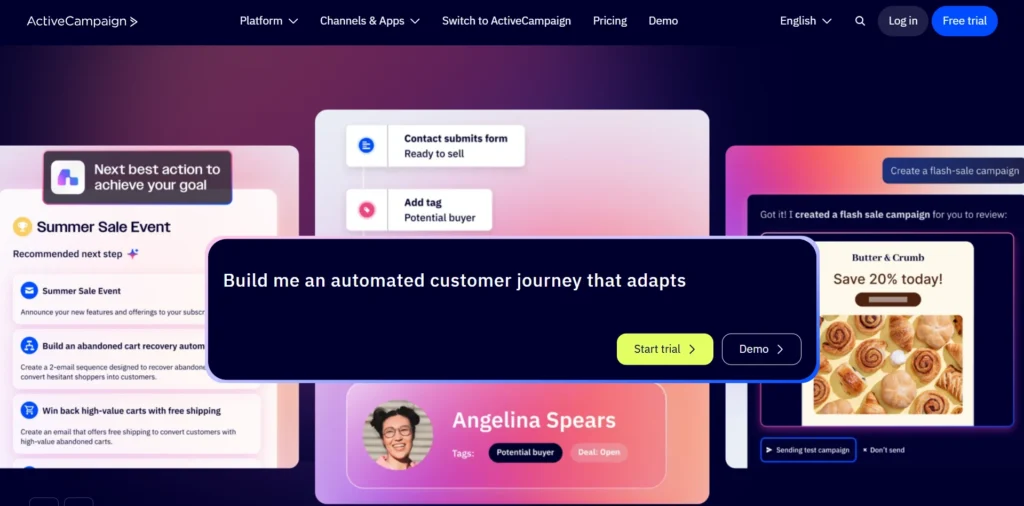
ActiveCampaign became popular because it connected messaging with behavioural automation more deeply than many traditional email systems.
Its strongest implementations usually involve:
- lifecycle automation
- customer nurturing
- behavioural segmentation
- sales follow-up coordination
The important shift here is that campaigns stop behaving like isolated sends.
Communication becomes part of the operational flow.
For example:
- A prospect downloads content.
- Behaviour updates lead scoring.
- Sales visibility changes.
- Nurture timing adjusts.
- Follow-ups trigger differently.
Everything becomes more context-aware.
That operational responsiveness is what modern teams increasingly want.
5. Customer.io

Customer.io tends to appeal to organizations wanting more control over event-driven communication.
Its strength is not necessarily ease.
It is orchestration flexibility.
This becomes especially valuable for:
- SaaS companies
- product-led organizations
- advanced lifecycle marketing
- multi-touch communication systems
The strongest communication automation systems increasingly behave less like campaign tools and more like behavioural infrastructure.
CRM Automation: Why HubSpot Still Sits at the Center for Many Teams
Even as automation ecosystems expanded, HubSpot remained valuable because it centralizes operational context.
It brings together:
- Contacts
- Activities
- Sales pipelines
- Communication history
- Workflow visibility
That operational memory matters.
6. HubSpot
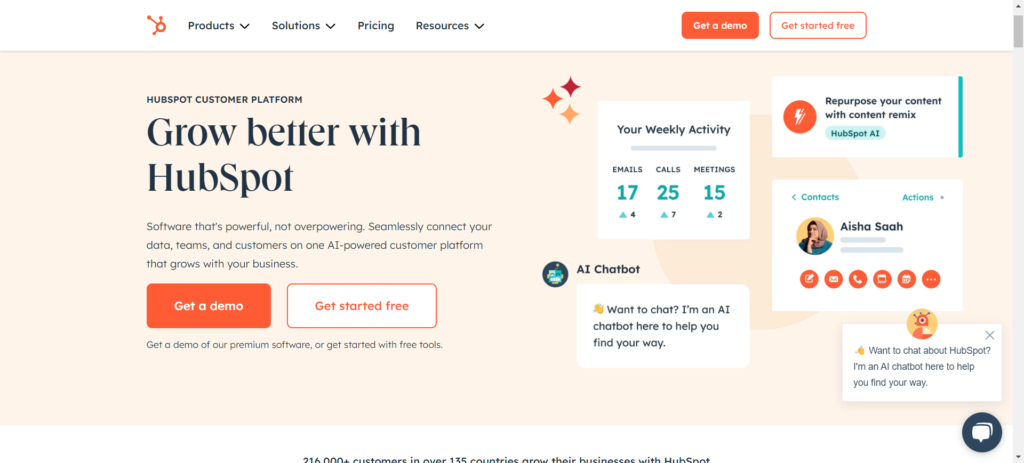
HubSpot’s biggest operational advantage is not automation alone.
It is coordination.
Marketing, sales, reporting, and communication begin operating from a shared context.
That reduces one of the biggest organizational problems:
different departments interpreting different realities.
Where HubSpot still performs strongly:
- lead lifecycle management
- CRM automation
- marketing-sales coordination
- centralized workflow visibility
The strongest modern stacks often use HubSpot as the operational center while extending automation outward through platforms like Zapier, Make, and AI systems.
Because modern operations are becoming layered rather than centralized entirely inside one platform.
Many businesses also extend HubSpot’s capabilities with specialized AI applications for content generation, sales assistance, reporting, and workflow automation. Exploring the best AI tools that integrate with HubSpot can help teams build a more connected marketing stack.