
The best AI SDR tools can research prospects, identify relevant buying signals, personalise outreach, manage follow-up sequences, qualify replies, and book meetings with minimal manual effort.
11x Alice is a strong option for companies seeking an autonomous enterprise outbound agent. Artisan Ava combines prospect data, research, multichannel campaigns and meeting booking in a self-service AI BDR platform. AiSDR, Reply.io Jason AI and Salesforge Agent Frank offer more accessible starting points for growing B2B teams.
For organisations that want AI to work alongside sales representatives rather than operate independently, Regie.ai, Amplemarket Duo, Unify and Apollo provide greater human control over targeting, messaging and campaign execution.
There is no universal best AI SDR. The right platform depends on:
- Your target market
- Monthly prospect volume
- Required outreach channels
- CRM
- Data and enrichment needs
- Desired level of autonomy
- Email infrastructure
- Compliance requirements
- Available human oversight
- Budget per qualified meeting
An AI SDR should not be selected based only on how many messages it can send. Poor targeting, inaccurate research, and weak deliverability can automate the wrong sales process faster.
Best AI SDR Tools at a Glance
| AI SDR tool | Best for | Autonomy model | Main channels | Starting price |
| 11x Alice | Enterprise autonomous outbound | Primarily autonomous | Email and supported multichannel workflows | $36,000 per year |
| Artisan Ava | End-to-end AI BDR campaigns | Autonomous with approval controls | Email, social and call tasks | Custom pricing |
| AiSDR | Research-led outreach for startups and growing teams | Autopilot or copilot | Email, LinkedIn and calls | From $250 per month |
| Regie.ai | Human and AI prospecting teams | Hybrid orchestration | Email, phone and social | From $180 per user per month |
| Reply.io Jason AI | Multilingual multichannel outreach | Autopilot or copilot | Email and LinkedIn, with broader Reply channels | From $500 per month |
| Salesforge Agent Frank | Lower-cost autonomous outreach | Autopilot or copilot | Email and LinkedIn | From $499 per month |
| Amplemarket Duo | Signal-based selling | Human-guided AI agents | Email, phone and social tasks | Custom pricing |
| HubSpot Prospecting Agent | HubSpot CRM users | Agent-assisted prospecting | Email, phone and LinkedIn preparation | $1 per recommended lead |
| Salesforce Agentforce SDR | Salesforce lead nurturing and qualification | Configurable agent | CRM-connected digital engagement | Consumption or licence based |
| Unify | Signal-triggered outbound workflows | Human-in-the-loop | Email, social and call tasks | Free and custom plans |
| Persana AI | Flexible enrichment and outbound workflows | Configurable AI agent | Email and connected platforms | Credit based |
| Apollo AI Assistant | Accessible all-in-one outbound execution | Human-guided automation | Email, calls and LinkedIn tasks | Free plan; paid plans from $49 per user |
Pricing and product details were reviewed on July 24, 2026. Plans, usage limits, and included infrastructure may change, so confirm the current terms with the provider before purchasing.
Our Top Recommendations
Best for autonomous enterprise outbound: 11x Alice
Alice is designed to run a large portion of an outbound motion, including prospect identification, research, personalised outreach and meeting booking. Its annual starting price and enterprise orientation make it more suitable for established sales organisations than early-stage teams.
Best for an end-to-end AI BDR: Artisan Ava
Ava combines prospect data, research, campaign generation, multichannel execution, reply management and calendar booking. Teams can allow autonomous execution or require approval before messages are sent.
Best for transparent entry-level AI SDR pricing: AiSDR
AiSDR provides a lower-cost Solo option alongside broader plans for research-led email, LinkedIn and phone outreach. It also offers reply handling and meeting booking rather than stopping at message generation.
Best for hybrid human and AI prospecting: Regie.ai
Regie.ai is designed around collaboration between sales representatives and AI prospecting agents. It combines signals, research, enrichment, sequencing, email, calling, and social activity into a single sales engagement environment.
Best for multilingual multichannel outreach: Reply.io Jason AI
Jason AI can find and research prospects, build sequences, personalise messages, manage replies and book meetings. Reply says Jason supports outreach in more than 50 languages and offers approval and autonomous operating modes.
Best for affordable autonomous outreach: Salesforge Agent Frank
Agent Frank provides autonomous and human-approved outreach at a lower published starting price than many enterprise AI SDR platforms. Buyers should account separately for the mailbox and domain infrastructure required to send campaigns.
Best for an accessible all-in-one outbound stack: Apollo
Apollo combines B2B data, enrichment, AI research, personalised messaging, sequences, deliverability tools and CRM workflows. It is not as autonomous as 11x or Artisan, but it gives smaller teams greater control at a significantly lower starting price.
How We Evaluated These AI SDR Tools
Reliqus reviewed each tool using official product pages, pricing information, help documentation and publicly available product material.
We considered:
- Prospect and account discovery
- B2B contact data
- Data enrichment
- Buying-signal detection
- Lead qualification
- Prospect research depth
- Email personalisation
- Multichannel sequencing
- Reply classification and handling
- Objection handling
- Meeting scheduling
- CRM synchronisation
- Email deliverability support
- Human approval controls
- Reporting and observability
- Pricing transparency
- Suitability for different company sizes
Access differs significantly across this market. Some platforms provide free plans or self-service access. Others require a sales demonstration, an annual contract, and an implementation process.
This article does not claim that Reliqus ran the same live outbound campaign through all 12 tools. Recommendations are based on documented capabilities, pricing structure and intended use cases.
Vendor-reported response rates, meeting rates, revenue figures and time savings are not treated as results every customer should expect.
What Is an AI SDR?
An AI SDR is software that performs or automates top-of-the-funnel sales activities traditionally handled by a sales development representative.
These activities may include:
- Defining an ideal customer profile
- Identifying target accounts
- Finding relevant contacts
- Researching companies and prospects
- Monitoring buying signals
- Qualifying leads
- Writing personalised outreach
- Running follow-up sequences
- Categorising responses
- Handling basic questions and objections
- Scheduling meetings
- Updating CRM records
A human SDR traditionally manages early sales-cycle activities before a prospect is ready for a full sales conversation. Salesforce describes this role as covering prospecting, gathering information, qualifying potential buyers and booking meetings.
An AI SDR goes further than a standard sales assistant by executing at least part of that workflow autonomously. Apollo describes an AI SDR as software that can handle prospecting, outreach and meeting-booking workflows with limited human intervention.
AI SDR vs AI Sales Assistant
An AI sales assistant helps a salesperson complete work. It may:
- Summarise an account
- Recommend a next step
- Draft an email
- Analyse a call
- Update a CRM record
- Identify pipeline risks
AI sales assistants can also overlap with broader AI marketing automation tools, particularly when sales and marketing workflows share lead data, CRM records and customer signals.
An AI SDR actively works the early sales pipeline. It may:
- Find prospects
- Enrich their information
- Add them to campaigns
- Send messages
- Manage follow-ups
- respond to replies
- Qualify interest
- Schedule meetings
Some products can operate in either mode. A copilot mode lets salespeople review and approve actions, while an autopilot mode allows the agent to execute within predefined rules.
Fully Autonomous vs Human-in-the-Loop AI SDRs
Fully autonomous AI SDR
The agent is expected to run much of the outbound process after the company defines its:
- Target audience
- Offer
- Messaging rules
- Sales playbook
- Exclusions
- Calendar availability
- Escalation conditions
Examples include:
- 11x Alice
- Artisan Ava
- AiSDR
- Jason AI
- Agent Frank
Human-in-the-loop outbound platform
AI performs research, prioritisation and message generation, but a salesperson retains more control over contact selection, approvals and campaign execution.
Examples include:
- Regie.ai
- Amplemarket Duo
- Unify
- Apollo
- Persana AI
The more autonomous the agent, the more important its approval controls, exclusions, audit records and failure-handling processes become.
The Best AI SDR Tools in 2026
1. 11x Alice
Best for: Established B2B organisations seeking autonomous outbound execution
Alice is the outbound digital worker offered by 11x.
It is designed to execute a broad outbound workflow, including identifying prospects, researching accounts, generating personalised outreach, managing multichannel activity and booking meetings.
11x also offers Julian for inbound lead qualification across phone, chat and SMS. Alice remains the more relevant product for teams evaluating outbound AI SDR platforms.
Key features
- Automated outbound prospecting
- Account and lead research
- Personalised outreach
- Signal-triggered campaigns
- Multichannel sequences
- Lead nurturing
- Meeting booking
- CRM synchronisation
- Campaign experimentation
- Inbound qualification through Julian
Pricing
11x currently publishes a starting price of $36,000 per year for its Growth plan.
Pro and Enterprise plans use custom pricing based on factors such as:
- Contact volume
- Number of users
- Outreach channels
- Integrations
- Support requirements
11x uses annual contracts for its published Growth offering.
Pros
- Covers a wide portion of the outbound process
- Suitable for high-volume B2B prospecting
- Combines outbound and inbound agent capabilities
- Publicly states an entry-level annual price
- Includes meeting booking
- Supports signal-triggered outreach
Potential limitations
- High starting commitment
- Primarily aimed at mid-market and enterprise teams
- Limited suitability for small experimental campaigns
- Requires strong ideal-customer-profile definitions
- Performance depends on list quality, offer quality and deliverability
- Larger plans require a custom quote
Reliqus verdict
11x Alice is one of the stronger candidates for organisations that want an AI SDR to operate as an execution layer rather than merely assist existing representatives.
It should be evaluated through a controlled pilot. Buyers should verify prospect quality, message accuracy, CRM write-back, reply handling and cost per qualified meeting before expanding usage.
2. Artisan Ava
Best for: Teams seeking a self-service, end-to-end AI BDR
Ava is Artisan’s AI business development representative.
Ava 2.0 can identify and research prospects, create personalised messages, run campaigns across email and social channels, support call steps, manage responses and schedule meetings.
Artisan also supports cold outbound, warm outbound, cross-sell, upsell and signal-triggered campaign types.
Key features
- Built-in prospect database
- Ideal-customer-profile filtering
- AI prospect research
- Personalised messaging
- Email and social outreach
- Native dialler tasks
- Signal-triggered campaigns
- Reply and objection handling
- Meeting booking
- Natural-language campaign management
Human control
Ava can operate autonomously, but teams can also:
- Approve messages before sending
- Define tone
- Lock calls to action
- Prohibit specific phrases
- Coach the system’s writing
These controls are important for teams that want automation without giving an agent unrestricted authority over brand communication.
Pricing
Artisan does not publish one standard subscription amount.
Pricing is based on the planned outbound volume and deployment. Its current plans include the full platform, with lead-contact allowances varying by package.
Artisan announced self-service access for Ava 2.0 with introductory credits, but larger deployments still require a customised plan.
Pros
- Covers lead discovery through meeting booking
- Offers both autonomy and approval controls
- Supports several campaign types
- Multichannel workflow
- Built-in data and research
- Suitable for both growing and enterprise teams
Potential limitations
- No straightforward fixed public price
- Total cost depends on outreach volume
- Requires careful campaign and deliverability setup
- Autonomous responses still need monitoring
- Vendor performance claims should be independently verified
Reliqus verdict
Artisan Ava is a strong candidate for companies that want to consolidate prospect data, research, sequencing and AI campaign execution.
The ability to require approval before sending makes it particularly relevant to teams adopting autonomous outbound gradually.
3. AiSDR
Best for: Startups and growing B2B companies seeking research-led autonomous outreach
AiSDR is designed to manage the outbound process from target selection through meeting booking.
It researches prospects, monitors buying signals and creates individualised messages before executing sequences across email, LinkedIn and supported call workflows. The platform can also classify replies, handle common questions and objections and schedule meetings.
Key features
- Signal-based targeting
- Prospect and account research
- AI-generated campaign strategies
- Email outreach
- LinkedIn messages and connection requests
- Phone-workflow support
- Multimedia messages
- Automated follow-up
- Reply classification
- Objection handling
- Meeting booking
- Autopilot and copilot operation
Pricing
AiSDR currently offers a Solo plan starting at $250 per month.
Broader team plans start at higher monthly commitments and may be billed quarterly. Pricing varies according to outreach and lead-search credits rather than the number of users alone.
AiSDR publishes a directional cold-prospect-to-meeting range of 1% to 3% based on its customer history, but it also notes that results vary by market, offer, and product-market fit. This should be treated as a vendor benchmark, not a forecast.
Pros
- Lower self-service entry point
- Prospect research before message generation
- Email, LinkedIn and call workflows
- Reply handling
- Meeting booking
- Copilot mode available
- Pricing information is more visible than many competitors
Potential limitations
- Credit usage may increase total cost
- Team plans can require quarterly billing
- Outreach results depend heavily on the offer
- LinkedIn automation needs careful account controls
- Multimedia personalisation may not suit every audience
Reliqus verdict
AiSDR is one of the more accessible options for companies that want more than a sequence-writing tool but are not ready for an enterprise-level annual commitment.
Its combination of research, multichannel outreach and reply handling makes it particularly relevant to startups with a defined B2B offer.
4. Regie.ai Prospecting Agents
Best for: Established SDR teams combining AI automation with human prospecting
Regie.ai positions itself as an AI sales engagement platform rather than a fully autonomous replacement for every SDR activity.
Its prospecting agents can support lead discovery, enrichment, research, personalised outreach, follow-ups and CRM activity across email, calls and LinkedIn. Human representatives remain involved in activities such as calls, approvals and higher-value interactions.
Key features
- Dynamic and static sequences
- First-party and third-party intent signals
- Prospect prioritisation
- Research agents
- Enrichment workflows
- Email messaging
- Power and parallel diallers
- Call coaching
- AI-generated voicemail
- Social prospecting
- CRM and sales-engagement integrations
- Agent-performance analytics
Pricing
Regie.ai currently publishes two main packages:
AI Sales Engagement Platform
- $180 per user per month
- Annual contract
- Minimum of 10 users
Force Multiplier Rep
- $499 per user per month
- Annual contract
- Minimum of five users
- Includes enrichment credits, research agents, additional mailboxes and a parallel dialler
Enterprise pricing is customised.
Pros
- Designed for collaboration between agents and representatives
- Strong calling features
- Buying-signal prioritisation
- Research and enrichment
- Clearer pricing than many enterprise competitors
- Provides visibility into agent performance
Potential limitations
- Seat minimums create a substantial annual commitment
- Better suited to an existing sales team than a founder working alone
- Requires process configuration
- Representatives still need to manage calls and complex replies
- Additional data and infrastructure needs may affect total cost
Reliqus verdict
Regie.ai is a strong choice for businesses that want AI to increase each representative’s prospecting capacity without fully removing people from the outbound process.
Its calling and coaching capabilities also make it better suited to multichannel SDR teams than to platforms focused almost entirely on email.
5. Reply.io Jason AI
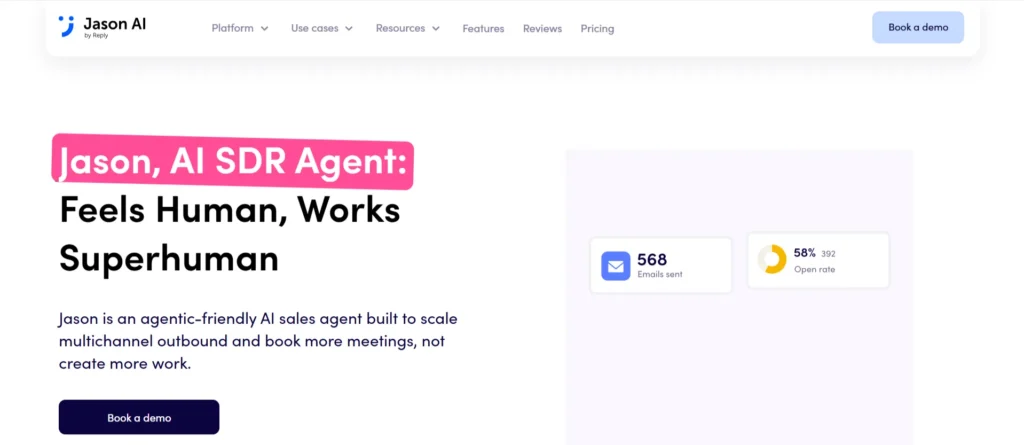
Best for: Lean teams needing multilingual, multichannel AI outreach
Jason AI is Reply.io’s AI SDR agent.
Users define their product, offer and sales strategy. Jason can then identify an ideal customer profile, source contacts, research prospects, create multichannel sequences, personalise messages and schedule meetings.
The agent can operate independently or allow salespeople to review and control parts of the workflow.
Key features
- B2B prospect data
- Natural-language ideal-customer-profile definition
- AI web research
- Intent signals
- Email outreach
- LinkedIn outreach
- Personalised sequences
- Reply management
- Approval mode
- Autopilot and copilot modes
- Meeting booking
- Outreach in more than 50 languages
- Mailbox warming and deliverability support
Pricing
Jason AI starts at $500 per month when billed annually for up to 1,000 active contacts.
Higher tiers support larger active-contact volumes. The plans include unlimited users, mailboxes and warm-up access, subject to Reply’s fair-usage terms.
Pros
- Lower starting price than many autonomous platforms
- Prospect data included
- Multilingual outreach
- Email and LinkedIn sequences
- Approval controls
- Reply handling
- Deliverability support
- Unlimited users on the AI SDR offering
Potential limitations
- Entry pricing requires annual billing
- Costs rise with active-contact volume
- LinkedIn workflows require careful platform compliance
- Global language support does not guarantee local market relevance
- AI-written replies still need quality monitoring
Reliqus verdict
Jason AI is a practical option for lean B2B teams that want prospecting, personalisation, sequence execution and meeting booking in one product.
Its multilingual support makes it particularly relevant to agencies and SaaS companies targeting multiple countries.
6. Salesforge Agent Frank
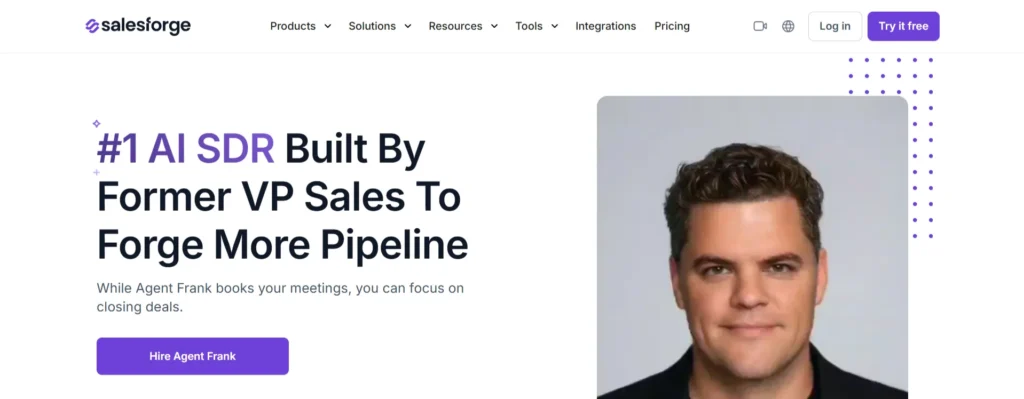
Best for: Cost-conscious teams wanting an autonomous or human-approved AI SDR
Agent Frank is Salesforge’s AI SDR.
It can manage prospecting, personalised email and LinkedIn outreach, campaign follow-up and meeting booking. Users can run it in an autonomous mode or use a copilot workflow in which a person reviews messages before they are sent.
Key features
- Prospecting
- Email personalisation
- LinkedIn outreach
- Conditional multichannel sequences
- Automated follow-ups
- Autopilot and copilot modes
- Meeting booking
- Active-contact-based pricing
- Salesforge workspace included
- Multiple mailboxes and LinkedIn senders
Pricing
Agent Frank currently starts at $499 per month.
The base offer is structured around active contacts, meaning contacts are counted while they are moving through an active sequence. A Salesforge workspace is included, but mailbox and domain infrastructure may require separate products or expenditure.
Pros
- Competitive published starting price
- Autonomous and approval-based workflows
- Email and LinkedIn outreach
- Flexible active-contact model
- Salesforge account included
- Can support multiple senders and mailboxes
Potential limitations
- Email infrastructure is not necessarily included in the base price
- New domains and inboxes require a warm-up period
- No unrestricted free trial for the complete agent
- Teams must understand active-contact calculations
- Deliverability remains the customer’s operational concern
Reliqus verdict
Agent Frank is appealing when a company wants an AI SDR at a more approachable price and is comfortable managing or purchasing its own email infrastructure.
The base subscription should not be compared with all-inclusive competitors until mailbox, domain, enrichment and sending costs are added.
7. Amplemarket Duo
Best for: Signal-based selling with human oversight
Duo is Amplemarket’s AI sales copilot and suite of sales agents.
Rather than functioning only as a high-volume autonomous email sender, Duo helps representatives identify who to contact, understand why the account matters, and create relevant outreach based on timing and buying signals.
Its agents can research prospects, detect signals and build personalised multichannel sequences.
Key features
- B2B data
- Contact and account research
- Buying-signal monitoring
- Signal-based prospect prioritisation
- Personalised multichannel sequences
- Email outreach
- Calling workflows
- Social tasks
- Follow-up support
- Objection handling
- Meeting scheduling
- Human review and control
Pricing
Amplemarket offers free trials across its plans, but complete pricing depends on the selected package, number of users, data access and Duo functionality.
The provider publishes a detailed pricing explanation, but prospective customers should request a quote based on their actual team size and outreach volume.
Pros
- Strong signal-based approach
- Combines data and outreach
- Supports human judgement
- Multichannel workflows
- Designed to improve timing, not only volume
- Useful for account-based prospecting
Potential limitations
- Fixed plan prices are not immediately clear
- Less autonomous than tools marketed as digital workers
- Advanced value depends on signal quality
- Representatives remain responsible for parts of execution
- Total cost depends on users and platform modules
Reliqus verdict
Amplemarket Duo is better suited to companies that want AI to improve the quality and timing of their representatives’ outreach than to businesses seeking a completely independent virtual SDR.
8. HubSpot Prospecting Agent
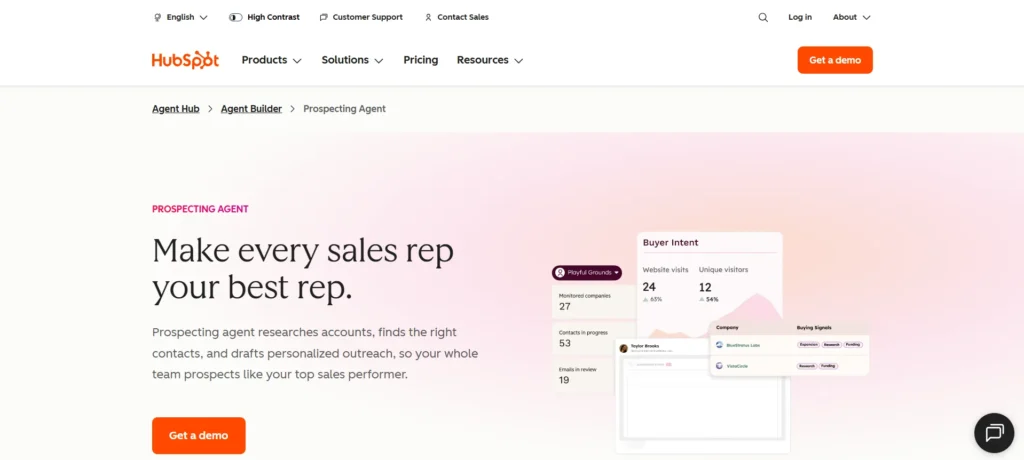
Best for: Sales teams already using HubSpot Smart CRM
HubSpot Prospecting Agent researches accounts, identifies relevant contacts, and drafts personalised outreach using CRM context and external company signals.
It can also connect to data providers such as ZoomInfo, Apollo, Surfe, and Seamless to help identify buying committee contacts within HubSpot.
Key features
- HubSpot CRM integration
- Account research
- Buying-signal monitoring
- Contact sourcing
- Third-party data integrations
- Personalised email drafts
- Custom sales plays
- Persona-based instructions
- Messaging guardrails
- Automatic and manual enrolment
Pricing
HubSpot currently charges $1 per lead the Prospecting Agent recommends for outreach.
The agent is available in the eligible Starter, Professional, and Enterprise editions and consumes HubSpot Credits.
Pros
- Works directly with HubSpot data
- Simple outcome-related pricing unit
- Contact sourcing integrations
- Customisable plays
- Messaging and engagement controls
- Suitable for existing HubSpot workflows
Potential limitations
- Requires an eligible HubSpot subscription
- Primarily creates and recommends outreach rather than replacing every SDR task
- Costs can rise with large prospect volumes
- HubSpot Credits add another usage layer
- Final results depend on CRM data quality
Reliqus verdict
HubSpot Prospecting Agent is a logical choice for companies already managing their marketing, CRM and sales activity in HubSpot.
It may be less suitable for teams seeking a separate autonomous agent that controls dedicated email infrastructure and reply handling outside HubSpot.
9. Salesforce Agentforce SDR
Best for: Salesforce enterprises automating lead engagement and nurturing
Salesforce’s Agentforce SDR can engage prospects using CRM and external data, answer questions, handle basic objections and schedule meetings.
Salesforce also describes a Lead Nurturing agent that can manage initial outreach, follow-ups, questions and meeting booking, giving representatives more time for qualified conversations.
Key features
- Salesforce CRM context
- Lead prioritisation
- Intent and enrichment signals
- Initial outreach
- Follow-up
- Question answering
- Objection management
- Meeting scheduling
- Salesforce Flow actions
- Configurable permissions
- Data Cloud integration
- Agent testing and governance
Pricing
Agentforce offers several pricing models, including:
- Flex Credits at $500 per 100,000 credits
- Conversation pricing at $2 per conversation
- Agentforce user licences
- Flat-fee and bundled Salesforce editions
The actual cost of an SDR workflow depends on the actions performed, the Salesforce products in use and the implementation.
Pros
- Deep Salesforce integration
- CRM data and permissions
- Can answer and qualify lead questions
- Supports actions through Salesforce workflows
- Flexible purchasing options
- Enterprise governance capabilities
Potential limitations
- Requires Salesforce expertise
- Pricing can be difficult to model
- May require Data Cloud and additional Salesforce products
- Better suited to enterprise nurture than simple cold-email campaigns
- Implementation effort can be substantial
Reliqus verdict
Agentforce SDR is most relevant to Salesforce customers that want AI-driven prospect engagement grounded in their existing CRM, workflows and permission structure.
It is not the simplest choice for a small business seeking an independent cold outreach system.
10. Unify
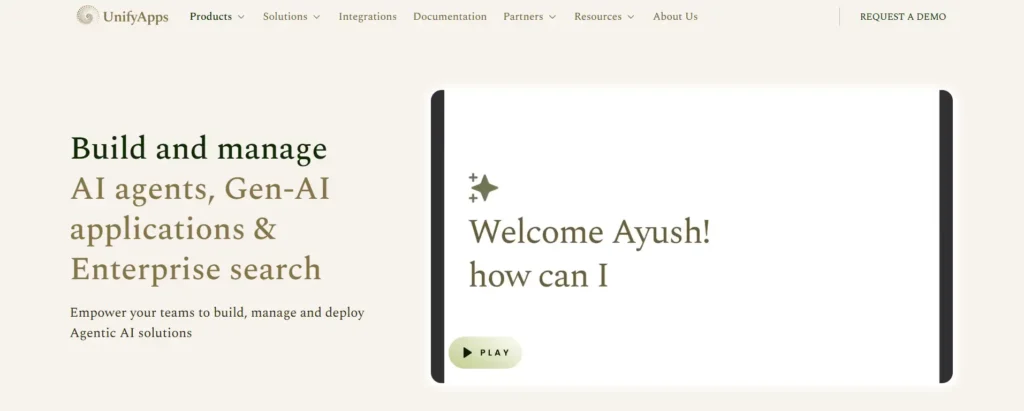
Best for: Signal-triggered outbound with representatives kept in control
Unify combines B2B data, intent signals, enrichment, account research, sequencing, deliverability and AI agents.
Users can describe an outbound strategy through a chat interface, build lists from multiple data sources and launch targeted sequences. Unify’s positioning emphasises AI working alongside salespeople rather than replacing them entirely.
Key features
- B2B contact and company data
- Waterfall enrichment
- More than 25 intent signals
- Account and prospect research
- AI message generation
- Automated sales plays
- Sequence creation
- Mailbox and deliverability support
- CRM synchronisation
- Reply classification
- Human review
Pricing
Unify currently provides a free entry point and custom annual pricing for larger deployments.
Paid usage is credit-based. Credits are consumed by data retrieval and platform actions, while AI-agent runs have their own credit rates.
Pros
- Strong intent-signal coverage
- Data, research and sequencing in one platform
- Human approval
- Automated signal-triggered plays
- Deliverability capabilities
- Free access available
- CRM connections
Potential limitations
- Credit usage can be difficult to estimate
- Full plans require custom pricing
- Not a completely autonomous AI SDR
- Representatives retain more execution responsibility
- Value depends on identifying useful signals
Reliqus verdict
Unify is a strong fit for sales teams that want to automate research and campaign preparation while preserving human judgement over targeting and sending.
It is particularly relevant to companies practising signal-based or account-based outbound.
11. Persana AI
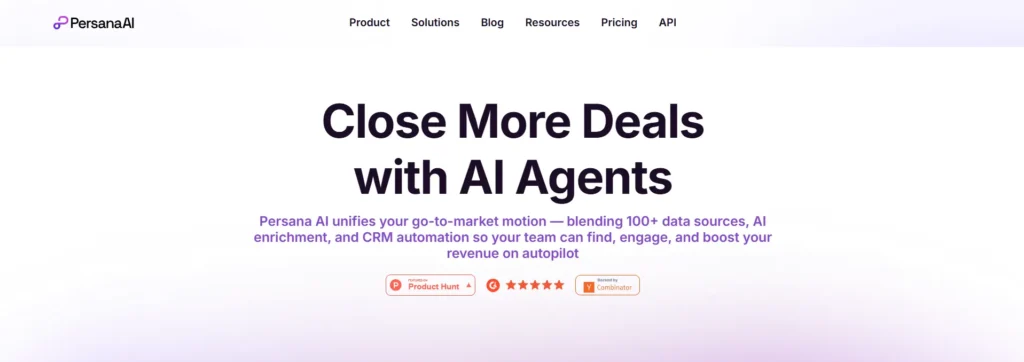
Best for: Flexible prospect enrichment, signal monitoring and outbound workflow creation
Persana AI combines prospect data, enrichment, buying signals, AI research, personalisation and workflow automation.
Users can build prospect lists, rank leads, monitor signals, generate messages and connect outbound activities to CRMs, email platforms, Slack and other systems.
Key features
- Data from more than 100 sources
- Contact enrichment
- Website-visitor signals
- Keyword intent
- Technographic information
- Competitor research
- Hiring and company signals
- Lead scoring
- AI-generated messages
- Outreach sequencing
- CRM and email-tool connections
- Custom workflows
Pricing
Persana uses credit-based plans. Credits cover data access, enrichment, research and AI messaging actions.
The company offers monthly plans and custom credit packages, but teams should calculate expected usage before selecting a tier.
Pros
- Broad data-source coverage
- Flexible workflow builder
- Signal-based targeting
- Research and personalisation
- CRM and platform integrations
- Suitable for custom outbound systems
Potential limitations
- Credit consumption can become difficult to forecast
- Requires more workflow configuration than a ready-made autonomous SDR
- Sending may depend on connected platforms
- Data accuracy varies across sources
- Users must design the sales process
Reliqus verdict
Persana is useful for growth and revenue-operations teams that want to build a tailored AI SDR workflow rather than adopt a single predefined autonomous agent.
12. Apollo AI Assistant
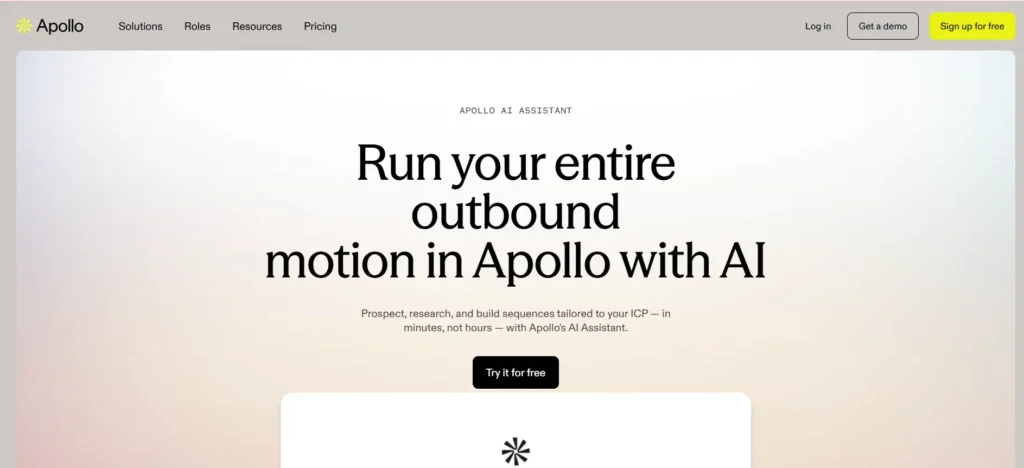
Best for: Startups and small sales teams wanting an affordable all-in-one outbound platform
Apollo’s AI Assistant can help users find prospects, research companies, enrich contact information, generate personalised messages and build multistep sequences.
It operates within Apollo’s broader B2B database, engagement, dialling, deliverability and workflow environment. The assistant can execute actions inside Apollo, but users generally retain more control than they would with a fully autonomous digital worker.
Key features
- B2B contact and company data
- AI prospect research
- Lead enrichment
- Intent topics
- Lead scoring
- AI email personalisation
- Multistep sequences
- Email and call tasks
- LinkedIn tasks
- Deliverability tools
- Workflow automation
- Sequence analytics
- CRM synchronisation
Pricing
Apollo currently offers:
- Free: $0
- Basic: $49 per user per month, billed annually
- Professional: $79 per user per month, billed annually
- Organisation: $119 per user per month, billed annually, with a three-seat minimum
Plans include different credit allowances, mailbox limits, intent topics, workflows and AI features. The AI Assistant is currently included as an introductory offer on paid plans, while free accounts receive a limited number of chats.
Pros
- Free plan
- Relatively transparent pricing
- Data and outreach in one platform
- AI research and personalisation
- Email, calling and LinkedIn tasks
- Workflow automation
- Deliverability tools
- Suitable for self-service adoption
Potential limitations
- Not as autonomous as dedicated AI SDR agents
- Credit costs apply to data and research actions
- Contact data must still be verified
- Users remain responsible for campaign strategy
- High-volume plans may require multiple subscriptions or add-ons
Reliqus verdict
Apollo is one of the strongest entry points for a startup or small B2B team that wants AI-supported outbound without committing several thousand dollars per month.
It is better described as an AI-powered outbound platform than a complete autonomous replacement for an SDR.
What About Inbound AI SDRs?
This comparison focuses primarily on outbound prospecting and automated outreach.
Inbound AI SDR platforms solve a different problem. They engage people who have already:
- Visited a website
- Submitted a form
- Requested a demo
- Started a free trial
- Downloaded content
- Shown a recognised buying signal
For example, Qualified Piper is designed to engage and qualify inbound prospects across website conversations and email, then schedule sales meetings. It should not be compared with an outbound platform solely on the number of cold prospects contacted.
Similarly, 11x Julian and some Salesforce Agentforce workflows focus more heavily on rapid inbound qualification and lead nurturing.
A separate inbound AI SDR comparison would be more useful for companies whose main problem is slow follow-up than for those with insufficient outbound coverage. For companies focused more broadly on automated customer interactions after a prospect becomes a customer, AI customer support agents can address a different part of the customer journey.
How to Choose the Right AI SDR Tool
1. Decide whether you want autonomy or assistance
Ask whether the system should:
- Recommend prospects
- Draft messages
- Require approval
- Send automatically
- Manage follow-ups
- Respond to replies
- Handle objections
- Schedule meetings
- Update CRM records
A company that needs message recommendations should not pay for a fully autonomous platform.
A company that wants complete execution should not purchase a writing assistant and expect it to act like an AI SDR.
2. Check where the prospect data comes from
AI personalisation is only as useful as its underlying information.
Evaluate:
- Contact database size
- Geographic coverage
- Email-verification method
- Phone-data availability
- Data-refresh frequency
- Job-change detection
- Technographic data
- Intent signals
- Website-visitor identification
- CRM enrichment
- Duplicate prevention
Ask the vendor to demonstrate results for your real target market, not a generic technology-company example.
3. Evaluate the quality of prospect research
Weak AI SDRs personalise messages using only:
- First name
- Company name
- Job title
- Industry
- Generic website text
Stronger research may include:
- Recent hiring
- Funding
- Product launches
- Technology adoption
- Executive changes
- Company priorities
- Relevant public statements
- Website activity
- CRM history
- Previous engagement
Every research point should be traceable to a source. A confident but inaccurate personalisation line can damage trust immediately.
4. Examine reply handling
Many products automate outbound messages. Fewer can safely manage replies.
Test whether the agent can distinguish:
- Interested
- Not interested
- Wrong person
- Referral to a colleague
- Out of office
- Unsubscribe
- Timing objection
- Pricing question
- Security question
- Existing customer
- Competitor
- Hostile response
The agent should not continue a sequence after an opt-out or clear rejection.
5. Review meeting-booking controls
Check whether the platform can:
- Use multiple representatives’ calendars
- Route by territory
- Route by account ownership
- Apply qualification rules
- Respect working hours
- Avoid duplicate meetings
- Handle rescheduling
- Record the source campaign
- Update CRM fields
- transfer relevant context to the sales representative
A meeting is not valuable if the prospect does not match the company’s qualification criteria.
6. Understand what is included in the price
The advertised AI SDR fee may not include:
- B2B contact data
- Email verification
- Mailboxes
- Sending domains
- Domain registration
- Inbox warm-up
- Phone numbers
- Calling minutes
- LinkedIn accounts
- CRM integration
- Setup
- Deliverability consulting
- Additional credits
Compare the complete operating cost rather than the base software subscription.
7. Test CRM synchronisation
The agent should correctly handle:
- New leads
- Existing contacts
- Account ownership
- Duplicates
- Suppression lists
- Opportunity status
- Previous communications
- Do-not-contact records
- Meeting outcomes
- Source attribution
Poor CRM synchronisation can result in contacting customers, open opportunities or people already being handled by another representative.
8. Assess deliverability support
A system that generates excellent messages but damages the sending domain is not a successful sales tool.
Review:
- SPF setup
- DKIM setup
- DMARC support
- Domain configuration
- Mailbox warming
- Sending limits
- Bounce prevention
- Spam monitoring
- Reply management
- Unsubscribe handling
- Domain-health reporting
Start with a small campaign rather than immediately activating the maximum sending volume.
How to Test an AI SDR Before Purchasing
Test 1: Ideal customer profile accuracy
Give each tool the same target definition.
Example:
United States-based B2B SaaS companies with 50 to 500 employees, using HubSpot, hiring sales representatives and recently expanding into a new market.
Review 100 suggested prospects.
Measure:
- Percentage matching company size
- Geographic accuracy
- Industry relevance
- Technology accuracy
- Signal accuracy
- Duplicate rate
- Contact seniority
- Email validity
- Accounts that should have been excluded
Test 2: Research accuracy
Select 20 prospects and manually verify every research point used in the outreach.
Classify each point as:
- Correct and relevant
- Correct but irrelevant
- Outdated
- Unsupported
- Incorrect
- Invented
An inaccurate claim should receive a stronger penalty than generic personalisation.
Test 3: Message quality
Use the same offer and audience across every tool.
Score messages for:
- Factual accuracy
- Relevance
- Clarity
- Length
- Tone
- Specificity
- Value proposition
- Call to action
- Repetition
- Unsupported assumptions
- Need for editing
Do not use open rate as the primary message-quality metric. Email privacy features and automated scanners can make open data unreliable.
Test 4: Sequence logic
Review whether the sequence:
- Uses appropriate timing
- Changes the message rather than repeating it
- stops after a reply
- stops after an unsubscribe
- handles out-of-office messages
- avoids excessive follow-ups
- uses channels appropriately
- respects local time zones
- avoids contacting the same account from multiple senders
Test 5: Reply handling
Create controlled replies representing:
- Positive interest
- Referral
- Objection
- Not now
- Unsubscribe
- Existing customer
- Wrong person
- Security question
- Pricing question
- Hostile response
Check whether the agent classifies and handles each reply correctly.
Test 6: Meeting qualification
Create prospects who:
- Match the ideal customer profile
- Fall below the minimum company size
- Work in an excluded industry
- Are outside the service area
- Have no authority
- Are existing customers
- Are competitors
The agent should not book every willing prospect.
Test 7: CRM accuracy
Confirm that the agent:
- Creates the correct record
- Avoids duplicates
- Assigns ownership correctly
- logs the communication
- updates status
- records opt-outs
- links the meeting
- preserves previous history
Suggested Scoring Framework
| Criterion | Weight |
| Prospect and data accuracy | 20% |
| Research and personalisation quality | 20% |
| Reply handling and qualification | 15% |
| Deliverability and sending controls | 10% |
| Sequence quality | 10% |
| CRM integration | 10% |
| Human control and governance | 5% |
| Reporting and observability | 5% |
| Pricing and overall value | 5% |
A serious compliance or data-governance failure should be treated separately rather than offset by high scores in other categories.
AI SDR Pricing Models Explained
Annual platform fee
The company pays a fixed annual amount based on:
- Prospect volume
- Channels
- Users
- Integrations
- Implementation scope
11x and many enterprise platforms use this approach.
Active contacts
The company pays according to the number of prospects actively moving through campaigns.
Reply.io Jason AI and Salesforge Agent Frank use forms of active-contact pricing.
Per lead or completed action
The business pays when the agent produces a defined result.
HubSpot charges according to leads for which its Prospecting Agent recommends outreach.
Per user
The company purchases a licence for each representative.
Regie.ai and many sales engagement platforms combine user licences with AI and data allowances.
Credits
Credits may be consumed for:
- Contact data
- Phone numbers
- Enrichment
- AI research
- Messages
- Agent actions
- Workflow runs
- Calling
Apollo, Persana, Unify, HubSpot and Salesforce use different forms of credit or consumption pricing.
Custom enterprise pricing
The vendor designs a quote based on:
- Team size
- Prospect volume
- Geographic markets
- Data needs
- Sending infrastructure
- Implementation
- Security requirements
- Support
Artisan, Amplemarket and several enterprise platforms use customised pricing.
Risks and Limitations of AI SDR Tools
Inaccurate personalisation
AI can misread a press release, confuse two companies or infer a business priority that does not exist.
Every additional research field creates another potential failure point.
Automated spam
An AI SDR can send more messages than a human representative, but volume does not create relevance.
Poor automation can:
- Damage the brand
- Increase spam complaints
- Exhaust the target market
- Reduce domain reputation
- Create negative social attention
- Lower future response rates
Data-quality problems
Contact databases may contain:
- Outdated positions
- Invalid email addresses
- Duplicate contacts
- Incorrect company information
- Personal addresses
- People who changed employers
- Individuals outside the target audience
AI does not make weak data accurate merely by placing it inside a personalised sentence.
Deliverability damage
High-volume campaigns can affect:
- Sending domains
- Main company domains
- Mailbox reputation
- Spam placement
- Future customer communication
Use dedicated infrastructure where appropriate, but do not use additional domains to avoid legitimate opt-outs or platform rules.
Compliance risk
In the United States, CAN-SPAM requires accurate header information, non-deceptive subject lines, identification of commercial messages, a valid postal address and a working opt-out process. Companies remain responsible for compliance even when a vendor sends the emails on their behalf.
Rules differ by country and recipient type. UK guidance distinguishes between corporate and individual subscribers and explains that consent, identification, opt-out and data-protection requirements may still apply to B2B outreach.
This article is not legal advice. Businesses should review the laws applying to every country, communication method and target audience in their campaigns.
Platform restrictions
Automating social-platform activity can violate platform terms or trigger account restrictions.
Review each platform’s current rules before enabling automated:
- Connection requests
- Direct messages
- Profile visits
- Data collection
- InMails
- Social engagement
Poor qualification
An AI SDR may book meetings with people who:
- Cannot purchase
- Work at the wrong company
- Fall outside the target market
- Are only seeking information
- Are competitors
- Are vendors
- Are existing customers
- Lack urgency or budget
Track qualified and attended meetings, not only booked meetings.
Limited objection handling
AI can handle common objections, but complex concerns involving:
- Legal terms
- Security
- Procurement
- Pricing exceptions
- Integrations
- Competitive strategy
- Contract commitments
should usually be transferred to a human representative.
Brand and reputational risk
A sales message is a public representation of the company.
Implement:
- Approved claims
- Prohibited phrases
- Tone guidelines
- Approval rules
- Escalation conditions
- Campaign audits
- Sending limits
- Immediate shutdown controls
NIST’s AI Risk Management Framework recommends managing AI risks throughout design, deployment, measurement and ongoing operation rather than treating governance as a one-time review.
Final Verdict
The strongest AI SDR tool is not necessarily the platform that contacts the most prospects.
It is the platform that can:
- Identify relevant companies and people.
- Research them accurately.
- Create useful and truthful personalisation.
- Send messages through healthy infrastructure.
- stop outreach when appropriate.
- Qualify replies correctly.
- Book meetings with suitable prospects.
- Maintain clean CRM records.
- Keep humans in control of sensitive decisions.
- Generate qualified pipeline at a sustainable cost.
Choose 11x Alice when your organisation wants a highly autonomous enterprise outbound agent.
Choose Artisan Ava when you want an end-to-end AI BDR with both autonomous execution and message-approval controls.
Choose AiSDR, Reply.io Jason AI or Agent Frank when you need a more accessible autonomous platform.
Choose Regie.ai, Amplemarket Duo or Unify when your company wants AI to increase representative capacity without removing people from outbound decisions.
Choose HubSpot Prospecting Agent or Salesforce Agentforce SDR when your sales operation is already centred on those CRMs.
Choose Apollo when you need an affordable combination of contact data, research, personalisation, sequencing and workflow automation.
Before signing an annual contract, run a controlled pilot using your real target market, offer and sales process.
Do not evaluate the platform only on activity volume. Measure prospect accuracy, message accuracy, qualified meetings, attended meetings, opportunities, pipeline and long-term domain health.
An AI SDR should improve the quality and consistency of sales development.
It should not simply automate more noise.
Frequently Asked Questions
What is the best AI SDR tool?
The best AI SDR tool depends on how much of the sales process you want to automate. 11x Alice and Artisan Ava are options for companies looking for more autonomous outbound execution. AiSDR, Reply.io Jason AI, and Salesforge Agent Frank offer AI-driven automation with different levels of human involvement. Regie.ai, Amplemarket Duo, Unify, and Apollo are better suited to teams that want AI assistance while keeping sales representatives involved.
Can an AI SDR replace a human SDR?
An AI SDR can automate repetitive tasks such as prospect research, list building, initial outreach, follow-ups, basic reply handling, lead qualification, meeting scheduling, and CRM updates. Human sales representatives remain important for discovery calls, relationship building, complex objections, negotiation, strategic accounts, procurement, security discussions, and commercial decisions. For most companies, the best approach is to automate repetitive work while keeping humans involved in qualified conversations.
What is the difference between an AI SDR and a sales engagement platform?
A sales engagement platform helps sales representatives manage activities such as email sequences, calls, follow-ups, and tasks. An AI SDR goes further by attempting to perform some of these activities independently. The distinction is becoming less clear as platforms such as Regie.ai, Reply.io, and Apollo increasingly combine sales engagement features with AI assistants and agents.
Can an AI SDR write personalized emails?
Yes. AI SDR platforms can use prospect, company, and intent data to generate personalized outreach. The level of personalization varies, from basic contact information to research based on company news, hiring activity, technology, and other buying signals. Businesses should verify AI-generated claims and personalization before sending messages at scale.
Can AI SDR tools send LinkedIn messages?
Some AI SDR platforms support LinkedIn-related sales activities, including connection requests, task management, and messaging. The level of automation varies by platform. Businesses should review LinkedIn’s current policies and platform rules before using automated activity on LinkedIn.
Can an AI SDR handle replies?
Some AI SDR tools can classify replies, answer common questions, handle basic objections, stop sequences, and identify prospects ready for a sales conversation. Reply handling should be carefully tested and configured to ensure that complex or sensitive conversations are routed to a human representative.
Can an AI SDR book sales meetings?
Yes. Many AI SDR platforms can connect with sales calendars and schedule meetings when prospects respond positively or meet predefined qualification criteria. Before enabling automated booking, businesses should configure calendar availability, lead routing, territory rules, and account ownership.
Which AI SDR is best for startups?
For startups, the best AI SDR depends on budget, sales volume, and the level of automation required. Apollo can be a practical starting point for teams that want prospecting, outreach, and sales engagement features in one platform. Tools such as AiSDR, Reply.io Jason AI, and Salesforge Agent Frank may be more suitable for startups seeking greater automation. Compare pricing, data access, integrations, and automation limits before choosing a platform.
Which AI SDR is best for enterprise teams?
Enterprise teams typically need more than automated outreach. They may also require CRM integrations, governance, data controls, multichannel capabilities, account-based workflows, and support for larger sales operations. 11x, Artisan, Regie.ai, Salesforce Agentforce, and Amplemarket are options worth evaluating based on the organization’s specific requirements and existing sales technology.
Are there free AI SDR tools?
Some AI SDR and sales platforms offer free plans, limited credits, trials, or introductory access. Apollo and Unify, for example, have offered free entry points, although usage and features may be limited. Because pricing and free-plan availability can change, check the provider’s current pricing before making a decision. A free trial or limited credit offer is different from a permanent free plan.
How much does an AI SDR cost?
AI SDR costs vary widely depending on the platform, level of automation, number of users, and required services. The total cost may include the software subscription, prospect data, email verification, mailboxes, domains, phone numbers, calling, LinkedIn tools, implementation, CRM integrations, and additional usage credits. Rather than focusing only on the cost per email, businesses should evaluate cost per qualified meeting, cost per opportunity, and pipeline generated.
What metrics should be used to measure an AI SDR?
Important AI SDR metrics include valid-contact rate, positive-reply rate, qualified-reply rate, meetings booked, meetings attended, qualified meetings, opportunities created, pipeline generated, cost per qualified meeting, cost per opportunity, bounce rate, unsubscribe rate, spam-complaint rate, incorrect-personalization rate, and AI reply-escalation rate. Open rate should not be treated as the primary success metric because qualified meetings, opportunities, pipeline, and revenue impact provide a more meaningful view of AI SDR performance.