
The best AI sales assistant depends on where your sales team loses the most time.
Salesforce Agentforce Sales is a strong option for enterprises running their sales operation in Salesforce. HubSpot Prospecting Agent is designed for HubSpot teams that want to research, qualify and follow up with leads. Microsoft Sales Agent brings CRM information into Outlook and Teams, while Apollo combines B2B data, prospecting and multichannel outreach in a comparatively accessible platform.
For teams focused on active opportunities, Gong, Outreach, Salesloft and Clari provide deeper conversation, pipeline and revenue intelligence. Pipedrive and Zoho Zia offer more approachable AI assistance for smaller CRM teams, while Lavender specialises in improving sales emails.
These platforms are not interchangeable. Some act as autonomous prospecting agents. Others assist sales representatives, analyse calls, recommend the next action or maintain CRM data. The right choice depends on the part of the sales cycle you want to improve. For ecommerce businesses, sales and customer-facing AI also need to fit into the wider ecommerce tech stack for Shopify brands, including support, retention, personalization, analytics, and post-purchase systems.
Best AI Sales Assistants at a Glance
| AI sales assistant | Best for | Main capability | Free access | Pricing approach |
| Salesforce Agentforce Sales | Salesforce-based enterprises | Prospecting, pipeline execution and CRM automation | Limited trials and demos | Per user or consumption-based |
| HubSpot Prospecting Agent | HubSpot CRM users | Lead research and personalised outreach | Available within eligible HubSpot editions | Per recommended lead |
| Microsoft Sales Agent | Microsoft 365 sales teams | CRM assistance inside Outlook and Teams | Depends on Microsoft licensing | Licence based |
| Gong | Conversation and deal intelligence | Call analysis, coaching, deal insights and follow-up | Demo only | Per user plus platform fee |
| Outreach | Enterprise revenue orchestration | Prospecting, engagement, deal management and forecasting | Demo only | Custom pricing |
| Salesloft Rhythm | Prioritising seller actions | AI-prioritised tasks and sales workflows | Demo only | Custom pricing |
| Clari | Pipeline management and forecasting | Forecasting, deal risk and revenue intelligence | Demo only | Custom pricing |
| Apollo | Prospecting and multichannel outreach | Contact data, research, sequencing and automation | Yes | Free and paid plans |
| ZoomInfo | B2B data and account prioritisation | Contact intelligence, intent data and prospecting | Free trial | Custom pricing |
| Pipedrive Sales Assistant | Small sales teams | Pipeline insights, reminders and deal predictions | 14-day CRM trial | Per user |
| Zoho Zia | Value-focused CRM teams | CRM insights, predictions and workflow assistance | Free CRM plan for three users | Per user |
| Regie.ai | Automated outbound prospecting | Research, content and multichannel outreach | Demo led | Custom pricing |
| Lavender | Sales email coaching | Real-time email feedback and personalisation | Free version and trial | Individual and team plans |
Pricing and feature availability were reviewed in July 2026. AI products change frequently, so buyers should confirm current plans, usage allowances and integrations directly with each provider.
Our Top Recommendations
Best for Salesforce enterprises: Salesforce Agentforce Sales
Agentforce Sales is designed for organisations that want AI agents to work with Salesforce CRM data, complete sales tasks and support representatives throughout the pipeline.
Best for HubSpot users: HubSpot Prospecting Agent
HubSpot Prospecting Agent can research contacts, identify relevant buying signals and execute an outreach strategy using information already stored in HubSpot.
Best for Microsoft 365 workflows: Microsoft Sales Agent
Microsoft Sales Agent brings CRM records, summaries, and sales insights into Outlook and Teams, reducing the need for representatives to repeatedly switch between email, meetings, and CRM screens.
Best for conversation intelligence: Gong
Gong captures sales interactions and uses them to produce summaries, coaching insights, deal signals and recommended actions.
Best for enterprise sales execution: Outreach
Outreach combines prospecting, sales engagement, deal management, forecasting and coaching in a broader revenue orchestration platform.
Best for accessible B2B prospecting: Apollo
Apollo combines a large B2B contact database with research, lead scoring, sequencing and workflow automation. It also offers a free self-service plan.
Best for small sales teams: Pipedrive Sales Assistant
Pipedrive gives smaller teams AI-assisted reporting, pipeline analysis, follow-up reminders and deal recommendations within an easy-to-use CRM.
Best for sales emails: Lavender
Lavender focuses specifically on writing and improving prospecting emails. It analyses messages in real time and recommends changes to structure, length, tone and personalisation.
How We Evaluated These Tools
Reliqus reviewed each platform using official product pages, help documentation, pricing information and publicly available demonstrations.
We considered:
- Prospect and account research
- Lead qualification and scoring
- CRM data access and updates
- Email and multichannel outreach
- Meeting preparation and follow-up
- Call recording and summaries
- Pipeline and deal-risk insights
- Forecasting
- Task prioritisation
- Human control over automated actions
- CRM and communication integrations
- Ease of implementation
- Pricing transparency
- Suitability for different company sizes
- Data governance and administrative controls
Hands-on access varies significantly. Apollo, Pipedrive, Zoho and Lavender provide self-service access or trials, while platforms such as Gong, Clari, Outreach and Salesforce are generally evaluated through demonstrations, trials or formal sales processes.
This article does not claim that Reliqus ran an identical performance test across every platform. Recommendations are based on documented capabilities and intended use cases. Vendor-reported productivity, reply rate, and revenue improvements are not treated as results every customer will achieve.
What Is an AI Sales Assistant?
An AI sales assistant is software that uses artificial intelligence to support or automate parts of the sales process.
Depending on the product, it may:
- Research prospects and target accounts
- Identify potential decision-makers
- Draft personalised emails
- Prioritise leads
- Recommend the next sales action
- Schedule follow-ups
- Summarise calls and meetings
- Update CRM records
- Identify stalled deals
- Forecast revenue
- Coach representatives
- Execute selected prospecting workflows
G2 defines AI sales assistant software as a category that helps sales teams automate routine activities and surface data-driven insights. It maintains separate views for enterprise and small-business products, demonstrating how broad the category has become.
The term does not describe one standard type of software. A tool that writes emails solves a different problem from one that forecasts revenue or autonomously contacts prospects.
AI Sales Assistant vs AI SDR vs Conversation Intelligence
Understanding these distinctions is essential before comparing products.
AI sales assistant
An AI sales assistant helps a human representative complete sales work. It may retrieve CRM information, draft emails, summarise calls or recommend actions.
Examples include:
- Microsoft Sales Agent
- Pipedrive Sales Assistant
- Zoho Zia
- Lavender
AI SDR
An AI sales development representative attempts to automate part of the outbound or inbound prospecting role. It may research accounts, identify contacts, generate messages, execute sequences and respond to selected signals.
Examples include:
- Regie.ai
- HubSpot Prospecting Agent
- Apollo AI Assistant
- Salesforce prospecting agents
Conversation intelligence platform
A conversation intelligence platform records and analyses sales calls or meetings. It identifies themes, objections, next steps, competitor mentions and coaching opportunities.
Examples include:
- Gong
- Clari Copilot
- Outreach Conversation Intelligence
Revenue orchestration platform
A revenue orchestration platform coordinates sales activity across prospecting, pipeline management, forecasting and coaching.
Examples include:
- Outreach
- Salesloft
- Clari
- Gong
A single platform may belong to more than one category. Some platforms also extend into customer-facing workflows, where AI customer support agents can handle questions, qualification, and service interactions alongside sales automation.
The Best AI Sales Assistant Tools in 2026
1. Salesforce Agentforce Sales
Best for: Enterprises operating their sales process through Salesforce
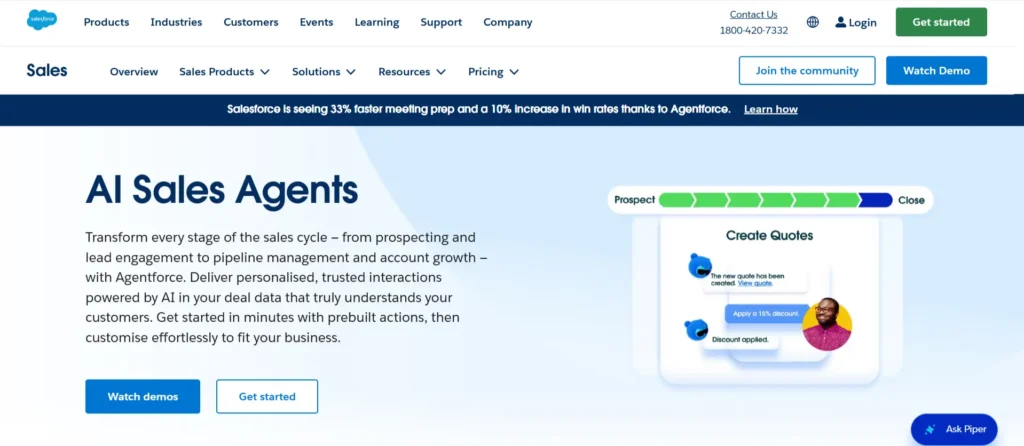
Agentforce Sales is Salesforce’s collection of AI agents and assistants for prospecting, pipeline management and seller productivity.
Salesforce introduced Agentforce Sales in March 2026 as a model in which specialised agents support representatives across the sales cycle. These agents can work with Salesforce CRM data, identify relevant prospects, prepare account context, update records and help sales teams progress opportunities.
Salesforce’s biggest advantage is context. Agentforce can use CRM records, Data Cloud information, Salesforce workflows and existing permission structures instead of operating as an isolated AI writing tool.
Key features
- Salesforce CRM integration
- Prospect and account research
- Lead and opportunity summaries
- Workflow and record automation
- Sales email generation
- Pipeline analysis
- Seller recommendations
- Agent actions through Salesforce Flow
- Configurable permissions and guardrails
- Consumption-based and user-based options
Pricing
Salesforce provides several Agentforce pricing models, including Flex Credits, conversation-based consumption and per-user licences. Agentforce 1 Sales editions have also been offered as bundled enterprise packages.
The total cost depends on the Salesforce edition, number of users, agent activity, Data Cloud requirements and implementation work.
Potential limitations
Agentforce is unlikely to be the simplest choice for a small team that does not already use Salesforce.
The system’s usefulness depends on:
- CRM data quality
- Salesforce configuration
- Defined workflows
- User permissions
- Internal administration
- Implementation resources
An advanced agent cannot reliably manage a pipeline built on incomplete, duplicated or outdated CRM records.
Reliqus verdict
Agentforce Sales is one of the strongest enterprise options for companies already committed to Salesforce. It is less attractive when the organisation needs a lightweight standalone prospecting assistant.
2. HubSpot Prospecting Agent
Best for: HubSpot customers automating lead research and personalised follow-up
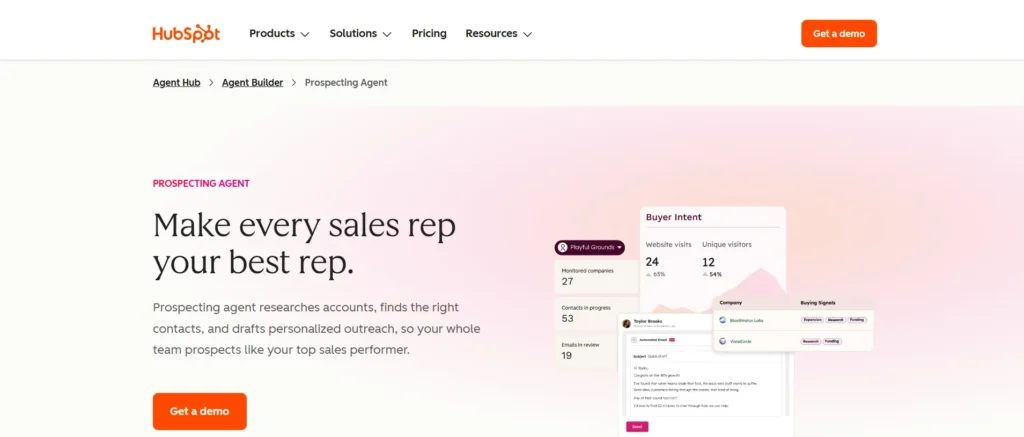
HubSpot Prospecting Agent is a Breeze AI agent that researches contacts and companies, identifies reasons to engage and executes a configurable outreach strategy.
Contacts can be enrolled manually or through defined rules. The agent can research accounts and generate emails based on CRM data and external business context.
HubSpot’s main advantage is that the agent works within the same CRM used for marketing, sales, and customer service information. Teams evaluating the broader AI tools that integrate with HubSpot can also consider how enrichment, automation, communication, and reporting tools extend the CRM.
Key features
- Contact and company research
- Signal-based prospecting
- Personalised email generation
- Manual or automated contact enrolment
- CRM-based lead context
- Scheduled or adaptive outreach
- Meeting-focused prospecting workflows
- HubSpot automation integration
- Central management through Agent Hub
Pricing
HubSpot currently prices Prospecting Agent at $1 per lead recommended for outreach. The agent is available in eligible Starter, Professional and Enterprise editions and consumes HubSpot Credits.
Businesses should confirm how many credits are included in their subscription and which actions consume additional credits.
Potential limitations
Prospecting Agent is primarily valuable to companies already using HubSpot CRM.
It should not automatically be treated as a replacement for a complete outbound sales team. Representatives still need to:
- Define target accounts
- Approve positioning
- Review sensitive messages
- Handle objections
- Conduct discovery
- Progress qualified opportunities
Reliqus verdict
HubSpot Prospecting Agent is a practical choice for growing companies that want AI-assisted prospecting without creating another disconnected sales database.
3. Microsoft Sales Agent
Best for: Sales representatives working primarily in Outlook, Teams and Microsoft 365
Microsoft Sales Agent brings CRM information and AI assistance into the Microsoft 365 applications sales representatives already use.
The agent connects with Microsoft Dynamics 365 Sales and Salesforce Sales Cloud. It can surface sales data in Outlook and Teams, summarise leads and opportunities, prepare representatives for meetings and help update CRM records.
Key features
- Outlook integration
- Microsoft Teams integration
- Dynamics 365 Sales connection
- Salesforce CRM connection
- Lead and opportunity summaries
- Meeting preparation
- Email drafting
- CRM updates
- Sales insights within Microsoft 365
- Conversational access to sales records
Pricing
Licensing depends on the organisation’s Microsoft 365 Copilot, CRM and Dynamics configuration. Microsoft has changed the naming and packaging of its sales AI products, so buyers should verify the current licensing requirements rather than relying on older Copilot for Sales pricing references.
Potential limitations
Microsoft Sales Agent is most valuable when representatives already spend much of their workday in Outlook and Teams.
Its usefulness may be reduced when:
- The CRM contains incomplete data
- Teams do not record activities consistently
- The company uses a CRM with limited integration support
- Representatives work mainly through a separate sales engagement platform
Reliqus verdict
Microsoft Sales Agent is a strong productivity assistant for reducing CRM context switching. It is not primarily an outbound prospecting database or autonomous AI SDR.
4. Gong
Best for: Conversation intelligence, deal inspection and sales coaching
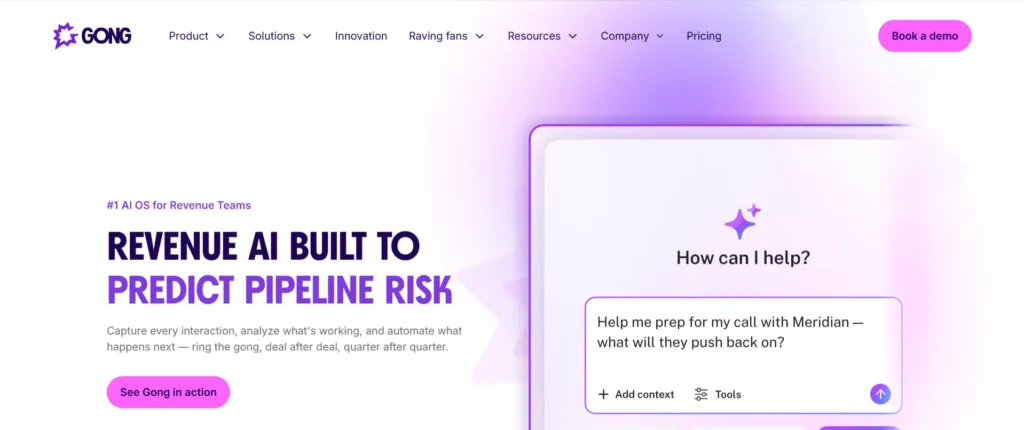
Gong captures customer interactions across calls, meetings and sales communications and uses that information to help teams understand deal progress.
Its Revenue AI OS now includes specialised agents, sales engagement functionality, coaching, account insights and governed AI actions. Gong continued to expand its agent and assistant capabilities in 2026, including custom agents, AI coaching, and a broader Gong Assistant experience.
Key features
- Call and meeting recording
- Transcription
- Conversation summaries
- Objection and competitor tracking
- Deal-risk signals
- Follow-up email generation
- Sales coaching
- Custom AI agents
- Account and pipeline insights
- Gong Engage for sales outreach
Pricing
Gong uses customised pricing. Its official pricing page states that licences are priced per user and that an additional platform fee is based on the number of supported users.
Potential limitations
Gong can be more expensive and more complex than a simple meeting notes application.
It delivers the greatest value when:
- A meaningful number of sales calls are recorded
- Managers actively use the insights
- CRM and opportunity data are maintained
- Coaching is part of the sales process
- Teams act on identified risks
Recording calls without changing seller behaviour is unlikely to justify the investment.
Reliqus verdict
Gong is one of the strongest options for sales organisations that want AI grounded in actual buyer conversations. It is less suitable for a small team that only needs contact data or email generation.
5. Outreach
Best for: Enterprise sales engagement and full-funnel revenue orchestration
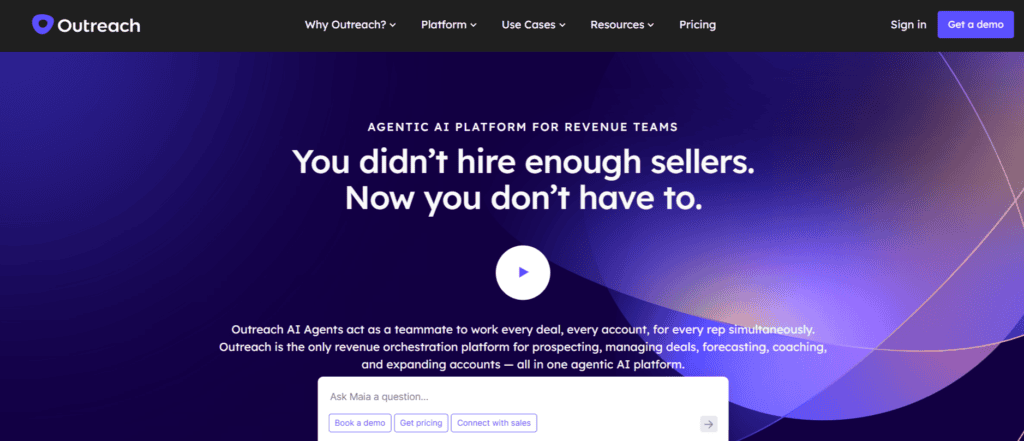
Outreach has expanded from a sales engagement platform into a broader agentic AI platform for revenue teams.
Its platform covers prospecting, account management, deal execution, forecasting, coaching and customer expansion. Outreach AI Agents are positioned as teammates that work across accounts and deals rather than as standalone email generators.
Key features
- Sales sequencing
- Email and call workflows
- Prospect prioritisation
- Deal management
- Account insights
- Conversation intelligence
- Forecasting
- Sales coaching
- Follow-up recommendations
- AI agents for revenue workflows
Pricing
Outreach uses custom pricing based on the products, team size and deployment. Buyers generally need to request a demonstration and formal quote.
Potential limitations
Outreach is designed for structured sales organisations. Smaller teams may not need its full combination of engagement, forecasting, coaching and revenue management.
Implementation also requires decisions about:
- Sequences
- CRM synchronisation
- activity rules
- user permissions
- performance reporting
- AI governance
Reliqus verdict
Outreach is a strong option for enterprise and mid-market teams looking to coordinate multiple parts of sales execution on a single platform.
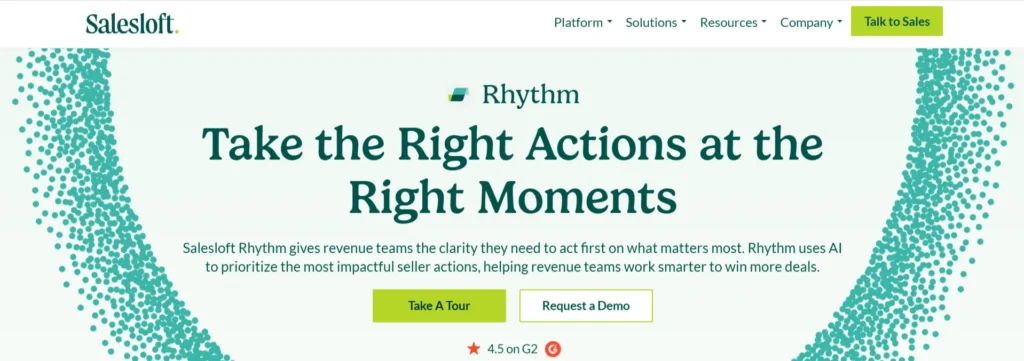
6. Salesloft Rhythm
Best for: Helping sales representatives decide what to do next
Salesloft Rhythm uses AI to prioritise seller actions based on signals from leads, accounts, opportunities, and customer activity.
Instead of presenting every possible task equally, Rhythm attempts to direct representatives toward the actions that are most likely to matter. Salesloft also provides sales automation, forecasting, chat agents and broader revenue orchestration capabilities.
Key features
- AI-prioritised seller actions
- Sales sequences
- Account and opportunity signals
- Lead and workflow management
- Email and call engagement
- Pipeline guidance
- Forecasting
- Chat agents
- CRM integration
- Manager insights
Pricing
Salesloft does not publish standard self-service prices. Businesses must speak with its sales team for package and pricing information.
Potential limitations
Rhythm is most effective when it receives reliable data from the CRM and connected sales systems.
Teams should test whether its recommendations:
- Match the sales methodology
- Prioritise genuinely valuable actions
- Reduce rather than increase task overload
- Explain why a task was recommended
- Can be adjusted by managers
Reliqus verdict
Salesloft Rhythm is useful for teams whose representatives struggle with fragmented task lists and inconsistent follow-up.
7. Clari
Best for: Pipeline inspection, deal risk and revenue forecasting
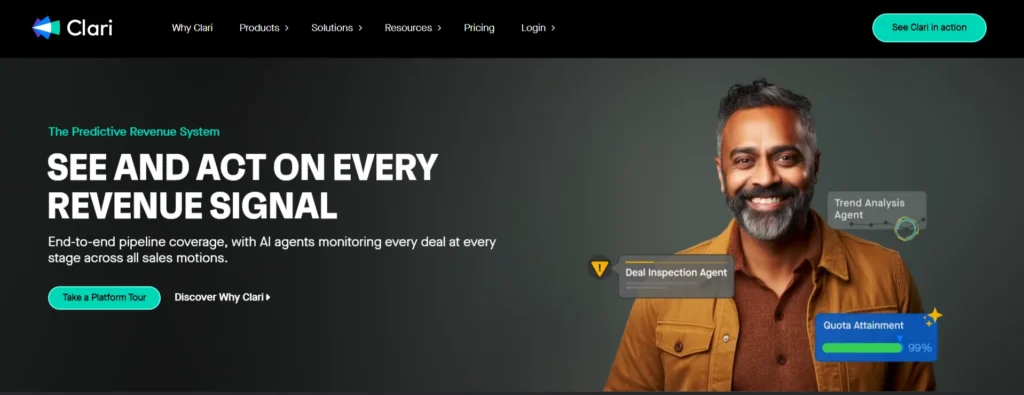
Clari is an enterprise revenue orchestration platform focused on improving visibility into pipeline activity and forecast outcomes.
Clari Copilot adds conversation intelligence by recording, transcribing and summarising calls. It can identify action items, support follow-up emails and connect conversation information with account and opportunity data.
Key features
- Revenue forecasting
- Deal inspection
- Pipeline-risk analysis
- Conversation intelligence
- Call summaries
- Follow-up email support
- Action-item extraction
- Revenue analytics
- CRM integrations
- Seller and manager workflows
Pricing
Clari offers customised pricing based on the organisation and use case. Its pricing page presents the platform as a tailored package with revenue AI, forecasting, workflow and integration capabilities.
Potential limitations
Clari is primarily designed for organisations with established revenue operations and formal forecasting requirements.
It may be excessive for a small sales team that mainly needs prospect lists, email assistance or meeting scheduling.
Reliqus verdict
Clari is a strong option when the main problem is unreliable forecasting or insufficient visibility into why deals are progressing, stalling or slipping.
8. Apollo
Best for: Accessible B2B prospecting, research and multichannel outreach
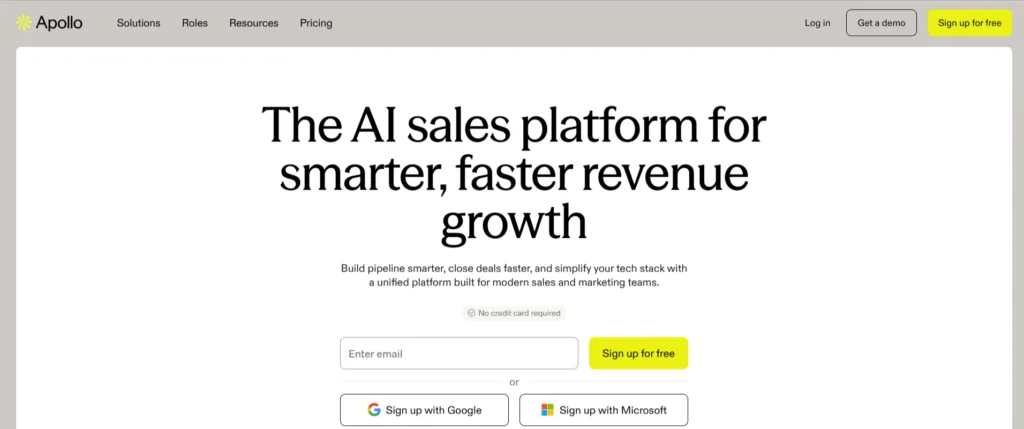
Apollo combines B2B contact data, prospecting, outreach, enrichment and deal-execution tools.
Its AI Assistant is designed to help users research accounts, build lists, score leads, create messages and launch multichannel sequences from a natural-language interface. Apollo also supports inbound lead qualification and sales conversation workflows.
Key features
- B2B contact and company database
- AI account research
- Lead scoring
- List building
- Email sequencing
- Multichannel outreach
- Data enrichment
- Workflow automation
- Conversation intelligence
- Browser and CRM extensions
Pricing
Apollo provides a free plan and paid editions. Its current pricing page includes AI Assistant, research, lead scoring, sequences and workflow functionality across different packages.
Because Apollo uses credits and plan-specific allowances, teams should calculate expected costs for:
- Contact data
- Email and phone access
- enrichment
- AI research
- dialling
- sequencing
- workflow usage
Potential limitations
Apollo’s broad feature set can encourage teams to automate outreach before improving their targeting and messaging.
Data accuracy should also be independently checked. No B2B database will have perfectly current contact information for every organisation.
Reliqus verdict
Apollo is one of the most practical choices for startups, agencies, and small- to mid-sized B2B teams that want data and outreach in a self-service platform.
9. ZoomInfo
Best for: B2B data, account intelligence and buying signals
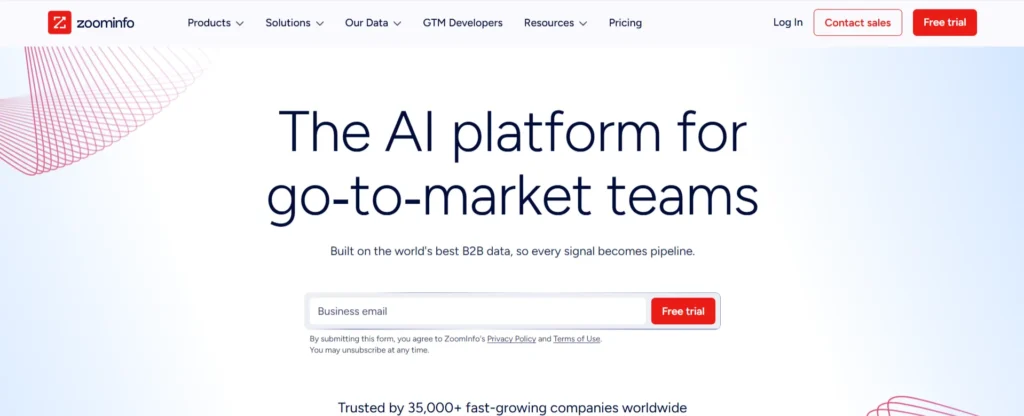
ZoomInfo combines B2B contact information, company data, intent signals and sales automation.
Its platform helps teams identify target accounts, find decision-makers, prioritise prospects and connect sales activity with market and account intelligence.
Key features
- Contact and company data
- Firmographic information
- Technographic information
- Intent signals
- Account prioritisation
- Data enrichment
- Prospecting workflows
- Sales and marketing integrations
- AI-assisted recommendations
- Lead and market intelligence
Pricing
ZoomInfo provides free trials for selected products but generally uses custom pricing. Cost depends on data access, user count, credits, intent features, enrichment and additional modules.
Potential limitations
ZoomInfo may represent a significant investment, particularly when a company needs multiple modules or large data allowances.
Buyers should evaluate:
- Match rates in their target market
- Contact accuracy
- International coverage
- Credit consumption
- Data-refresh frequency
- CRM enrichment rules
- Privacy and compliance requirements
Reliqus verdict
ZoomInfo is best suited to teams that see data quality and buying signals as the foundation of their sales process.
10. Pipedrive Sales Assistant
Best for: Small and growing teams managing a straightforward sales pipeline
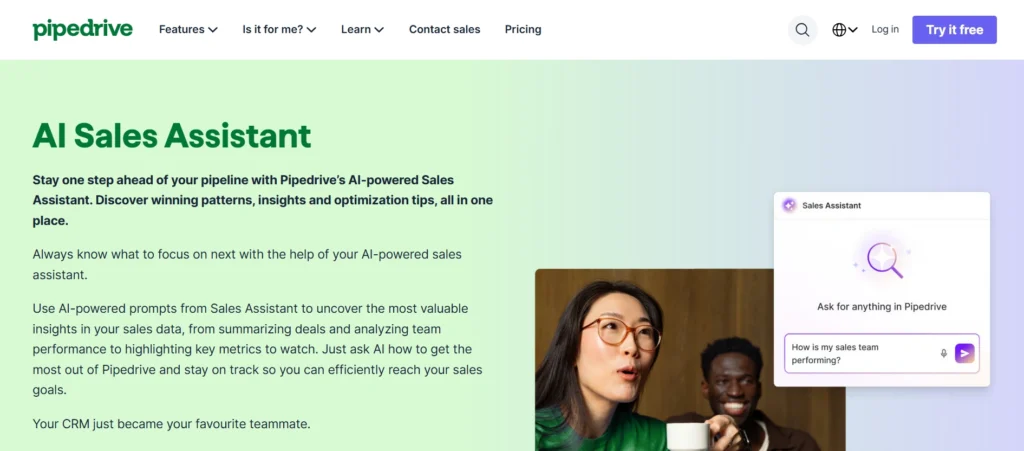
Pipedrive Sales Assistant helps users analyse CRM data, identify patterns, summarise deals and understand which opportunities need attention.
The assistant can answer natural-language questions about the pipeline, highlight performance trends and provide recommendations based on activity and deal information. Pipedrive also offers AI-assisted report creation, email tools and lead scoring across its CRM plans.
Key features
- Pipeline summaries
- Performance insights
- Deal win-probability predictions
- Next-action recommendations
- Goal tracking
- Sales forecasting
- AI-assisted reports
- Follow-up reminders
- Deal-change summaries
- Email writing and summarisation on selected plans
Pricing
Pipedrive currently offers:
- Lite from $14 per user per month when billed annually
- Growth from $39
- Premium from $59
- Ultimate from $79
A 14-day free trial is available. Feature access varies by plan.
Pipedrive’s documentation also states that some Sales Assistant capabilities may remain in beta or be limited to selected accounts, so availability should be confirmed during the trial.
Potential limitations
Pipedrive does not provide the same depth of conversation intelligence or enterprise forecasting as Gong or Clari.
It is better suited to teams prioritising:
- Simplicity
- Pipeline visibility
- affordable CRM access
- routine follow-up
- basic sales insights
Reliqus verdict
Pipedrive is one of the most approachable options for a small team that wants AI assistance inside a usable CRM rather than a complex revenue platform.
11. Zoho Zia
Best for: Cost-conscious companies using Zoho CRM
Zia is Zoho CRM’s conversational AI assistant.
It can retrieve CRM information, answer natural-language questions, create reports and workflows, summarise records, predict sales outcomes and support lead or deal assignment.
Key features
- Conversational CRM access
- Lead and deal insights
- Sales predictions
- Record summaries
- Workflow creation
- Report creation
- Lead assignment
- Anomaly detection
- Email and activity intelligence
- Integration across the Zoho ecosystem
Pricing
Zoho CRM provides a free edition for up to three users and a 15-day trial of paid functionality. Zia features vary by CRM edition.
Zoho has also introduced Zia Agents, which can automate workflows across Zoho applications, including sales development and email response activities.
Potential limitations
Zoho’s large product ecosystem can make feature packaging difficult to understand. Teams should verify which Zia functions are included in the CRM edition they plan to purchase.
Reliqus verdict
Zia offers strong potential value for companies that need CRM assistance, analytics and workflow automation without enterprise-level pricing.
12. Regie.ai
Best for: B2B outbound teams combining AI agents with human sales representatives
Regie.ai focuses on prospecting and outbound sales workflows.
Its platform includes autonomous AI sales agents for account research and outreach alongside a Copilot experience designed to help human representatives create and execute personalised engagement.
Key features
- Account and prospect research
- Personalised outreach content
- Multichannel sequences
- AI sales agents
- Human-representative task generation
- Engagement-signal monitoring
- Campaign creation
- CRM integration
- Intent-based workflow adjustment
- Outbound analytics
Pricing
Regie.ai generally uses custom pricing based on team size, products and sales volume.
Potential limitations
Regie.ai overlaps heavily with the AI SDR category. Buyers should define how much autonomy they want to provide.
Important questions include:
- Does a person approve messages before sending?
- How are responses classified?
- When does the system stop outreach?
- How are opt-outs processed?
- Which activities are written back to the CRM?
- How are errors and inappropriate messages reviewed?
Reliqus verdict
Regie.ai is most relevant to established B2B outbound teams that want to coordinate autonomous prospecting with human-led selling.
13. Lavender
Best for: Improving the quality of sales emails
Lavender is an AI sales email coach that analyses messages while representatives write them.
It evaluates factors such as structure, length, clarity, tone and mobile readability, then recommends changes. Its Personalization Assistant can provide prospect context, while integrations allow the coach to work inside email and sales platforms.
Lavender also publishes benchmarking research based on emails processed through its platform. Its 2026 cold-email report analysed 231,818 recent messages from a much larger dataset across approximately 50,000 active inboxes.
Key features
- Real-time email scoring
- Message-improvement suggestions
- Personalisation assistance
- Mobile preview
- Email-writing frameworks
- Team coaching analytics
- Gmail and Outlook support
- Apollo integration
- Gong integration
- Multilingual email coaching
Pricing
Lavender offers a free version and trials of its paid features. Paid plans are available for individual sellers and teams.
Potential limitations
Lavender does not provide a complete CRM, B2B database, forecasting system or autonomous prospecting operation.
Its narrower focus is also its main strength. It is designed to improve messages, not manage the whole pipeline.
Reliqus verdict
Lavender is a strong complementary tool for teams whose biggest problem is low-quality or inconsistent sales email writing.
How to Choose the Right AI Sales Assistant
Start with the workflow you want to improve
Do not begin with a vendor name.
Identify whether the main problem is:
- Finding relevant prospects
- Qualifying inbound leads
- Researching accounts
- Writing outreach emails
- Recording calls
- Updating CRM records
- Following up after meetings
- Identifying deal risk
- Forecasting revenue
- Coaching representatives
- Prioritising daily tasks
A conversation-intelligence platform will not fix weak contact data. An AI email coach will not repair an unreliable sales forecast.
Consider your existing CRM
A native assistant may be easier to implement than a separate product. However, teams should also consider how their sales tools fit into broader AI marketing automation tools and cross-platform workflows.
Examples include:
- Agentforce for Salesforce
- HubSpot Prospecting Agent for HubSpot
- Microsoft Sales Agent for Dynamics 365 or Salesforce
- Pipedrive Sales Assistant for Pipedrive
- Zia for Zoho CRM
However, native integration should not override product fit. A built-in assistant is not automatically better if it cannot perform the workflow the sales team actually needs.
Separate assistance from autonomy
Decide whether the tool should:
- Recommend an action
- Draft an action for approval
- Perform an action automatically
- Contact a prospect autonomously
- Respond to replies
- Update the CRM
- Book meetings
- Escalate conversations
The greater the autonomy, the stronger the controls should be. This becomes especially important for agencies and distributed teams building an AI-powered agency operating system across sales, communication, project management, and automation.
Review data sources
An AI assistant’s output is only as reliable as its context.
Ask whether it uses:
- CRM records
- Email and calendar history
- Call transcripts
- company websites
- contact databases
- intent data
- product documentation
- third-party enrichment
- manually approved information
Review where that data comes from and how frequently it is updated.
Evaluate explainability
A sales representative or manager should understand why the system:
- Recommended a lead
- Changed a score
- Flagged a deal
- Predicted a close date
- Suggested an action
- Generated a particular message
Recommendations that cannot be explained are harder to trust and improve.
Calculate the full cost
Pricing may include:
- User licences
- Platform fees
- AI credits
- contact-data credits
- phone numbers
- email verification
- dialler minutes
- implementation
- CRM integration
- onboarding
- premium support
Calculate the total cost for expected usage rather than comparing only advertised entry prices.
How to Test an AI Sales Assistant
Reliqus recommends creating a standard test before making a purchase.
Test 1: Prospect research
Provide the same target-account criteria to each compatible tool.
Evaluate:
- Relevance of selected companies
- Accuracy of company information
- Contact quality
- Explanation of account fit
- Duplicate handling
- Research time
- Manual correction required
Test 2: Email personalisation
Ask each tool to create an email for the same prospect using the same offer.
Evaluate:
- Factual accuracy
- Relevance
- Tone
- Specificity
- unsupported assumptions
- length
- call to action
- need for human editing
Test 3: CRM assistance
Ask the tool to:
- Summarise an opportunity
- identify missing information
- recommend the next action
- update a field
- create a follow-up task
Evaluate both answer quality and action accuracy.
Test 4: Meeting follow-up
Use the same recorded sales call where possible.
Evaluate:
- Transcript accuracy
- Summary quality
- Action-item extraction
- objection identification
- competitor detection
- follow-up email accuracy
- CRM update quality
Test 5: Pipeline analysis
Use historical opportunities with known outcomes.
Evaluate whether the tool can:
- Identify stalled deals
- detect missing decision-makers
- recognise weak engagement
- distinguish real risk from normal delay
- explain its recommendations
- avoid leaking future outcome data into the test
Suggested scoring framework
| Criterion | Weight |
| Workflow accuracy | 20% |
| CRM and data integration | 15% |
| Quality of recommendations | 15% |
| Automation and action capabilities | 10% |
| Human control and approvals | 10% |
| Ease of use | 10% |
| Reporting and explainability | 10% |
| Pricing and value | 5% |
| Security and governance | 5% |
The weighting should change by use case. A prospecting platform should receive more weight for contact quality, while a forecasting platform should receive more weight for pipeline accuracy.
Risks and Limitations of AI Sales Assistants
Incorrect personalisation
AI can invent a prospect’s priorities, misinterpret a job title or reference outdated company information. A personalised email is not valuable when the personalisation is wrong.
Poor CRM data
Duplicated contacts, inconsistent deal stages and missing activities can produce unreliable recommendations. Clean CRM data before using AI to automate decisions based on that data.
Excessive outreach
An AI tool can generate and send messages faster than a human team, but higher volume does not guarantee a better pipeline.
Uncontrolled automation can damage:
- Sender reputation
- email deliverability
- brand trust
- prospect experience
- domain reputation
Compliance risks
Commercial outreach remains subject to applicable marketing, privacy, and electronic communication rules.
In the United States, the CAN-SPAM Act establishes requirements for commercial email, including accurate sender information and a working opt-out method.
Rules differ by country and recipient type. The UK Information Commissioner’s Office explains that B2B marketing requirements vary between corporate subscribers and individual subscribers, while identification and opt-out obligations still apply.
Companies should obtain legal advice for the regions and channels they use.
Biased lead prioritisation
Historical sales data may reflect past targeting practices and missed opportunities.
A model trained on that history may continue to prioritise the same industries, company types, or contact profiles without proving that they are the best future prospects.
Unauthorised actions
An autonomous assistant may send an inappropriate message, update the wrong record or contact someone who should have been excluded.
Use:
- Approval steps
- role-based access
- sending limits
- suppression lists
- audit logs
- test environments
- rollback procedures
NIST’s AI Risk Management Framework recommends managing trustworthiness throughout the design, deployment and evaluation of AI systems rather than treating risk review as a one-time step.
Final Verdict
The best AI sales assistant is the one that solves a clearly defined sales problem without creating more operational complexity.
Choose Salesforce Agentforce Sales when your organisation needs enterprise AI grounded in Salesforce data and workflows.
Choose HubSpot Prospecting Agent when your sales and marketing information already lives in HubSpot and you want to automate research and follow-up.
Choose Microsoft Sales Agent when representatives need CRM context inside Outlook and Teams.
Choose Gong for conversation and deal intelligence, Outreach or Salesloft for structured revenue execution and Clari for forecasting and pipeline inspection.
Choose Apollo for accessible B2B prospecting, Pipedrive or Zoho Zia for smaller CRM teams and Lavender when improving sales emails is the primary requirement.
Before purchasing, test whether the tool can:
- Work with your actual CRM data.
- Produce factually accurate research.
- Recommend actions your representatives trust.
- Complete permitted tasks without damaging records.
- Respect exclusions and opt-outs.
- Explain why leads and deals were prioritised.
- Escalate uncertain decisions to a person.
- Deliver measurable value at your expected usage level.
The goal is not to automate every sales activity.
The goal is to remove low-value work while helping sales representatives make better decisions, follow up consistently and spend more time speaking with the right prospects.
Frequently Asked Questions
What is the best AI sales assistant?
There is no single best AI sales assistant for every business. Salesforce Agentforce Sales, HubSpot Prospecting Agent, Microsoft Sales Agent, Apollo, Gong, and Pipedrive each serve different sales needs, so the right choice depends on your CRM, team size, and sales workflow.
What can an AI sales assistant do?
An AI sales assistant can research accounts, find contacts, score leads, draft messages, schedule follow-ups, summarise meetings, update CRM records, identify pipeline risks, and recommend next actions. Features vary by platform.
Is an AI sales assistant the same as an AI SDR?
No. An AI sales assistant typically supports human sales representatives with specific tasks, while an AI SDR is designed to automate more of the prospecting and outreach process. Some platforms offer both capabilities.
Can an AI sales assistant send emails automatically?
Yes. Some AI sales assistants can automatically generate and send sales emails, while others require human approval. Businesses should review sending limits, approval controls, opt-out management, and compliance settings before enabling automated outreach.
Can AI sales assistants update a CRM?
Yes. Many AI sales assistants can create or update CRM records, activities, notes, and tasks. The available functions depend on the CRM integration and permissions provided to the AI tool.
Can AI sales assistants replace sales representatives?
AI sales assistants can automate research, administrative tasks, summaries, and some outreach activities. Human sales representatives remain important for relationship building, negotiation, complex discovery, strategic decisions, and handling unusual objections.
Are there free AI sales assistants?
Yes. Some AI sales and CRM platforms offer free plans or limited free functionality, while others provide free trials. Availability and limitations vary, so businesses should check the provider’s current pricing before choosing a tool.
How much do AI sales assistants cost?
Pricing varies based on factors such as users, contacts, leads, credits, email volume, features, and platform access. Options range from free plans and entry-level tools to enterprise platforms costing hundreds of dollars per user each month.