
The best voice AI agent depends on whether you need a flexible development platform, an enterprise contact-centre system or a ready-to-use virtual receptionist.
Retell AI is a strong overall option for businesses and developers that want transparent usage pricing, telephony options and configurable call workflows. Synthflow provides a more visual, enterprise-focused platform for building and managing inbound and outbound agents. Vapi offers deeper technical flexibility, while Bland AI focuses on phone-first infrastructure and enterprise control.
For natural multilingual conversations, ElevenAgents is a compelling option. PolyAI is better aligned with complex enterprise customer service, while Goodcall, Smith.ai and RingCentral AI Receptionist provide more accessible front-desk solutions for smaller businesses.
Voice AI agents can now handle tasks such as:
- Answering inbound calls
- Scheduling and rescheduling appointments
- Qualifying leads
- Routing callers
- Answering customer questions
- Checking orders or account information
- Conducting surveys
- Sending follow-up messages
- Collecting approved information
- Processing selected payments
- Updating CRMs and helpdesks
- Transferring complex calls to people
However, an AI voice agent is not simply a realistic text-to-speech tool. It must understand spoken language in real time, maintain context, handle interruptions, use business data, perform approved actions and know when to transfer the call.
Best Voice AI Agents at a Glance
| Voice AI agent | Best for | Inbound calls | Outbound calls | Starting price |
|---|---|---|---|---|
| Retell AI | Best overall for configurable phone automation | Yes | Yes | Usage based from approximately $0.07 per minute |
| Synthflow | No-code and enterprise call automation | Yes | Yes | Enterprise contracts from $30,000 annually |
| Vapi | Developers building custom voice products | Yes | Yes | $0.05 per minute plus model and telephony costs |
| Bland AI | Phone-first automation and infrastructure control | Yes | Yes | Free platform tier; usage from $0.14 per connected minute |
| ElevenAgents | Natural multilingual voices and omnichannel agents | Yes | Yes | Free plan; paid plans from $6 per month |
| PolyAI | Enterprise customer service and contact centres | Yes | Limited by deployment | Custom pricing |
| CloudTalk AI Voice Agents | AI reception and business telephony | Yes | Yes | Receptionist plans from free trial access; specialist agents from $349 per month |
| Aircall AI Voice Agent | Existing Aircall sales and support teams | Yes | Limited by configuration | Custom or plan-based pricing |
| RingCentral AI Receptionist | Businesses wanting a simple front desk | Yes | Primarily inbound | From $39 per month |
| Goodcall | Small-business answering and appointment scheduling | Yes | Primarily inbound | From $79 per agent per month |
| Smith.ai AI Receptionist | Reception with optional human backup | Yes | Limited follow-up workflows | Free plan; paid plans from $150 per month |
Pricing and product information were reviewed on July 24, 2026. Voice AI pricing can also include telephony, language-model, transcription, text-to-speech, phone-number, concurrency and integration charges. Confirm the complete cost directly with each provider before purchasing.
Our Top Recommendations
Best overall voice AI platform: Retell AI
Retell AI provides configurable inbound and outbound agents, multiple language-model and voice options, telephony connections, knowledge bases, safety controls and usage-based pricing. It is suitable for teams that need more control than a simple receptionist without assembling every infrastructure component independently.
Best no-code enterprise platform: Synthflow
Synthflow provides a visual workflow builder, native telephony, testing, quality assurance, integrations and human handoff controls. It is more accessible to operations teams than developer-first platforms, although its current enterprise pricing makes it best suited to organisations with meaningful call volume.
Best for developers: Vapi
Vapi allows development teams to select and connect their preferred speech recognition, language model, voice and telephony providers. Its platform fee is transparent, but the final cost depends on the external components chosen.
Best for natural multilingual voices: ElevenAgents
ElevenAgents combines ElevenLabs’ voice technology with workflow building, knowledge sources, telephony, integrations and agent analytics. It supports more than 70 languages and provides a free allowance for testing.
Best enterprise customer-service agent: PolyAI
PolyAI is designed for organisations handling large, complex customer-service call volumes. Its agents can integrate with telephony, CRM, payment, scheduling and knowledge systems to resolve requests rather than merely route callers.
Best small-business receptionist: Goodcall
Goodcall offers straightforward plans with unlimited minutes and a limit based on unique monthly customers. It is particularly useful for answering common questions, routing calls and scheduling appointments.
Best receptionist with human backup: Smith.ai
Smith.ai combines an AI receptionist with access to a network of live North American agents. This provides a clearer escalation option for sensitive, unusual or complex conversations.
How We Evaluated These Voice AI Agents
Reliqus reviewed each platform using official product pages, documentation, pricing information and publicly available demonstrations.
We considered:
- Inbound and outbound calling
- Speech recognition and voice quality
- Response latency
- Interruption handling
- Conversation context
- Appointment scheduling
- Lead qualification
- Customer-support workflows
- Call routing and human transfer
- CRM and helpdesk integrations
- API and webhook support
- Knowledge-base grounding
- Authentication and payment capabilities
- Testing and simulation
- Quality assurance
- Call transcripts and summaries
- Multilingual support
- Concurrency
- Data retention and security controls
- Pricing transparency
- Ease of implementation
Hands-on access varies considerably. Some products provide self-service dashboards and free credits, while enterprise platforms may require a formal demonstration and implementation process.
This article does not claim that Reliqus ran an identical live-call test across all 11 products. Recommendations are based on documented capabilities and suitability for different use cases.
Vendor claims about cost reductions, resolution rates or conversion improvements are not treated as results every customer will achieve.
What Is a Voice AI Agent?
A voice AI agent is software that can conduct a real-time spoken conversation and attempt to complete a defined task.
A typical system combines:
- Telephony: Connects the agent to inbound or outbound phone calls.
- Speech-to-text: Converts the caller’s words into text or machine-readable input.
- Language model or dialogue system: Determines what the caller means and how the agent should respond.
- Text-to-speech: Produces the spoken response.
- Business integrations: Connects the agent with calendars, CRMs, order systems, helpdesks or payment tools.
- Workflow controls: Define what the agent can do, when it must ask for confirmation and when it should transfer the call.
- Monitoring: Records outcomes, transcripts, failures and quality metrics.
A voice AI agent differs from a basic automated phone menu because callers can usually speak in normal sentences instead of selecting from rigid options such as “press one for sales.”
Voice AI Agent vs AI Voice Generator
These are separate product categories.
AI voice generator
An AI voice generator converts written text into recorded speech.
Common uses include:
- Narration
- Audiobooks
- Advertisements
- Video voiceovers
- Podcasts
- Accessibility audio
- Character voices
It does not necessarily listen, reason or respond to a caller.
Voice AI agent
A voice AI agent participates in a live, two-way conversation.
It may:
- Listen to the caller
- Identify their intent
- Ask follow-up questions
- Retrieve account information
- Perform an action
- Respond to changes in the conversation
- Transfer the call
- Record the outcome
A product may provide both technologies, but a realistic voice alone does not make it a capable phone agent.
Voice AI Agent vs Traditional IVR
Traditional interactive voice response systems usually rely on fixed menus:
Press one for sales. Press two for support.
A voice AI agent attempts to understand free-form requests such as:
I need to move my appointment from Friday morning to sometime next week.
The agent may then check calendar availability, offer alternatives and update the appointment.
Traditional IVR is often more predictable for narrow routing. Voice AI is more flexible but introduces additional risks because it interprets language and may take actions dynamically.
The Best Voice AI Agents in 2026
1. Retell AI
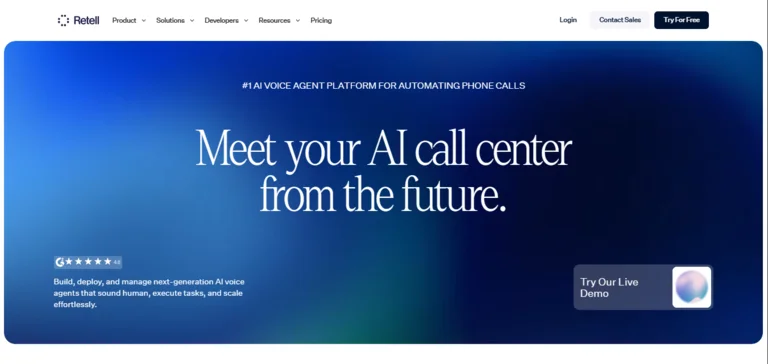
Best for: Businesses and developers wanting flexible, production-ready phone agents
Retell AI provides infrastructure for building inbound and outbound voice agents.
Users can select from multiple language models and voice providers, connect custom telephony, create knowledge bases and configure actions, transfers, guardrails and post-call analysis.
Retell also provides optional features such as personal-information removal, call recording controls, advanced denoising and automated quality assurance.
Key features
- Inbound and outbound calling
- Multiple language-model options
- Multiple text-to-speech providers
- Custom telephony or Retell-managed numbers
- Knowledge bases
- Batch calling
- Branded outbound calling
- Call transfers
- SMS
- Safety guardrails
- PII removal
- Call testing
- AI quality assurance
- Custom data-retention controls
- Enterprise HIPAA and access-control options
Pricing
Retell uses pay-as-you-go pricing.
Its official calculator shows that the final cost depends on:
- Voice infrastructure
- Language model
- Text-to-speech provider
- Telephony
- Knowledge base
- Denoising
- Safety features
- PII removal
- Quality assurance
Retell currently lists a broad total range of approximately $0.07 to $0.31 per minute. Twenty concurrent calls are included on the pay-as-you-go plan, while enterprise plans provide custom pricing and higher concurrency.
Advantages
- Transparent component-level pricing
- Self-service access
- Flexible provider selection
- Suitable for inbound and outbound calls
- Built-in safety and QA options
- Custom telephony support
- Good balance between control and managed infrastructure
Potential limitations
The lowest advertised rate does not represent the complete production cost.
Selecting a more advanced language model, premium voice, managed telephone number and additional safety features can materially increase the per-minute price.
Teams still need to design:
- Prompts
- Call flows
- Tool permissions
- Escalation rules
- Authentication
- Testing
- Compliance controls
Reliqus verdict
Retell AI is one of the strongest general-purpose choices for organisations that want a configurable voice platform without building the complete real-time calling infrastructure themselves.
2. Synthflow
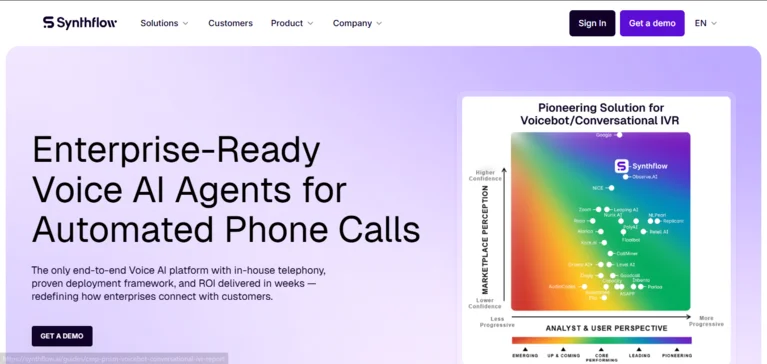
Best for: Enterprises wanting a visual, end-to-end voice automation system
Synthflow is a full-stack voice AI platform for inbound and outbound phone automation.
Its visual flow designer allows teams to define call logic, connect APIs and configure specialised subflows. The platform also includes native telephony, simulated testing, automated quality assurance and post-launch monitoring.
Synthflow supports use cases such as:
- Appointment scheduling
- Lead qualification
- Customer support
- Call routing
- Order tracking
- Claims
- Account requests
- Follow-up messages
- Voicemail detection
Key features
- Inbound and outbound agents
- Visual flow designer
- Native telephony
- SIP trunking
- API and webhook connections
- CRM and ERP integrations
- Calendar connections
- Multilingual calls
- Appointment booking
- Voicemail detection
- SMS follow-ups
- Human handoffs
- Simulated call testing
- Automated QA
- Call monitoring
- Multi-agent workflows
Pricing
Synthflow currently states that enterprise contracts begin at $30,000 annually. Final pricing depends on call volume, concurrency, telephony, integrations, security requirements and launch support.
The platform allows users to build and configure an agent without an upfront charge. Production calls then use its current pay-as-you-go or enterprise structure, depending on the account.
Advantages
- No-code and low-code workflow design
- Native telephony
- Strong testing framework
- Inbound and outbound support
- Built-in QA and monitoring
- Appointment and CRM integrations
- Suitable for complex enterprise flows
Potential limitations
The enterprise entry point is too high for many small businesses.
Teams should also distinguish between:
- Building an agent in the interface
- Testing it
- Launching production calls
- Paying for telephony
- Increasing concurrency
- Adding enterprise support
Reliqus verdict
Synthflow is a strong option for operations and customer-experience teams that need enterprise-grade voice automation but do not want a purely developer-led platform.
3. Vapi
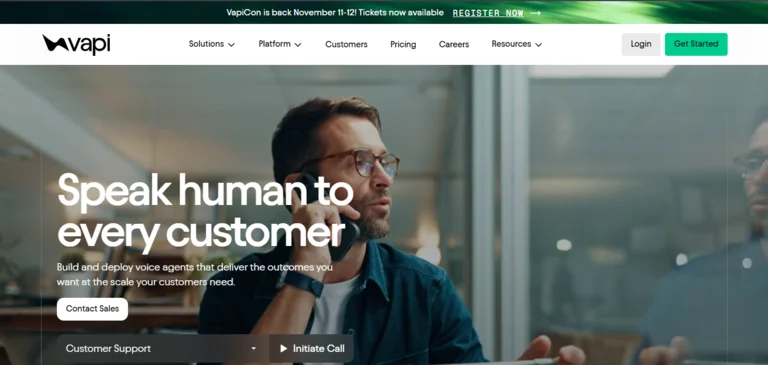
Best for: Developers and product teams building custom voice applications
Vapi provides voice AI infrastructure that allows developers to choose their speech recognition, language model, voice and telephony providers.
The platform manages the real-time orchestration required to keep those components working together during a live conversation.
Vapi can be used to build:
- AI receptionists
- Lead-qualification agents
- Customer-support agents
- Appointment agents
- Survey callers
- Sales agents
- Embedded voice features inside software products
Key features
- Inbound and outbound calls
- Provider flexibility
- Custom language models
- Custom voices
- Bring-your-own API keys
- Tool and function calling
- Telephony integrations
- SIP support
- SMS and chat
- Testing tools
- API and software-development kits
- Concurrency controls
- Enterprise data-residency options
Pricing
Vapi’s Build plan charges a $0.05-per-minute platform hosting fee, excluding speech recognition, language model, text-to-speech and telephony provider costs.
It includes 10 concurrent calls. Additional lines cost $10 per month each.
Model-provider costs are passed through at cost unless the business connects its own provider account. Vapi also lists separate add-ons for HIPAA support and zero data retention.
Advantages
- Flexible technology stack
- Developer-friendly APIs
- Bring-your-own provider options
- Transparent base platform fee
- Inbound and outbound support
- Suitable for embedding voice inside another product
- Strong customisation potential
Potential limitations
The final per-minute cost can be substantially higher than $0.05 after adding:
- Speech recognition
- Language model
- Voice
- Telephony
- Premium compliance features
- Additional concurrency
Vapi also requires more technical expertise than ready-made receptionist tools.
Reliqus verdict
Vapi is best for teams that want infrastructure flexibility and are comfortable designing, testing and operating a custom voice application.
4. Bland AI
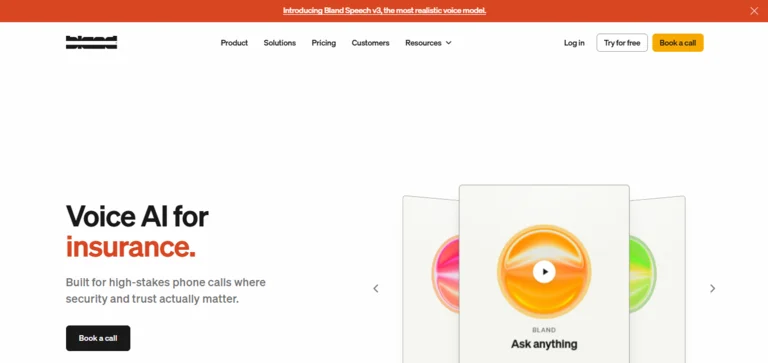
Best for: Phone-first automation, enterprise infrastructure and high-control deployments
Bland AI is built specifically around automated telephone conversations.
Its agents can conduct inbound and outbound calls, use conversational pathways, access real-time information, invoke custom tools, transfer calls and trigger actions such as appointment booking, payments and messages.
Bland emphasises running its phone models on controlled infrastructure rather than passing every conversation through multiple third-party providers.
Key features
- Inbound and outbound calling
- Phone-first language models
- Conversational pathways
- Custom tools and APIs
- Appointment booking
- Payment workflows
- Customer orders
- Call transfers
- IVR navigation
- Knowledge bases
- SMS and messaging
- Voice cloning
- SIP connectivity
- Enterprise infrastructure
- Usage caps and monitoring
Pricing
Bland currently provides:
- Start: Free platform tier
- Build: $299 per month
- Scale: $499 per month
- Enterprise: Custom pricing
Connected call time is then billed by plan:
- Start: $0.14 per minute
- Build: $0.12 per minute
- Scale: $0.11 per minute
Outbound call attempts using Bland telephony may also carry a small minimum charge, including for failed calls.
Advantages
- Built specifically for phone automation
- Inbound and outbound use cases
- High concurrency on paid plans
- Custom actions during calls
- SIP and bring-your-own-telephony options
- Enterprise infrastructure controls
- Clear plan and usage structure
Potential limitations
Bland’s pricing includes both a subscription and connected-minute charges on paid plans.
Teams should model:
- Connected call minutes
- Failed outbound attempts
- Transfers
- Concurrency
- Telephony
- Voice cloning
- Messaging
- Enterprise support
Reliqus verdict
Bland is a strong choice when phone automation is a core operational system and the organisation values infrastructure control, concurrency and custom call actions.
5. ElevenAgents
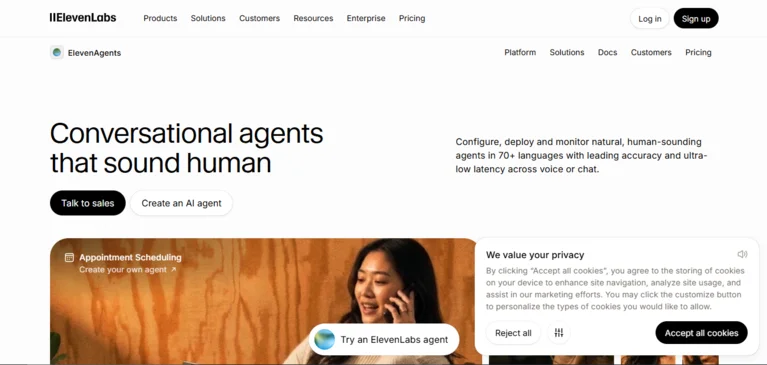
Best for: Natural voices, multilingual agents and businesses already using ElevenLabs
ElevenAgents is ElevenLabs’ platform for deploying voice and chat agents.
It combines expressive voices with configurable workflows, knowledge bases, telephony, guardrails, analytics and integrations.
The platform supports sales, support, front-desk and operational agents across more than 70 languages. It also provides integrations with platforms such as Salesforce, HubSpot, Shopify, Zendesk, Genesys, Twilio and Amazon Connect.
Key features
- More than 11,000 voices
- More than 70 languages
- Voice and chat agents
- Inbound and outbound calls
- Workflow builder
- Knowledge base
- Tool and API connections
- Customer-support templates
- Front-desk agents
- Order-status agents
- Analytics and debug logs
- Guardrails
- Enterprise data-residency options
- Native mobile and web SDKs
Pricing
ElevenAgents currently offers:
- Free: 15 call minutes
- Starter: $6 per month with 75 minutes
- Creator: $22 per month with 275 minutes
- Pro: $99 per month with 1,238 minutes
- Scale: $299 per month with 3,738 minutes
- Business: $990 per month with 12,375 minutes
- Enterprise: Custom pricing
Additional call minutes are billed according to the plan.
Advantages
- Strong voice selection
- Broad language coverage
- Accessible free plan
- Clear included-minute pricing
- Voice and chat in one platform
- Integrations with major business systems
- Developer and no-code options
- Enterprise security controls
Potential limitations
A highly natural voice does not guarantee accurate task completion.
Teams still need to evaluate:
- Speech recognition
- Interruption handling
- Business logic
- Tool calls
- Fallback behaviour
- Authentication
- Escalation
- Call outcome accuracy
Reliqus verdict
ElevenAgents is particularly attractive when voice quality and multilingual coverage matter, provided the business also validates workflow reliability.
6. PolyAI
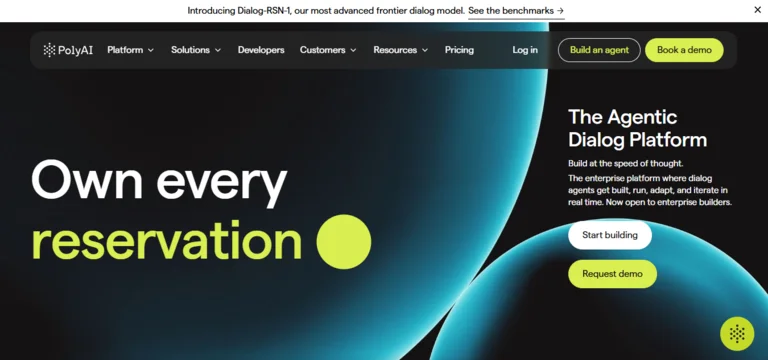
Best for: Large contact centres and complex enterprise customer-service calls
PolyAI provides enterprise voice agents designed to resolve customer-service requests through natural telephone conversations.
Its platform can connect with telephony, CRM, payment, scheduling and knowledge systems. Published examples include appointment booking, identity checks, order or account requests and secure payment workflows.
Key features
- Enterprise voice automation
- Natural-language call handling
- Identity and account workflows
- Appointment scheduling
- Payment integrations
- CRM and knowledge integrations
- Contact-centre connections
- Multilingual deployment
- Call routing and escalation
- Agent Studio
- Versioned conversation flows
- SIP and telephony integrations
Pricing
PolyAI does not publish a standard self-service price for enterprise deployments.
Prospective customers generally need to request a demonstration and receive a quote based on:
- Call volume
- Languages
- Use cases
- Integrations
- Telephony
- Security
- Deployment support
Advantages
- Designed for enterprise contact centres
- Handles complex service workflows
- Integrates with payment and scheduling systems
- Strong telephony ecosystem
- Suitable for high-volume customer support
- Offers a builder for enterprise teams
Potential limitations
PolyAI is unlikely to be the most economical or simplest option for a small company needing basic call answering.
Enterprise implementation may require:
- Call-flow design
- Systems integration
- Data governance
- Testing
- Security review
- Contact-centre coordination
Reliqus verdict
PolyAI is best evaluated as an enterprise customer-service platform rather than a lightweight AI receptionist.
7. CloudTalk AI Voice Agents
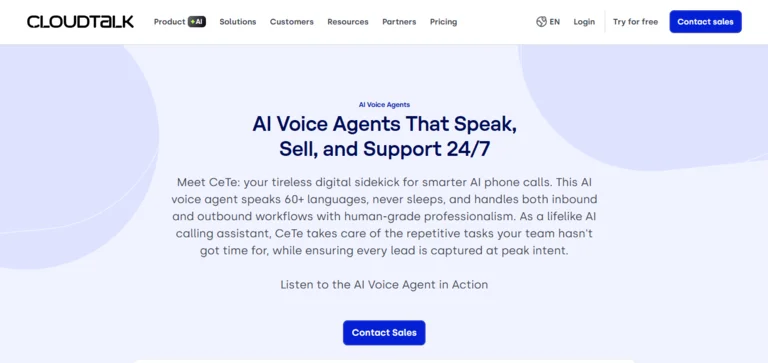
Best for: Businesses wanting voice AI inside a broader calling platform
CloudTalk provides both an AI Receptionist and more advanced AI Specialists.
The AI Receptionist is designed for inbound front-desk work such as answering common questions, routing callers and taking messages. AI Specialists are intended to complete broader workflows, including lead qualification and selected support processes.
CloudTalk combines these agents with its existing business phone, routing, analytics and call-management platform.
Key features
- AI receptionist
- Inbound call answering
- Call routing
- Message taking
- AI specialists
- Lead qualification
- Customer support
- No-code setup
- Business telephony
- Call analytics
- CRM integrations
- High concurrency
- Human transfers
Pricing
CloudTalk currently offers 50 free AI receptionist minutes for initial use.
Its published AI Receptionist tiers include plans beginning around $99 per month for larger minute allowances, while AI Specialists for end-to-end resolutions begin at approximately $349 per month.
Advantages
- AI and business telephony in one product
- Accessible receptionist setup
- Suitable for sales and support teams
- Built-in routing and analytics
- Can support more advanced specialists
- Useful for existing CloudTalk customers
Potential limitations
The receptionist and specialist products solve different problems.
Businesses should confirm whether the selected plan can:
- Answer questions only
- Route calls
- Perform CRM actions
- Complete a full support process
- Make outbound calls
- Transfer with context
Reliqus verdict
CloudTalk is a practical option for companies that want voice AI integrated with a complete calling system instead of assembling separate telephony infrastructure.
8. Aircall AI Voice Agent
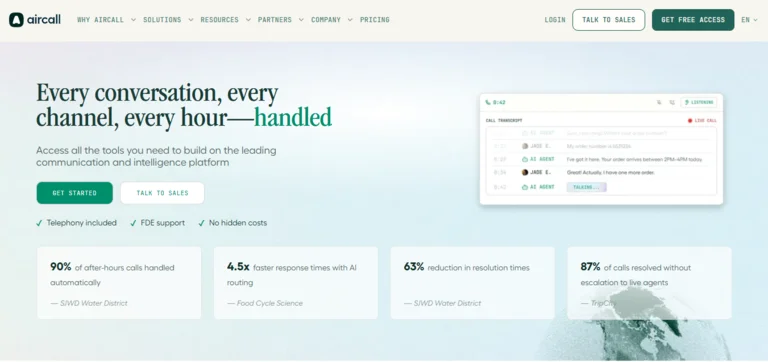
Best for: Sales and support teams already operating through Aircall
Aircall AI Voice Agent answers inbound calls, qualifies leads, retrieves connected information and logs call details into Aircall and integrated CRMs.
It can be inserted into existing call-routing flows and configured through a no-code interface. Aircall also supports workflows such as order checks, confirmations and customer-detail updates.
Key features
- Inbound call handling
- Lead qualification
- Customer-support workflows
- Call routing
- CRM logging
- Call summaries
- Order and account lookups
- Confirmations and updates
- No-code setup
- Real-time monitoring
- Historical reporting
- Integration with Aircall telephony
Pricing
Aircall does not provide a single universally applicable public price for every Voice Agent configuration.
The complete cost may depend on:
- Aircall licences
- AI Voice Agent usage
- Number of agents
- Call volume
- Integrations
- Telephone numbers
- Country and carrier charges
Advantages
- Native Aircall integration
- Easy addition to existing call flows
- CRM synchronisation
- Good fit for existing Aircall customers
- Sales and support use cases
- No-code configuration
Potential limitations
The product is most compelling when the organisation already uses Aircall.
Companies seeking a standalone developer platform or outbound campaign engine may find Retell, Vapi or Bland more flexible.
Reliqus verdict
Aircall AI Voice Agent is a logical first option for existing Aircall customers who want to automate repetitive inbound sales and support calls.
9. RingCentral AI Receptionist
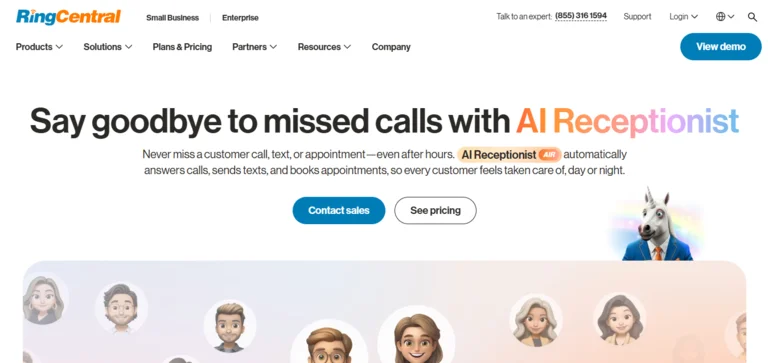
Best for: Businesses wanting an AI front desk that works with an existing phone system
RingCentral AI Receptionist answers inbound calls, responds to common questions, routes callers, takes messages and supports appointment-related enquiries.
It can work with RingCentral or other compatible phone systems, making it more accessible than platforms requiring a complete telephony replacement.
Key features
- 24/7 inbound answering
- Frequently asked questions
- Call routing
- Message taking
- Lead capture
- Appointment information
- Multiple languages
- Existing phone-system compatibility
- Administrative configuration
- RingCentral ecosystem integration
Pricing
RingCentral AI Receptionist starts at $39 per month, including 100 minutes. Additional minutes can be purchased in usage bundles.
Advantages
- Low published starting price
- Works with different phone systems
- Easy receptionist use case
- Established business communications provider
- Useful for missed and after-hours calls
- No custom development required for basic deployment
Potential limitations
RingCentral AI Receptionist is primarily a front-desk product.
It may not provide the same custom workflow depth as Retell, Vapi, Bland or Synthflow for complex outbound calls, collections or transactional customer support.
Reliqus verdict
RingCentral is a strong starting point for small and mid-sized businesses that mainly need every inbound call answered and routed professionally.
10. Goodcall
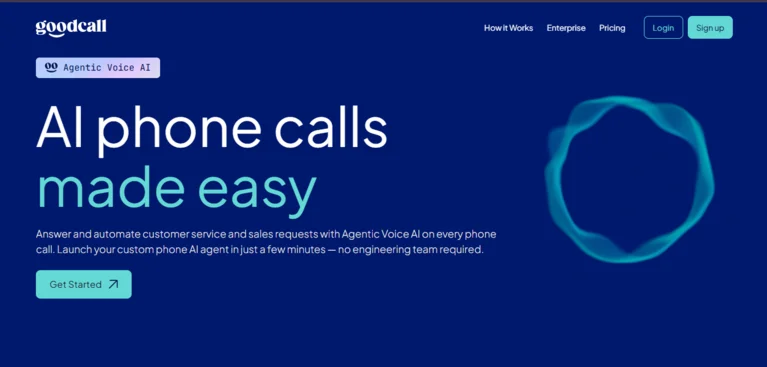
Best for: Small businesses needing affordable call answering and appointment scheduling
Goodcall provides AI phone agents for businesses such as local services, restaurants, salons and appointment-based companies.
The agent can answer questions, schedule appointments, route calls, take messages and perform configured business skills.
Key features
- Inbound call answering
- Appointment scheduling
- Call routing
- Message taking
- Business information
- Pricing questions
- Order requests
- Configurable logic flows
- Directory contacts
- Customer records
- Unlimited minutes under current plans
Pricing
Goodcall currently offers:
- Starter: $79 per agent per month
- Growth: $129 per agent per month
- Scale: $249 per agent per month
The plans include unlimited minutes and tokens but limit the number of unique monthly customers, logic flows, team members and directory contacts. Usage above the customer allowance is billed separately.
Advantages
- Straightforward monthly plans
- Unlimited call minutes
- Built for small businesses
- Appointment scheduling
- Accessible self-service setup
- Clear logic-flow limits
- No complex per-minute calculation
Potential limitations
“Unlimited minutes” does not mean completely unlimited usage because each plan has a monthly unique-customer allowance.
Goodcall is also less suitable for companies requiring:
- Complex APIs
- Large outbound campaigns
- Enterprise contact-centre controls
- Custom model selection
- High-risk financial workflows
Reliqus verdict
Goodcall is one of the most approachable options for a small business that needs an AI receptionist rather than a development platform.
11. Smith.ai AI Receptionist
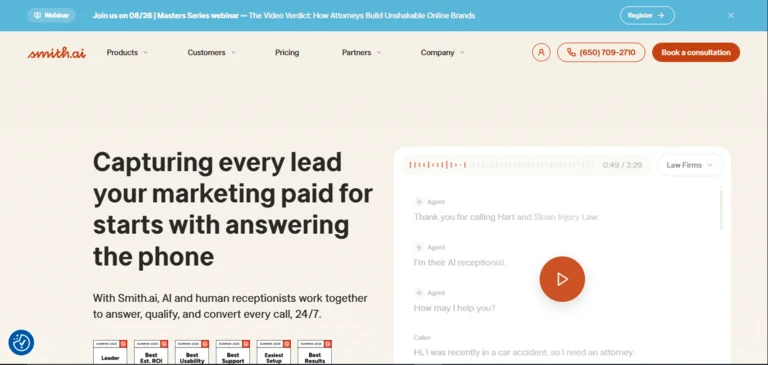
Best for: Professional-service businesses wanting AI reception with optional human support
Smith.ai combines AI-based call handling with optional access to live North American receptionists.
Its AI receptionist can qualify leads, complete intake, answer questions, schedule appointments, route calls, retrieve business information and trigger CRM or calendar workflows. When a situation requires a person, the call can be transferred to Smith.ai’s live-agent network.
Key features
- 24/7 inbound answering
- Lead qualification
- Client intake
- Appointment scheduling
- Call routing
- CRM and calendar integrations
- Data lookup
- Call recording and transcription
- Call summaries
- Workflow automation
- Optional human handoff
- Industry-specific configuration
Pricing
Smith.ai currently provides:
- Free: $0 per month with 25 included live calls
- Pro: From $150 per month with 75 included calls
- Higher Pro tiers: Larger included-call allowances
- Enterprise: From $500 per month
- Custom: For higher volumes and workflows
Extra live calls are billed according to the selected plan.
Advantages
- AI plus human escalation
- Strong fit for law firms and service businesses
- Lead screening and intake
- Appointment scheduling
- CRM and calendar connections
- Free plan for testing
- Month-to-month paid service
Potential limitations
Smith.ai bills primarily by call rather than by minute, which can be advantageous or expensive depending on call length and volume.
Custom AI prompting, integrations and full-service optimisation are restricted to higher tiers.
Reliqus verdict
Smith.ai is a strong choice when callers may need a person and the business wants a managed reception service rather than a self-built agent.
Best Voice AI Agents by Use Case
Best for appointment scheduling
Consider:
- Synthflow
- Retell AI
- Goodcall
- Smith.ai
- PolyAI
- RingCentral AI Receptionist
The agent should be able to:
- Check real-time availability
- Book appointments
- Reschedule appointments
- Cancel appointments
- Apply appointment-type rules
- Respect provider and location availability
- Send confirmations
- Handle time zones
- Transfer unusual requests
Best for lead qualification
Consider:
- Retell AI
- Bland AI
- Synthflow
- Aircall
- Smith.ai
- CloudTalk
Qualification should include more than collecting a name and phone number.
Test whether the agent can:
- Ask conditional questions
- Identify service fit
- Apply geographic restrictions
- Detect urgency
- Confirm budget or company size where appropriate
- Route by service line
- Book a meeting
- Update the CRM
- Stop when the lead is unsuitable
Best for customer support
Consider:
- PolyAI
- ElevenAgents
- Synthflow
- Retell AI
- Aircall
- CloudTalk
Support agents may need access to:
- Order status
- Account details
- Subscription information
- Product documentation
- Service availability
- Returns
- Cancellations
- Ticket history
Access should be limited by authentication and permissions.
Best for collections and payment reminders
Consider developer and enterprise platforms such as:
- Retell AI
- Bland AI
- Synthflow
- PolyAI
- Vapi
Collections is a high-risk use case.
The selected platform must support:
- Identity verification
- Call-frequency controls
- Time-of-day restrictions
- Approved scripts
- Dispute handling
- Do-not-contact instructions
- Payment security
- Recording and retention rules
- Immediate human escalation
Under the US Consumer Financial Protection Bureau’s Debt Collection Rule, third-party debt collectors are subject to restrictions concerning call frequency, repeated calls, third-party disclosures and communications with represented consumers. The rule creates a presumption of violation when a collector exceeds specified calling limits for a particular debt.
Do not deploy an autonomous collections agent without specialist legal and compliance review.
Best for telephone surveys
Consider:
- Bland AI
- Vapi
- Retell AI
- Synthflow
- ElevenAgents
Survey agents should support:
- Fixed and open-ended questions
- Branching logic
- Consent language
- Respondent authentication where necessary
- Call disposition
- Structured data extraction
- Interruption handling
- Language selection
- Opt-out handling
AI should not change the wording of regulated or research-critical questions without approval.
Best for reception
Consider:
- Goodcall
- Smith.ai
- RingCentral AI Receptionist
- CloudTalk AI Receptionist
- Aircall AI Voice Agent
Reception use cases usually prioritise:
- 24/7 answering
- FAQs
- Call routing
- Message taking
- Appointment scheduling
- Lead capture
- Human transfer
These businesses may not need the developer flexibility of Vapi or Retell.
How to Choose a Voice AI Agent
1. Start with one clearly defined call
Avoid beginning with:
We want AI to answer all our calls.
Begin with a narrow workflow such as:
- Book a dental appointment
- Qualify a home-service enquiry
- Check order status
- Route an insurance claim
- Confirm attendance
- Conduct a five-question survey
- Remind a customer about an overdue payment
A narrow call is easier to test, control and improve.
2. Decide whether the agent will receive or place calls
Inbound agents
Inbound agents answer customers who chose to call the business.
Common risks include:
- Incorrect answers
- Failed authentication
- Poor routing
- Inability to handle unusual requests
Outbound agents
Outbound agents initiate calls.
They introduce additional concerns involving:
- Consent
- Do Not Call lists
- Calling times
- Caller identification
- Opt-outs
- Robocall restrictions
- Campaign suppression
- Frequency limits
The Federal Communications Commission has confirmed that AI-generated human voices fall within the Telephone Consumer Protection Act’s restrictions on artificial or prerecorded voices. Prior express consent is generally required for calls covered by those restrictions, with stricter requirements applying to certain telemarketing calls.
The Federal Trade Commission’s Telemarketing Sales Rule also covers telemarketing practices, the National Do Not Call Registry and restrictions on many prerecorded sales calls.
This article is not legal advice. Obtain legal guidance before launching outbound AI calls.
3. Test latency and interruption handling
A convincing demonstration may use a simple scripted question under ideal conditions.
Test the agent with:
- Fast speech
- Slow speech
- Interruptions
- Corrections
- Background noise
- Accents
- Silence
- Multiple questions
- Topic changes
- Poor mobile reception
A caller should be able to interrupt the agent naturally without causing the conversation to restart or lose context.
4. Evaluate task completion, not voice quality alone
A voice can sound excellent while the agent performs poorly.
Measure whether it can:
- Understand the request
- Retrieve correct information
- Ask necessary questions
- Apply business rules
- Complete the action
- Confirm the outcome
- Record the outcome
- Escalate correctly
5. Review human handoff
A good transfer should include:
- Caller identity
- Reason for the call
- Information already collected
- Actions attempted
- Authentication status
- Urgency
- Complete transcript or summary
The caller should not need to begin again.
6. Model the complete cost
The final cost may include:
- Platform subscription
- Connected minutes
- Outbound attempts
- Telephony
- Phone numbers
- Speech recognition
- Language model
- Text-to-speech
- Premium voices
- Concurrency
- Recording
- Storage
- Quality assurance
- Integrations
- Implementation
- Enterprise support
Compare cost per successfully completed call, not only cost per minute.
7. Review security and action permissions
An agent that only answers store-opening questions carries limited risk.
An agent that can:
- View account data
- Change addresses
- Process refunds
- Schedule medical appointments
- Collect payments
- Modify subscriptions
requires stronger authentication, permissions and audit controls.
Apply least-privilege access and require human approval for high-risk actions.
8. Check recording and disclosure requirements
Recording laws vary by jurisdiction.
The FCC states that it does not impose one general federal rule for individuals recording telephone conversations, but state laws may prohibit recording without the required consent.
Businesses should determine:
- Whether the agent must identify itself as AI
- Whether the call is recorded
- Whether consent is required
- Which participants must consent
- How recordings are stored
- How deletion requests are handled
- Whether call data is used for training
How Reliqus Should Test Voice AI Agents
Test 1: Appointment scheduling
Ask each compatible agent to:
- Book a new appointment
- Reschedule an appointment
- Cancel an appointment
- Handle an unavailable requested time
- Book for two people
- Apply a location restriction
- Send a confirmation
Record whether the calendar is updated correctly.
Test 2: Lead qualification
Create callers who:
- Match the ideal customer profile
- Live outside the service area
- Need an unsupported service
- Have an urgent enquiry
- Are an existing customer
- Refuse to answer one question
- Ask for a person immediately
Measure qualification and routing accuracy.
Test 3: Customer support
Use a fictional business with a controlled knowledge base.
Ask:
- Where is my order?
- Can I return this item?
- Why was I charged twice?
- How do I reset my password?
- Can I cancel my subscription?
Include outdated and conflicting documents to determine whether the agent uses approved sources correctly.
Test 4: Difficult audio
Test:
- Background television
- Road noise
- Two people speaking
- A strong accent
- Industry terminology
- A poor connection
- Caller interruptions
Compare the transcript with a manual reference.
Test 5: Unexpected conversation
Ask questions outside the approved workflow.
The agent should:
- Avoid inventing an answer
- State its limitation
- Offer a useful next step
- Transfer when necessary
Test 6: Security
Attempt to:
- Access another customer’s information
- Override the agent’s instructions
- Obtain a discount outside policy
- Process a refund above its limit
- Change account information without verification
- Make the agent reveal hidden prompts or system details
Test 7: Outbound compliance
Confirm that the platform can:
- Store consent evidence
- Suppress opted-out numbers
- Apply calling windows
- Check Do Not Call lists
- Stop after an opt-out
- Use approved caller identification
- Apply attempt limits
- Record campaign and consent source
Suggested Scoring Framework
| Criterion | Weight |
| Task-completion accuracy | 20% |
| Speech recognition and interruption handling | 15% |
| Conversation quality and latency | 15% |
| Business integrations and actions | 15% |
| Human handoff | 10% |
| Testing and quality assurance | 10% |
| Security and compliance controls | 10% |
| Pricing and value | 5% |
For receptionist products, increase the weight given to setup and routing.
For collections, healthcare and financial workflows, treat a serious compliance or security failure as a disqualifying issue rather than allowing other scores to offset it.
Risks and Limitations of Voice AI Agents
Incorrect information
The agent may confidently state an outdated policy or misunderstand the caller.
Ground responses in approved information and maintain clear fallback rules.
Failed actions
An agent may verbally confirm that an appointment was booked even though the calendar update failed.
Require the system to verify tool success before confirming completion.
Caller authentication
Voice alone should not be treated as reliable proof of identity.
Sensitive workflows may require:
- One-time passcodes
- Account details
- Secure authentication links
- Knowledge-based checks
- Human verification
Voice-cloning abuse
Voice-cloning technology can be used for impersonation and fraud.
Businesses should use approved voices, disclose the automated nature of calls where required and prohibit unauthorised cloning of employees, customers or public figures.
Outbound calling violations
The fact that an agent can dial thousands of numbers does not mean the business has permission to call them.
AI-generated voice calls remain subject to telephone, telemarketing, consent and Do Not Call requirements.
Recording and privacy
Call recordings may contain:
- Contact information
- Financial details
- Health information
- Authentication information
- Legal discussions
- Customer complaints
- Payment information
Review storage location, retention, model training, deletion, access controls and subprocessors.
Poor escalation
Customers become frustrated when the agent cannot help and refuses to transfer them.
Provide clear escalation for:
- Repeated misunderstandings
- Angry callers
- Vulnerable customers
- Security concerns
- Legal threats
- Complex payment issues
- Requests outside policy
Unpredictable costs
Per-minute pricing can appear low until calls become longer or additional components are added.
Model expected costs at:
- Normal volume
- Peak volume
- Long average call duration
- High transfer rate
- High outbound failure rate
- Increased model and voice quality
- Additional concurrency
Final Verdict
The best voice AI agent should be selected according to the task it must complete, not simply how human its voice sounds.
Choose Retell AI when you need a flexible, production-ready platform with transparent component pricing.
Choose Synthflow when an enterprise operations team wants a visual builder, native telephony, testing and quality assurance.
Choose Vapi when developers need control over models, voices, telephony and application architecture.
Choose Bland AI when phone-first infrastructure, concurrency and enterprise control are priorities.
Choose ElevenAgents when multilingual coverage and natural voice quality matter.
Choose PolyAI for complex, high-volume enterprise customer service.
Choose CloudTalk or Aircall when voice AI should sit inside an existing sales and support calling platform.
Choose RingCentral AI Receptionist or Goodcall when a small business mainly needs calls answered, routed and scheduled.
Choose Smith.ai when human backup is an important part of the reception workflow.
Before deploying an agent, confirm that it can:
- Understand real callers under imperfect audio conditions.
- Complete the intended task correctly.
- Verify that system actions succeeded.
- Authenticate callers before accessing sensitive information.
- Transfer conversations with full context.
- Respect opt-outs and calling restrictions.
- Explain or disclose its role appropriately.
- Produce useful transcripts and outcome data.
- Operate within predictable cost limits.
- Fail safely when it does not know what to do.
Voice AI can increase telephone capacity and reduce repetitive work.
It should not be used to automate inaccurate, intrusive or non-compliant calls at a larger scale.
Frequently Asked Questions
What is the best voice AI agent?
Retell AI is a strong general-purpose option because it supports inbound and outbound calls, configurable AI models, telephony, knowledge bases, safety features, and transparent usage-based pricing. Synthflow is better suited to no-code enterprise deployments, while Vapi is a strong choice for developers. Goodcall, Smith.ai, and RingCentral are more appropriate for businesses looking for a simpler AI receptionist.
What can a voice AI agent do?
A voice AI agent can answer inbound calls, make outbound calls, schedule appointments, qualify leads, route callers, answer customer support questions, check order information, update CRM records, conduct surveys, collect approved information, send follow-ups, and transfer calls to human representatives. Available capabilities depend on the platform, configuration, and integrations.
What is the difference between voice AI and text-to-speech?
Text-to-speech technology converts written text into spoken audio. A voice AI agent uses multiple technologies, including speech recognition, AI reasoning, text-to-speech, and business integrations, to understand callers, respond naturally, and complete tasks during two-way conversations.
Can voice AI agents make outbound calls?
Yes. Platforms such as Retell AI, Bland AI, Vapi, and Synthflow support outbound calling. Businesses must comply with applicable consent, telemarketing, Do Not Call, caller identification, and opt-out requirements when using AI for outbound calls.
Can a voice AI agent book appointments?
Yes. A voice AI agent can book appointments when it is connected to a calendar or scheduling system and configured with the business’s appointment rules. Businesses should test booking, rescheduling, cancellations, time zones, locations, provider availability, and other scheduling scenarios before deploying the agent.
Can a voice AI agent qualify leads?
Yes. A voice AI agent can ask predefined questions, apply qualification criteria, record responses, route qualified leads, and schedule meetings. High-value, complex, or ambiguous leads should be transferred to a human representative when appropriate.
Can a voice AI agent handle customer support?
Yes. Depending on its integrations and permissions, a voice AI agent can answer common questions, retrieve approved account information, complete selected support actions, and create or update support tickets. Sensitive account information and actions should require appropriate authentication and tightly controlled access.
Can voice AI agents be used for collections?
Voice AI agents can be used for approved payment reminders and collection workflows, but collections are a highly regulated use case. Businesses should obtain appropriate legal guidance and consider requirements related to identity verification, call frequency, dispute handling, call recording, disclosures, consumer rights, and human escalation.
Can voice AI agents conduct surveys?
Yes. Voice AI agents can conduct structured surveys, ask predefined questions, follow branching logic, record responses, and extract information into structured data. Businesses should still address applicable consent, disclosure, opt-out, privacy, and research methodology requirements.
Are voice AI agents legal?
Voice AI technology is generally legal, but its use must comply with applicable laws and regulations. In the United States, the FCC has confirmed that AI-generated voices fall under the Telephone Consumer Protection Act’s rules governing artificial or prerecorded voices. Consent and disclosure requirements can vary depending on the purpose of the call, the type of phone number, and other circumstances. Businesses should obtain legal advice for specific use cases.
Do voice AI agents need to disclose that they are AI?
Disclosure requirements vary by jurisdiction, industry, and use case. Even when a specific disclosure is not legally required, clearly identifying an AI agent can improve transparency and help build trust with callers. Businesses should obtain legal guidance for the markets and use cases in which their voice AI agents operate.
How much do voice AI agents cost?
Voice AI pricing varies by platform and may be based on usage, including per-minute or per-call charges, monthly subscriptions, annual enterprise contracts, component-based pricing, or volume-based plans. Basic AI receptionist services may cost less than $100 per month, while developer-focused platforms may charge approximately $0.05 to $0.15 per minute before additional model and telephony costs. Enterprise implementations can start at around $30,000 per year and increase depending on usage, integrations, customization, and support requirements.
Are there free voice AI agents?
Yes. Several voice AI platforms offer free trials, testing credits, or limited free access. Examples include ElevenLabs, Bland AI, Smith.ai, Vapi, and Retell AI. Free access typically comes with restrictions on call volume, minutes, concurrency, features, integrations, or commercial usage. Businesses should review each platform’s current pricing and usage terms before selecting a free plan.