

When patients search for healthcare providers today, one of the first things they see is not a website; it is the Google Maps Local Pack.
For searches like:
- “pain management near me”
- “cardiologist Bergen County”
- “urgent care open now”
- “best dermatologist near me”
- “physical therapist in Paramus”
Google prioritizes map listings, reviews, business profiles, physician credibility, and local trust signals over traditional organic links.
Google Maps is no longer just a digital directory; it is one of the most powerful patient acquisition systems in healthcare. Yet, most medical practices still misunderstand how local algorithms evaluate clinics in 2026.
Google Maps Rankings Are Not Random
Many clinics assume local rankings follow basic website SEO rules:
- More keywords
- More backlinks
- More blog posts
- More site traffic
This misconception is why most healthcare SEO fails. Google Maps operates on a distinct three-pillar framework:
- Relevance: How closely the clinic’s listing and entity profile match search intent.
- Distance: Proximity between the clinic and the patient or searched geographic entity.
- Prominence: How trusted, well-reviewed, and authoritative the practice is across the web.
While most healthcare providers focus narrowly on relevance and assume distance is uncontrollable, the practices dominating local rankings consistently win on prominence.
Healthcare Is Different From Other Local Businesses
Healthcare falls directly under Google’s “Your Money or Your Life” (YMYL) classification. Because medical search queries directly impact safety, physical health, finances, and overall quality of life, Google evaluates these businesses with heightened algorithmic scrutiny.
Rankings are not determined by location pinpoints alone. Google increasingly measures:
- Patient review sentiment and frequency
- Physician authority and credential verification
- Real-world patient engagement signals
- Website Experience, Expertise, Authoritativeness, and Trustworthiness (E-E-A-T)
- Cross-platform business consistency (NAP: Name, Address, Phone)
With the rise of AI-driven search summaries and entity-based indexing, trust signals now outweigh raw keyword frequency within a modern healthcare marketing system.
Why Most Medical Practices Never Crack the Top 3
Creating a Google Business Profile (GBP) is a baseline entry point, not an SEO strategy. Clinics often plateau or drop out of visibility due to:
- Passive review workflows: Infrequent review volume, stale feedback, or unaddressed patient complaints.
- Incomplete listing assets: Missing secondary categories, outdated office hours, empty service menus, or dead booking links.
- Disconnected web properties: Thin service pages and zero localized landing content.
- Invisible practitioners: Individual physicians omitted from the profile and missing from structured schema markup.
In competitive healthcare markets like Bergen County, marginal differences in verifiable trust signals separate the top three rankings from absolute obscurity.
The 6 Core Google Maps Ranking Factors for Healthcare
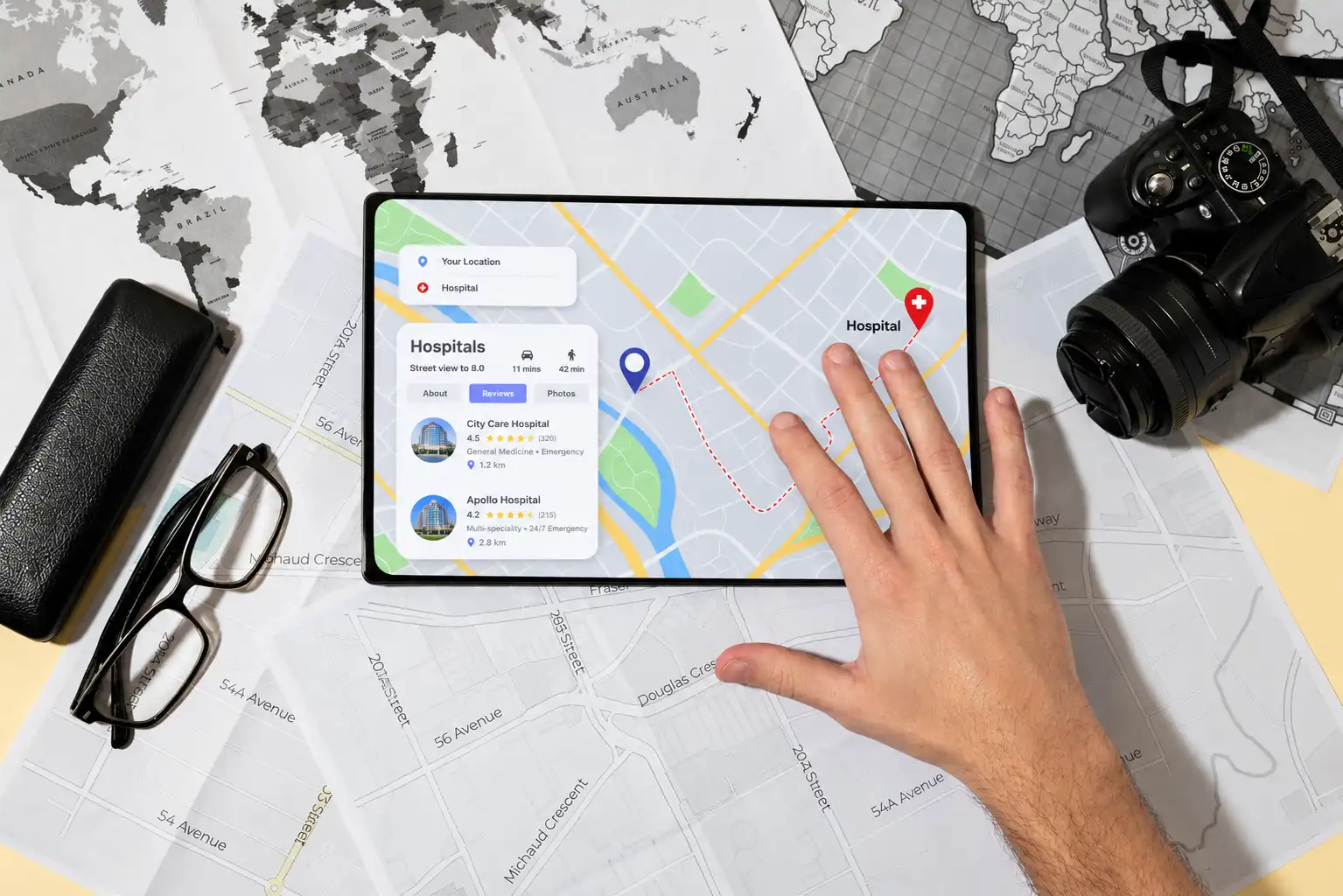
1. Google Business Profile Optimization
Your GBP is your primary patient acquisition asset. Comprehensive healthcare optimization via dedicated Google My Business optimization services includes:
- Primary and Secondary Categories: Exact primary categorization with relevant secondary specialties.
- Service Menus: Granular treatment listings tied directly to target clinical conditions.
- Direct Booking Integrations: Verified, functional appointment links.
- Associated Practitioners: Department and individual practitioner profile linking.
- Visual Trust: High-resolution interior, exterior, staff, and medical technology photos.
- Active Q&A Management: Preemptively answering standard patient and insurance inquiries using ongoing Google My Business management.
2. Strategic Healthcare Review Velocity
Healthcare reviews are assessed on clinical credibility, bedside manner, wait times, staff empathy, and treatment efficacy. Google’s algorithms monitor:
- Velocity and recency: Consistent weekly intake rather than unnatural bursts.
- Keyword sentiment: Organic mentions of treatments, specific physicians, and clinic atmosphere.
- Provider responsiveness: Professional, HIPAA-compliant responses posted to both positive and negative reviews.
A practice with a 4.8-star rating, recent reviews, and steady patient engagement will consistently outrank a static 5.0-star listing that hasn’t received a review in six months. Implementing targeted near-me optimization strategies can replicate how local clinics boost walk-ins through genuine patient feedback loops.
3. Website Authority
Google Maps does not function in isolation from organic search. A medical practice website acts as the primary data layer verifying the Google Business Profile through specialized healthcare SEO services:
- Physician Biography Pages: Detailing board certifications, clinical backgrounds, and hospital affiliations.
- Condition and Treatment Content: Medically accurate, deep content that proves topical authority.
- Structured Data: Robust MedicalBusiness, Physician, and LocalBusiness schema markup.
- Hyper-Local Architecture: Clear neighborhood, town, and regional landing pages.
4. Local Relevance
Keyword stuffing city names into business titles violates Google guidelines and yields diminishing returns. Instead, partner with high-integrity local SEO services to build organic local relevance via:
- Reviews referencing regional areas and surrounding townships.
- Prominently displayed directions and regional landmarks on contact pages.
- Hospital network connections, local medical citations, and community sponsorships supported by verified link building services for healthcare websites.
5. Patient Engagement and Behavioral Signals
Google tracks how users interact with your listing across desktop and mobile devices:
- Click-to-call frequency
- Request directions actions
- Click-through rates (CTR) from map results
- Direct appointment scheduling taps
When searchers repeatedly interact with a listing and stay engaged, algorithms recognize the clinic as an authentic, high-quality solution.
6. Physician-Specific E-E-A-T
Healthcare is unique because individual practitioner reputation directly influences institutional visibility. Strong physician visibility requires:
- Individual practitioner listings nested cleanly within the primary clinic profile.
- Matching NPI (National Provider Identifier) data across medical directories.
- Prominent, indexable media mentions, academic publications, and board accreditations.
The AI Search Factor
Patients no longer search exclusively via simple two-word phrases. To understand how AI is changing healthcare search, consider modern multi-modal and conversational queries:
- “Who is the best sports medicine doctor near Paramus for a torn meniscus?”
- “Paediatrician open late on weekends with easy parking in Bergen County.”
Google synthesizes Maps listings, web content, patient review phrases, and third-party credential databases to generate real-time answers. If your reputation data is fragmented, modern AI search engines will bypass your practice.
Clinics staying ahead are increasingly leveraging specialized AI SEO services and modern discovery algorithms to secure citations across AI Overviews and answer engines.
Multi-Location Healthcare SEO: Avoiding the Split-Authority Trap
Healthcare groups expanding across multiple regional offices often make the mistake of creating identical, generic pages for each branch.
Implementing structured local SEO for multi-location clinics is essential because Google evaluates every clinic address independently. Multi-location organizations require:
- Distinct, location-specific Google Business Profiles.
- Dedicated location landing pages featuring unique staff, address details, localized FAQs, and specific facility photos.
- Independent patient review collection workflows tailored to each physical office.
The Cost of Poor Conversion Signals
Achieving top-three placement on Google Maps is only half the battle. If high visibility does not translate into confirmed patient appointments, your visibility will degrade over time.
Common conversion bottlenecks include:
- Outdated or mismatched operational hours that lead to abandoned calls
- Missing or non-functional online scheduling links
- Broken, mobile-unfriendly websites that load slowly
- Unaddressed negative reviews left visibly unattended on the profile
A clinic that captures 100 profile visits and converts 20 into appointments delivers a stronger behavioral engagement signal to Google than a competitor that captures 300 visits that result in immediate bounces.
Strategic Blueprint: Building a High-Prominence Medical Maps Asset

To dominate competitive local markets, healthcare organizations must deploy an integrated, operational blueprint:
| Focus Area | Core Action Items | Primary Impact |
| Profile Architecture | Claim, verify, assign exact medical categories, set up insurance and booking links. | Establishes absolute search relevance. |
| Reputation Systems | Deploy automated, HIPAA-compliant post-appointment SMS/email review requests. | Drives the review velocity required for prominence. |
| Clinical Content | Build doctor-authored, localized symptom and treatment guides supported by Physician schema. | Satisfies E-E-A-T and links website authority to Maps. |
| Engagement Optimization | Add direct booking capabilities, monitor Q&As weekly, and upload real facility/team photos. | Improves click-to-call and scheduling conversion rates. |
The Bergen County Example: A Tale of Two Clinics
To understand how these factors play out in a competitive regional healthcare market, examine two hypothetical pain management groups serving the Bergen County, NJ corridor (Paramus, Hackensack, Fort Lee, Ridgewood):
Clinic A:
Created a bare-bones Google profile five years ago under the generic category “Doctor.” Their address is registered to a shared corporate suite. The website consists of a generic home page, a sparse contact form, and zero provider bios. They have twelve reviews, no owner responses, and no listed insurance.
Clinic B:
Operates a fully verified profile with the primary category “Pain Management Physician.” Their website features dedicated doctor bios outlining board certifications and hospital affiliations, rich condition libraries for spinal pain, and embedded Google Maps driving directions. They use an automated system to generate steady reviews highlighting specific treatments, and staff responds professionally to feedback weekly.
Even if both clinics employ equally capable physicians, Clinic B will overwhelmingly dominate the Local 3-Pack across Bergen County. Google’s algorithm does not measure clinical brilliance in an exam room; it measures verified trust signals, community prominence, and accessible patient data.
Google Maps SEO Is Now Reputation and Trust Engineering
The days of ranking in Google Maps by submitting your practice to hundreds of low-tier web directories are long gone.
Local visibility is now an organic reflection of reputation management, operational precision, clinical credibility, and technical website optimization. Google wants to verify that your practice is not just geographically close to the patient, but also the safest, most authoritative, and most responsive choice for their care.
If you are ready to make your clinic the leading local choice, contact us today to discuss a customized local healthcare search audit.
FAQs
How do medical practices rank in Google Maps?
Medical practices rank in Google Maps based on relevance, distance, and prominence. Google also evaluates reviews, website authority, physician credibility, local trust signals, and patient engagement.
Are reviews important for healthcare Google Maps rankings?
Yes. Reviews strongly influence rankings, click-through rates, patient trust, and local visibility in healthcare search results.
Does website SEO affect Google Maps rankings?
Absolutely. Strong healthcare websites reinforce local authority, trust, EEAT, and topical relevance, all of which influence Google Maps visibility.
Why are physician bios important for local healthcare SEO?
Physician bios strengthen expertise and trust signals. Google increasingly evaluates provider authority when ranking healthcare businesses.
What is the most important factor for healthcare local SEO?
There is no single factor, but trust signals matter most collectively. Reviews, physician authority, Google Business Profile optimization, local relevance, and patient engagement all play major roles.
Can multi-location clinics rank well in Google Maps?
Yes, but each location needs its own localized authority, reviews, optimization, and trust signals to compete effectively.