
Most marketing teams are not struggling because they lack creative ideas.
They are struggling because creative execution keeps breaking operationally.
A campaign starts with clarity.
Then the workflow expands.
Someone writes copy in ChatGPT.
Someone creates visuals in Canva.
Another person adjusts sizing for ads.
A strategist rewrites headlines.
A designer reviews layouts.
A manager requests revisions.
Assets move across Slack, folders, comments, screenshots, and meetings.
Eventually, the team spends more energy coordinating creative work than producing it.
This is one of the biggest shifts happening inside modern marketing operations.
AI dramatically accelerated content generation.
But generation alone did not solve creative operations.
In many organizations, it exposed deeper problems:
- inconsistent messaging
- fragmented workflows
- repeated creative work
- asset chaos
- slow approvals
- disconnected systems
That is why workflows built around Canva, ChatGPT, Adobe Express, and Gamma are becoming increasingly important together.
Not because teams want more AI tools.
Because modern marketing increasingly depends on reducing the distance between:
- idea
- creation
- adaptation
- approval
- publication
The strongest teams today are not simply using AI to make graphics faster.
They are building systems where:
- creative ideas become reusable
- campaigns move with less friction
- brand consistency improves
- production scales operationally
- teams publish faster without losing quality
This guide is not about “Canva tips.”
It is about how modern marketing teams are building AI-assisted creative workflows using Canva, ChatGPT, and connected production systems.
Because the important question is no longer:
“Can AI create marketing assets?”
It is:
“Can our creative workflow actually scale without becoming chaotic?”
Canva Made Design Easier. But Creative Operations Are Still Complicated.
When Canva became mainstream, it changed marketing production permanently.
Non-designers could finally create:
- social graphics
- presentations
- ad creatives
- pitch decks
- campaign visuals
without depending entirely on specialist design software.
That accessibility mattered.
Marketing teams moved faster.
Founders published more.
Content velocity increased dramatically.
But another problem emerged as output volume grew.
Creative production became easier.
Creative coordination became harder.
A team might now produce:
- LinkedIn graphics
- Meta ad creatives
- email banners
- presentation slides
- landing page visuals
- short-form video thumbnails
- campaign variations
every single week.
The challenge is no longer: “Can we create assets?”
The challenge becomes: “How do we maintain consistency while producing at scale?”
That is where AI-assisted workflows become operationally valuable.
Not because AI replaces designers.
Because it reduces repetitive production friction.
What Marketing Teams Actually Struggle With
If you spend enough time talking with marketing teams, agencies, content operators, and performance marketers, the frustrations become remarkably similar.
Not because everyone uses the same software.
Because creative operations naturally create bottlenecks.
One recurring issue is creative inconsistency.
Different contributors generate different tones, visual styles, and messaging structures.
Another major frustration is revision fatigue.
Campaigns rarely fail because nobody had ideas.
They fail because:
- approvals slow down
- edits multiply
- versions become confusing
- execution loses momentum
There is also increasing operational fatigue around adaptation work.
One creative concept becomes:
- ten ad sizes
- five platform formats
- three presentation versions
- multiple social adaptations
That production overhead compounds quickly.
And perhaps the biggest issue:
creative systems rarely retain learning.
A team discovers:
- strong hooks
- high-performing visual structures
- successful ad messaging
- effective prompt patterns
Yet those insights often disappear into chats, folders, or old campaign files.
The strongest AI-assisted creative systems solve this by making workflows reusable instead of temporary.
Many organizations document these repeatable systems inside collaborative workspaces, creating centralized knowledge hubs through Notion and ChatGPT workflows for content teams.
The Five Layers of an AI-Assisted Creative Workflow
Before selecting tools, define the operational layer.
Most modern creative systems operate across five functions.
Ideation
Where concepts and messaging originate.
Creation
Where assets are produced.
Adaptation
Where campaigns scale across formats.
Collaboration
Where teams review and refine work.
Publishing
Where production becomes operationally repeatable.
Different tools support different layers.
The strongest systems connect them naturally.
Ideation Systems: Where ChatGPT Changed Creative Production
One of the biggest changes AI introduced into marketing was reducing the friction between concept and execution.
Teams no longer wait until design starts to explore campaign directions.
Ideas can now evolve operationally much earlier.
1. ChatGPT
Most discussions around ChatGPT focus on generation speed.
But for marketing teams, its strongest operational value is often creative acceleration.
Campaign hooks.
Ad variations.
Messaging structures.
Headline exploration.
Audience angles.
Creative briefs.
Content adaptation.
The strongest teams rarely use ChatGPT randomly.
They build repeatable prompt systems around it, often relying on proven frameworks similar to the best ChatGPT prompts for digital marketers.
For example:
campaign objective
→ audience context
→ creative angle generation
→ headline exploration
→ visual direction
→ Canva production
→ campaign adaptation
That operational structure matters more than individual prompts.
Where ChatGPT tends to work especially well:
- campaign ideation
- ad copy workflows
- content repurposing
- presentation drafting
- creative exploration
- messaging variation
The important shift is that ideation becomes operationally scalable.
Creative Production: Why Canva Became Operational Infrastructure for Marketing Teams
Canva’s biggest contribution was not templates.
It was reducing creative dependency.
Marketing teams could finally move faster independently.
That changed content operations completely.
2. Canva
Canva works especially well because it lowers production friction across multiple marketing environments simultaneously.
A single campaign idea can quickly become:
- social graphics
- ad creatives
- presentation assets
- lead magnets
- internal visuals
without rebuilding everything from scratch.
The strongest Canva workflows usually prioritize:
- reusable templates
- centralized brand systems
- campaign consistency
- rapid adaptation
rather than isolated asset creation.
One important operational observation:
The most effective teams rarely treat Canva as “design software.”
They treat it as production infrastructure.
That mindset changes how workflows get built.
3. Adobe Express
Adobe Express becomes valuable when teams want stronger creative flexibility while maintaining marketing speed.
Many organizations eventually outgrow purely template-driven production.
Campaigns become more customized.
Brand expectations increase.
Visual refinement matters more.
Adobe Express helps reduce the gap between:
professional creative environments
and
fast marketing execution.
Where it tends to work especially well:
- branded campaigns
- higher-design environments
- content-heavy marketing teams
- creative scaling operations
The strongest implementations still prioritize workflow speed rather than perfection.
Because modern marketing rewards consistency of execution more than isolated creative brilliance.
Presentation & Narrative Workflows: Why Teams Are Rethinking How They Communicate Internally
One of the most overlooked parts of creative operations is internal communication.
Campaign proposals.
Strategy decks.
Creative rationale.
Reporting.
Client presentations.
These assets consume enormous production time across agencies and marketing departments.
4. Gamma
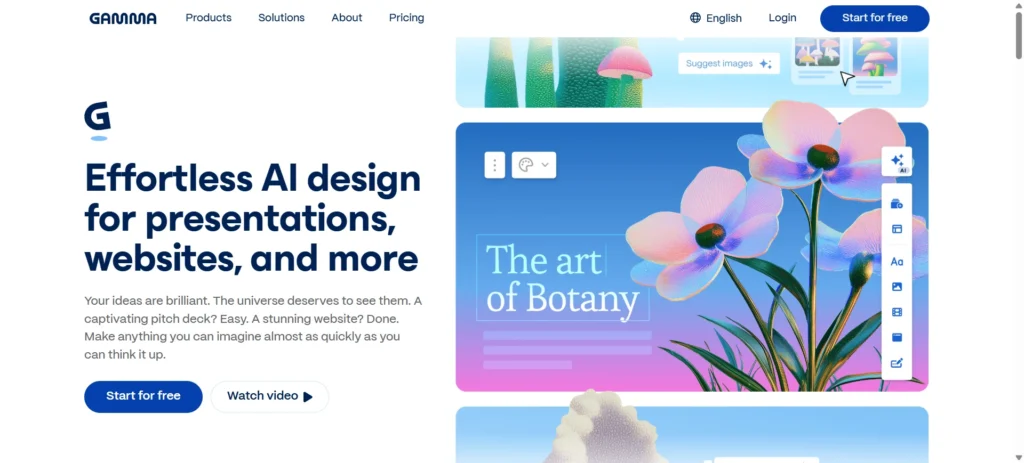
Gamma became interesting because it reduces friction between thinking and presentation.
Instead of treating presentations like isolated design projects, teams can move from concept to structured narrative much faster.
This matters operationally because:
many marketing delays happen during communication packaging rather than strategy itself.
Where Gamma tends to work especially well:
- pitch decks
- campaign storytelling
- internal documentation
- strategy communication
- proposal workflows
The strongest teams use tools like Gamma to accelerate operational clarity, not merely visual polish.
Related: AI presentation maker tools