
Most content teams do not struggle because they lack ideas.
They struggle because knowledge keeps disappearing.
- A strategist researches a topic once, and nobody reuses the insights later.
- A writer creates strong prompts, but they stay trapped inside one chat.
- Campaign learnings live in Slack threads nobody revisits.
- SEO structures get rebuilt repeatedly.
- Brand language becomes inconsistent across contributors.
- Writers ask the same onboarding questions every month.
Teams generate more content than ever before, yet operationally many organizations still behave like they are starting from zero every week.
This is one of the most important shifts happening inside modern marketing operations.
AI dramatically increased content production speed.
But speed alone does not create operational intelligence.
In many organizations, AI actually exposed a deeper problem.
Knowledge fragmentation.
- Prompts scattered across chats.
- Research duplicated constantly.
- Outputs disconnected from systems.
- Workflow decisions dependent on memory instead of infrastructure.
That is why platforms like Notion, ChatGPT, Claude, Perplexity, and Airtable are becoming increasingly important together.
Not because teams need more AI tools.
Because modern content operations increasingly depend on reusable systems.
The strongest content teams today are not simply using AI to generate faster drafts.
They are building environments where:
- research compounds
- prompts become reusable
- workflows become repeatable
- campaign knowledge stays searchable
- execution becomes operational instead of tribal
This guide is not about “best AI prompts.”
It is about how modern content teams are building AI-enabled operational systems using Notion and connected AI workflows.
Because the important question is no longer:
“Can AI create content?”
It is:
“Can our team actually reuse what it learns?”
Most Teams Have AI Tools. Very Few Have AI Systems.
This is one of the biggest misunderstandings in modern marketing right now.
Companies believe AI adoption means: buying access to AI tools.
But operationally, that changes very little on its own.
A writer opens ChatGPT.
A strategist uses Claude.
Someone researches through Perplexity.
Another person stores ideas in Notion.
The work gets done.
But the organization does not become more intelligent over time.
Because the knowledge stays fragmented.
That fragmentation becomes expensive quickly.
- Prompts disappear.
- Research repeats.
- Messaging drifts.
- New employees restart learning cycles.
- Content quality varies depending on who generated it.
The strongest AI-enabled teams are approaching the problem differently.
Instead of asking: “How do we generate more?”
they ask: “How do we retain operational learning?”
That shift changes everything.
AI becomes more valuable when outputs become infrastructure instead of isolated tasks.
And this is where Notion becomes operationally important.
Not simply as documentation software.
But as organizational memory.
To understand how this shift works in real systems, see how teams implement structured workflows in this guide on content marketing automation strategy.
What Content Teams Actually Lose Every Month
If you spend enough time talking with content marketers, agencies, SEO teams, and editorial operators, the frustrations become surprisingly consistent.
Not because teams use the same workflows.
Because content operations naturally create repetition when systems stay weak.
One recurring issue is prompt loss.
Teams discover workflows that work well.
Then nobody documents them properly.
Another recurring frustration is duplicated research.
Different writers independently investigate the same topics repeatedly because previous work is difficult to retrieve operationally.
There is also increasing inconsistency around brand voice.
AI accelerates production.
But without centralized systems, outputs drift quickly across contributors.
And perhaps most importantly:
campaign learning rarely compounds.
A team learns something valuable about:
- search intent
- customer objections
- conversion messaging
- ad hooks
- content structure
Yet six months later the same lessons get rediscovered again.
Not because teams are careless.
Because operational memory was never built into the workflow.
This is exactly why modern systems rely heavily on structured automation approaches like those explained in the what is content automation guide.
The Five Layers of an AI Content Operating System
Before selecting tools, define the operational layer.
Most mature AI-enabled content systems operate across five functions.
- Knowledge: Where information becomes searchable.
- Prompt Infrastructure: Where AI workflows become reusable.
- Execution: Where production moves operationally.
- Automation: Where repetitive coordination disappears.
- Learning: Where campaign insight compounds over time.
Different platforms support different layers.
The strongest systems connect them naturally.
Knowledge Systems: Why Notion Became the Operational Layer for Modern Content Teams
Content operations become difficult when information exists everywhere simultaneously.
- Google Docs.
- Slack threads.
- AI chats.
- Spreadsheets.
- Editorial calendars.
- Research notes.
- Prompt libraries.
Eventually, teams stop struggling with content creation itself.
They struggle with retrieval.
That is where centralized knowledge systems become operationally valuable.
1. Notion
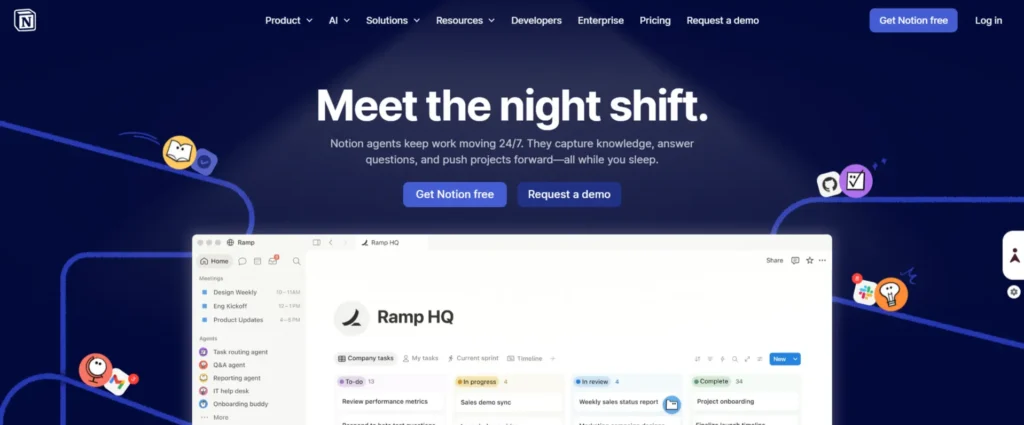
Notion became increasingly important because it allows content systems to behave less like folders and more like operational environments.
Instead of storing disconnected documents, teams can connect:
- SOPs
- prompts
- campaign systems
- editorial workflows
- content databases
- research repositories
- onboarding systems
This matters because modern content operations are no longer linear.
A blog post is connected to:
- SEO research
- content briefs
- AI prompts
- internal linking
- campaign objectives
- distribution workflows
- performance analysis
The strongest Notion environments reduce the distance between knowledge and execution.
Where Notion tends to work especially well:
- content operations
- SEO systems
- AI workflow documentation
- editorial management
- campaign knowledge bases
- onboarding systems
The biggest operational advantage is not flexibility alone.
It is continuity.
Teams stop rebuilding systems repeatedly.
To see how automation strengthens these environments, read automating content creation and optimization.
2. Airtable
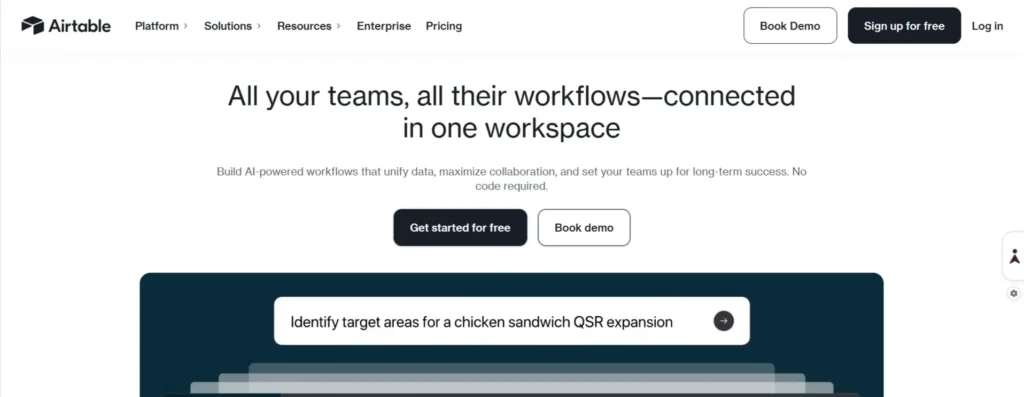
Airtable becomes especially useful when content systems start requiring stronger operational visibility. Examples include:
- Editorial pipelines.
- Campaign tracking.
- Asset coordination.
- Workflow status.
- Production timelines.
Its biggest operational value is often visibility across moving content environments.
Because content teams usually slow down when coordination becomes unclear.
AI Intelligence Layers: Where Content Workflows Become Reusable
One of the biggest mistakes organizations make with AI is treating prompts like temporary interactions instead of operational assets.
The strongest teams increasingly build:
- reusable prompts
- structured workflows
- repeatable AI systems
- knowledge-enhanced generation
That changes AI from convenience into infrastructure. To understand how AI is reshaping this layer, explore how AI is changing content marketing.
3. ChatGPT
ChatGPT became mainstream because it dramatically lowered the friction between idea and execution.
But operationally, its most interesting use case is not generating isolated outputs.
It is accelerating structured workflows.
Examples:
- SEO content systems
- content brief generation
- repurposing workflows
- headline exploration
- strategy drafting
- campaign ideation
- outline systems
The strongest teams rarely use ChatGPT randomly.
They build repeatable operational patterns around it.
For example:
Research framework → prompt structure → output review → publishing workflow → performance feedback loop.
That operational layering matters more than individual prompts.
Practical use case: ChatGPT for Paraphrasing and Content Creation
4. Claude

Claude became increasingly popular among writing-heavy teams because many users prefer its long-context reasoning and editorial tone handling.
This becomes especially useful during:
- strategy documents
- long-form editing
- workflow planning
- content restructuring
- research interpretation
The strongest teams often use different AI systems for different operational strengths rather than forcing one platform into every workflow.
5. Perplexity

Perplexity changes the workflow earlier in the content lifecycle. It improves:
- Research.
- Discovery.
- Information synthesis.
- Trend analysis.
What makes this operationally important is speed of understanding.
Content teams increasingly spend less time gathering raw information and more time deciding:
- what matters
- what deserves expansion
- what supports strategic positioning
That changes how research workflows operate entirely.
AI Tools Are Not Enough — Systems Are the Advantage
The biggest shift in modern content operations is not AI adoption.
It is system design.
Teams that win are not producing more content.
They are building infrastructure where:
- Research compounds
- Prompts are reusable
- Workflows are repeatable
- Knowledge is searchable
- Execution becomes operational
See the top tools used in these systems: Top Content Automation Tools