There is no set formula for selling on social anymore. One day, you are watching someone unpack cereal on Instagram, the next they are casually sliding in a product link mid-bite – and it is sold out. That is the energy of social commerce trends right now. Unfiltered. Unplanned. Unhinged in the best way. And that is exactly why the old funnel and shopping journey are dead.
So if you want in, here are 9 latest social commerce trends worth paying attention to – the kind that don’t wait for brand approvals or campaign calendars.
What Is Social Commerce: Understanding The Basics
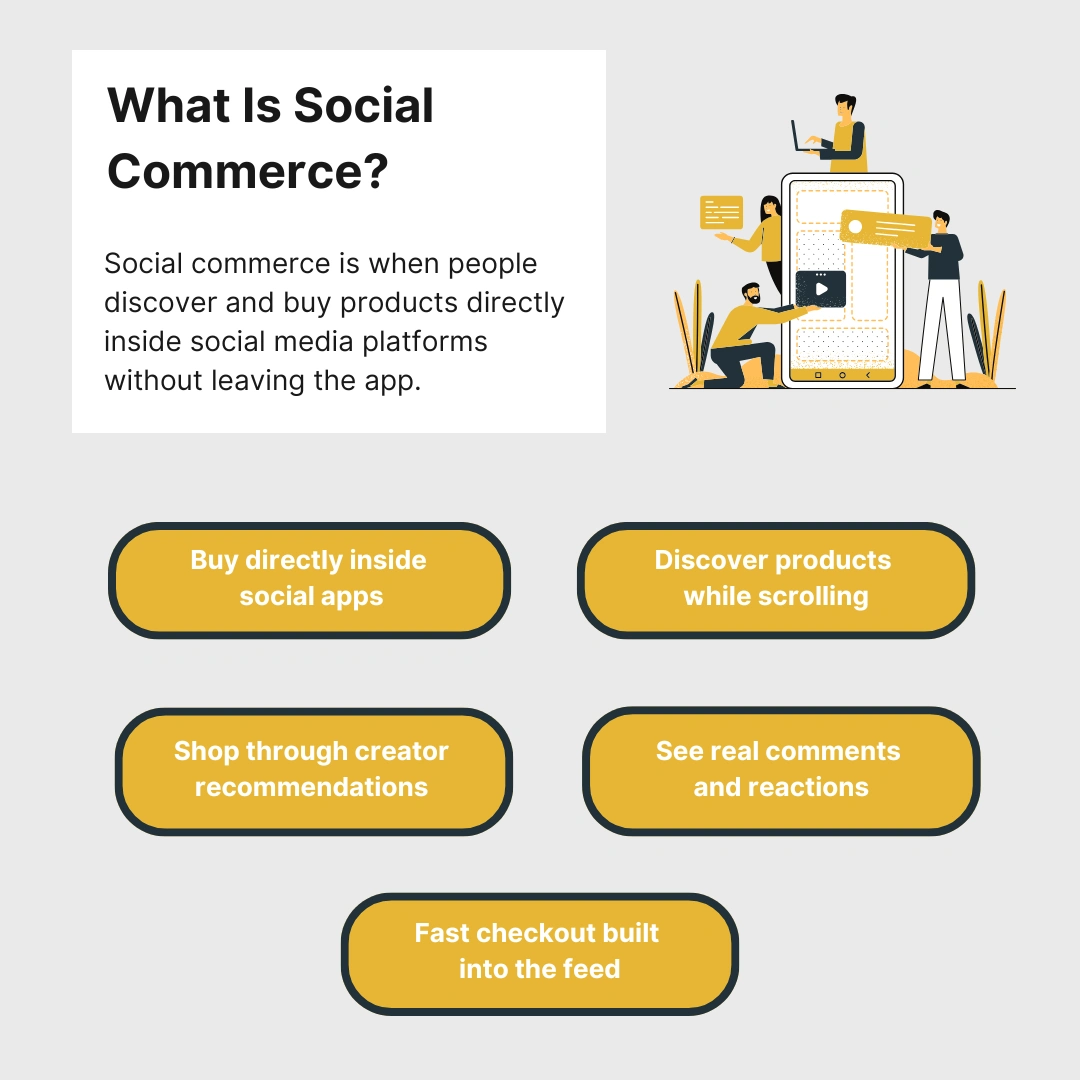
Social commerce is when people buy products directly through social media platforms. It blends product discovery, engagement, and checkout all in one feed. Social media shopping is different from regular online shopping because:
- They shop right inside the app.
- They discover products while scrolling.
- They can buy from creators they trust.
- They see real comments and reactions before they buy.
It is fast and built into the social media sites people already use every day. That is why the social commerce industry is growing so quickly, especially with younger generations.
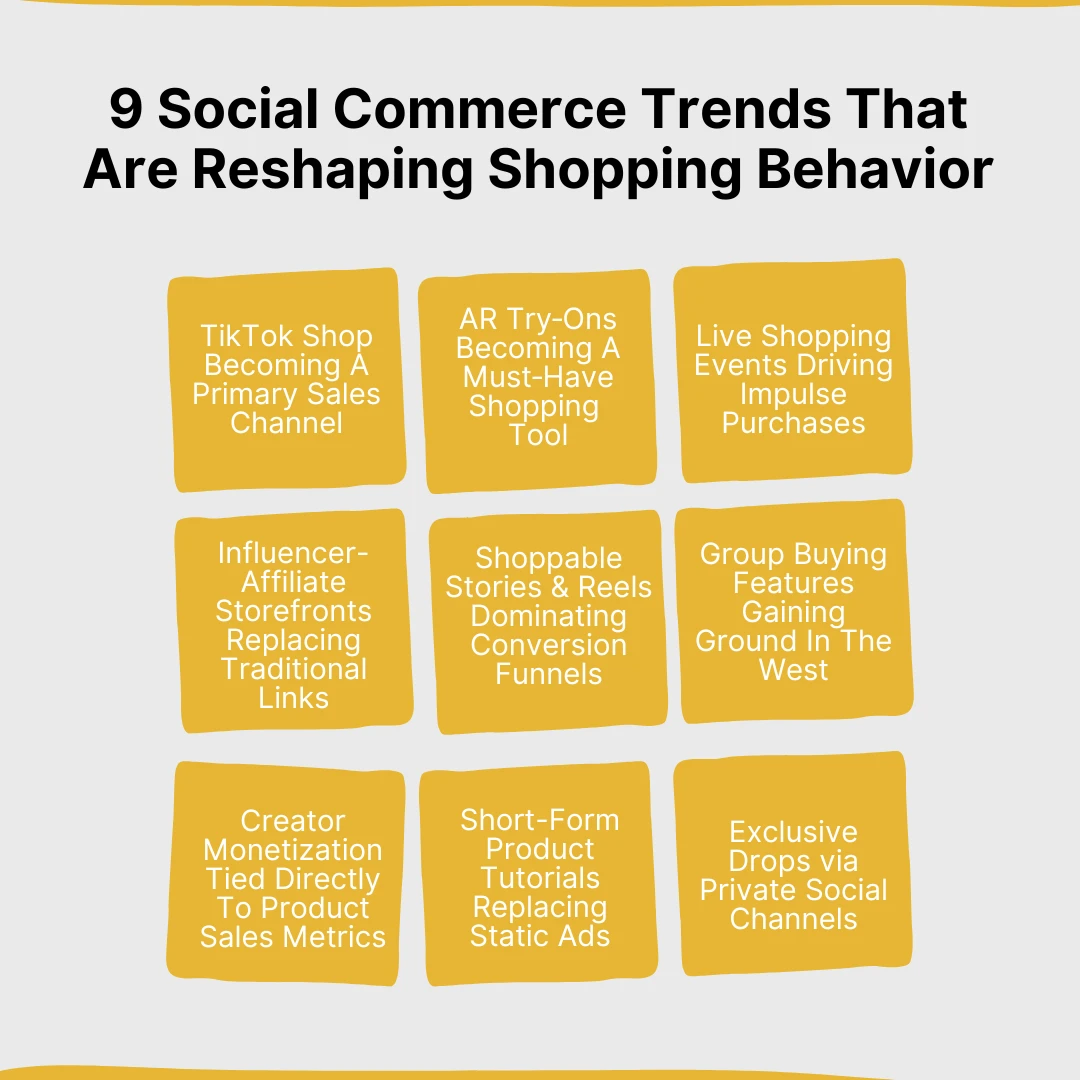
9 Top Social Commerce Trends Changing How Customers Buy Online
Social commerce isn’t some “emerging channel” anymore; it is the channel. If you are selling anything online, chances are people are finding it through a scroll or a story. Let’s break down 9 key trends taking over the global social commerce market right now.
1. TikTok Shop Becoming A Primary Sales Channel For DTC Brands
Let’s be blunt: if you are a direct-to-consumer (DTC) brand and you are not selling through TikTok Shop, you are handing easy wins to your competitors.
It is now the main sales channel for tons of DTC founders. Some are even skipping Shopify or Amazon at launch and going straight to TikTok because it puts everything in the middle of a story. And then it puts a Buy button right there.
It is built for discovery. Built for storytelling. Built to sell – fast.
Here are some quick numbers to give you an idea about the social media landscape:
- TikTok Shop has crossed $500M in monthly retail social commerce sales in the US alone.
- Over 15 million products are listed globally, making it one of the most popular social commerce platforms.
- Some indie brands are hitting their entire monthly targets from a single viral creator.
Real-World Example: Canvas Beauty Brand
Canvas Beauty is a haircare brand founded by Stormi Steele. What makes their TikTok Shop use interesting is how aggressively they leaned into creator-led selling instead of brand-led ads. Rather than pushing polished brand videos, Canvas Beauty allowed hundreds of TikTok creators to sell products directly through their own content using TikTok Shop links.
Most of the videos were basic bathroom demos or “this actually fixed my hair” clips. Canvas Beauty also structured TikTok Shop-exclusive bundles. These weren’t available on their website in the same way.
They also focused hard on TikTok Shop live sessions. Just real-time hair routines and Q&A about ingredients. When something sold out mid-live, it created urgency without forcing it.
2. Augmented Reality Try‑Ons Becoming A Must‑Have Shopping Tool
Online shoppers want to experience products before they buy. That is why AR (augmented reality) try‑on features inside social apps and filters are blowing up in social commerce.
Rather than guessing if a lipstick shade will look good or whether a chair fits your living room, people can try it on or visualize it right in the app before they buy. And no, this interactive shopping trend isn’t niche tech hype – it is pushing real social media purchases.
Here’s what is happening now:
- AR lets social media shoppers virtually try on makeup, glasses, or clothes in real time inside social apps.
- Beauty and fashion brands are putting interactive AR filters in Stories and Reels to boost sales.
- Furniture and home decorators use AR to show how products will actually look in your space before purchase.
Real-World Example: Warby Parker
Warby Parker’s AR try-on strategy inside social platforms is very deliberate. They focused on native AR lenses and camera-based try-ons promoted through Instagram and Snapchat. When someone saw a Story ad or Reel, they could immediately try frames using their front camera, without breaking the flow.
The key detail here is how they used AR as a decision filter, not a gimmick. The AR experience focused on scale and face fit. It didn’t over-style the visuals. It helped people quickly eliminate what didn’t work.
They also paired AR try-ons with social proof overlays. Popular frames had small callouts like “most tried this week” or “top-rated for wide faces,” which helped people decide while they were still in try-on mode.
3. Live Shopping Events Driving Impulse Purchases
This one is no longer just a “China thing.” Live-streamed shopping events are finally catching up outside Asia, and they are fueling one of the most interesting shopping behaviors: buying in the moment.
It is raw. It feels like FaceTiming a friend who is showing you what they just bought – and that is exactly why it works.
Creators go live on the best social commerce platforms, talk through a product, demo it, maybe offer a flash deal, and… online purchases start happening.
Some quick context:
- TikTok alone hosts thousands of live social shopping streams a day now.
- Meta’s quietly building out more live selling tools for creators on both Facebook and IG.
- And live eCommerce sales among consumers worldwide are expected to reach $67.8 billion by 2026.
Real-World Example: BlendJet
BlendJet is a portable blender brand. Their TikTok live sessions are energetic and intentionally imperfect. Someone blends smoothies on a kitchen counter. Someone else answers questions in the comments. Flavors get mixed live. Colors get swapped mid-demo.
The impulse factor comes from time-bound bonuses, not heavy discounts. BlendJet also uses comment-triggered demos. If enough people ask about frozen fruit or protein powder, they do it live on the spot. That keeps the audience engaged and pushes fence-sitters to buy because their specific concern just got answered.
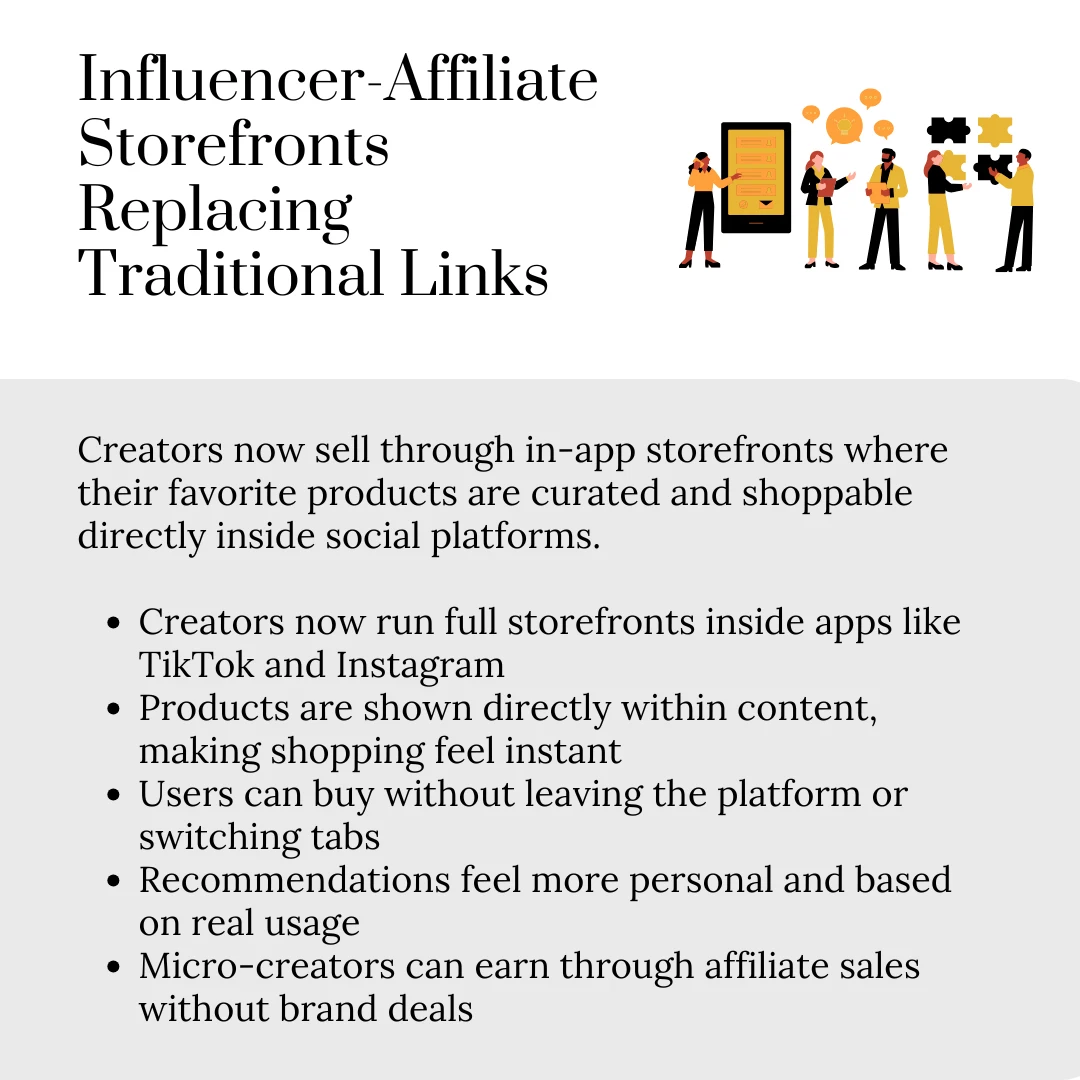
4. Influencer-Affiliate Storefronts Replacing Traditional Links
Creators used to beg you to “click the link in bio” for a 10% discount code. That type of influencer marketing is done.
Now, they have full storefronts inside the app – curated product shelves that look like their personal mini boutiques. Whether it is TikTok Shop or Instagram’s affiliate program, creators aren’t just linking stuff anymore. They are building stores.
What’s different here:
- The recommendations are more authentic. It is “this is what I actually use.”
- These storefronts are right where the content is. No jumping between tabs.
- TikTok’s Creator Affiliate Program even lets micro-creators earn without any brand deals. They just sell products that are already trending.
Real-World Example: Parade
Parade, the DTC underwear brand, leaned into influencer storefronts. They encouraged creators to build mini storefronts featuring their favorite Parade pieces and collections. These storefronts were located directly within TikTok Shop and Instagram’s affiliate ecosystem.
What made this effective is how the creators positioned them. Instead of “shop Parade,” it became “my everyday rotation” or “what I wear under work clothes.”
Parade also used storefront performance to decide which creators got early access to launches. High-performing storefronts got first drops, which pushed creators to optimize how they presented products.
5. Shoppable Stories & Reels Dominating Conversion Funnels
With evolving consumer behavior, nobody is clicking through carousel ads anymore. People are buying from Stories. From Reels. From short, full-screen videos that catch them in the middle of scrolling. These formats are now driving sales.
Stories – once seen as a quick update too – are now packed with product tags and native shopping buttons. No one is sending social media users to a landing page anymore. They are making the pitch and the sale right there – part of a global market shift that pushed social commerce spending to $1.2 trillion.
Here’s what has changed:
- Instagram Reels get more engagement than feed posts, and now they directly push to checkout.
- Meta’s internal data showed that Reels ads had a 2x higher click-through rate than traditional social media ads last year.
- TikTok and Instagram are both prioritizing shoppable video formats in their algorithms, which means more views and more conversions.
Real-World Example: Custom Sock Lab
Custom Sock Lab uses shoppable Stories and Reels as the final conversion push. Most of their Reels focus on the customization process. You see logos being stitched. Color palettes laid out. Packaging prepared. The product tag sits quietly in the corner the entire time.
What is smart is how they use Stories to capture intent. After someone watches a Reel, they see a Story sequence showing use cases – company merch, event giveaways, team kits. Each Story has a different tagged product option tied to that use case.
They also use Story highlights as evergreen sales funnels. “Bulk Orders,” “Events,” “Fast Turnaround.” Each highlight contains tagged products so people can buy without DMing or emailing.
6. Group Buying Features (Like WeChat) Gaining Ground In The West
This one is still early, but it is gaining serious traction. Group buying (aka social buying) has been huge in Asia for years, especially on platforms like WeChat and Pinduoduo.
The concept is simple – when shopping online, you get a discount if you buy together with friends. It is simple, and it taps directly into two core motivators: saving money and doing what your friends are doing.
Now we are starting to see Western platforms experiment with this model too.
Some signals:
- Facebook Marketplace quietly tested group buying options in select regions.
- TikTok has added team-purchase features in some of its Southeast Asia markets and is expected to roll them out more widely.
- Smaller platforms like Temu and Flip are already leaning hard into social discounts and invite-based pricing.
Real-World Example: Temu
Temu has made group buying casual. Instead of framing it as “group buying,” Temu positions it as “invite a friend to unlock your price.” What is important is that the discount is linked to participation, not volume. You don’t need 10 friends. Sometimes one is enough. That keeps friction low and completion rates high.
Temu also times group offers around trending products. If something starts getting traction organically, a group-buy option appears shortly after. That turns momentum into social pressure.
7. Creator Monetization Tied Directly To Product Sales Metrics
This is a big shift in social media marketing, and it is changing how creators think about content.
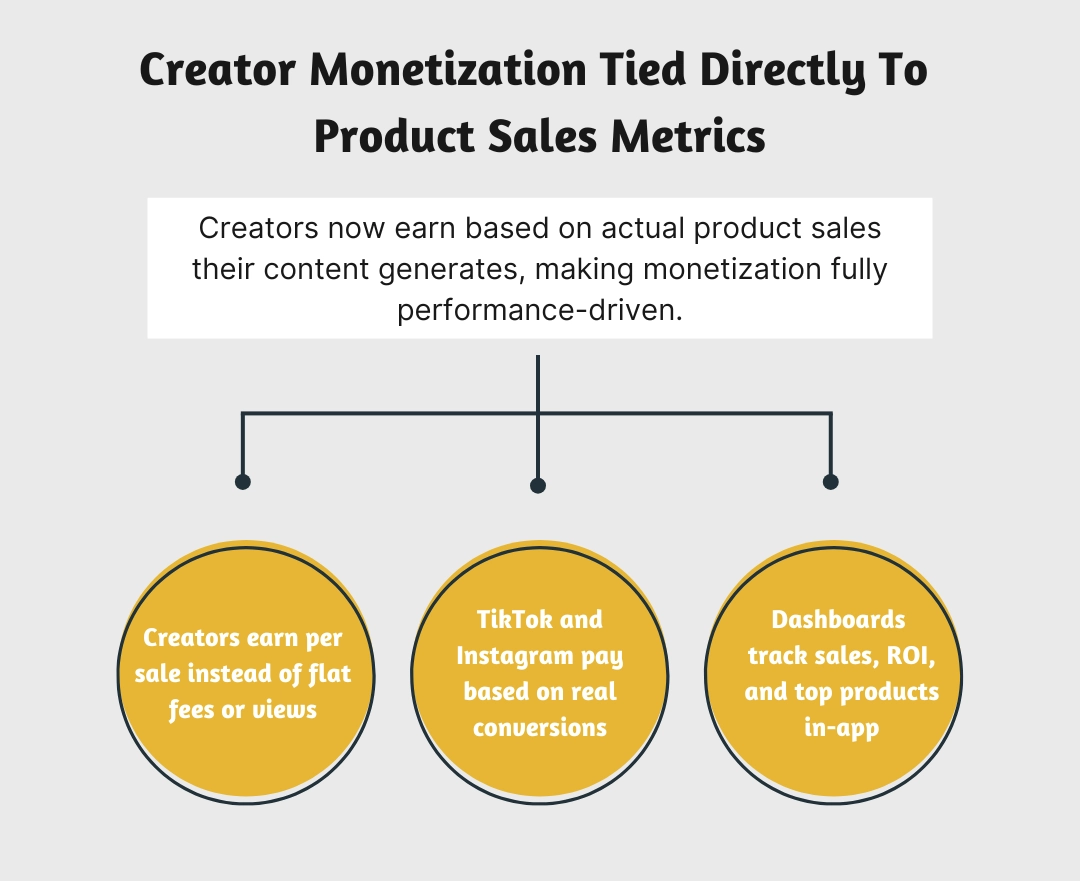
For years, monetization meant brand deals for flat rates or views-based payouts. But now, social platforms are tying creator earnings directly to how much product they move. If your post sells more, you earn more. It is that simple, and that performance-driven.
Here’s how this trend is showing up:
- TikTok’s Creator Affiliate Program rewards creators based on real-time product sales they generate.
- Instagram and Facebook are rolling out similar features where creators earn a commission per sale, not per post.
- Social media apps are building dashboards for creators to track conversions, best-sellers, and ROI – inside their content tools.
Real-World Example: Uproas
Uproas is a good example of how creator earnings are becoming tied to actual customer value instead of post-performance. The company rewards creators with 25% of subscription revenue from the customers they bring in, and those earnings continue for as long as the customer stays subscribed.
That changes the content strategy completely. A creator talking about Uproas agency ad accounts is focused on attracting media buyers and eCommerce operators who are likely to become paying subscribers.
The feedback cycle is much tighter. Uproas gives creators access to real-time tracking through Whop, so they can see exactly which referrals convert and which content leads to paying customers.
For example, a creator might compare agency ad accounts with standard ad accounts in one video. Another video might walk viewers through account stability and spending limits. If one topic consistently brings in more subscribers, the creator has a clear reason to make more content around it.
8. Short-Form Product Tutorials Replacing Static Social Media Advertising
Product photos are nice. But product demos are what actually convert.
Short-form tutorials – 15 to 45 seconds – are quickly becoming the dominant format for product discovery and decision-making. Even big e-Commerce brands are ditching studio shoots and going with lo-fi, UGC-style tutorials. Because that is what potential customers actually stop to watch.
Why it works:
- Tutorials build trust. They show the product in action.
- They don’t hit like targeted ads. They feel like someone is helping you solve a problem.
- They fit perfectly into Reels, TikToks, and Shorts, which is where the majority of consumer attention is right now.
Real-World Example: DialMyCalls
DialMyCalls shows how effective short-form tutorials can be when the goal is helping people understand a product quickly.
Many of their Shorts and Reels focus on one specific task at a time. One video shows how to send a mass text message. Another walks viewers through creating a contact list. Each tutorial stays focused on a single action.
And instead of talking about platform features in general terms, the tutorials show specific workflows from start to finish. Viewers watch a task being completed in real time. That creates confidence because they can picture themselves using the same process.
The style is much closer to user-generated content than traditional advertising. The videos rely on simple screen recordings and direct walkthroughs. A presenter shows exactly where to click and what happens next. Within a few seconds, viewers can see the product solving a real communication problem.
9. Brands Launching Exclusive Drops Via Private Social Channels
This is all about direct access. Not just who sees your product, but who is allowed to buy it.
More and more brands are now launching exclusive product drops through private or invite-only social media channels. It is a shift from public promotion to controlled distribution. Rather than pushing a drop to everyone, brands are creating tight and hype-driven social commerce spaces where the drop looks special. And that scarcity is intentional and powerful.
Some real-world signs this trend is picking up:
- Fashion brands and sneaker companies are using WhatsApp channels to announce timed drops directly to VIPs.
- Instagram Close Friends lists are being used for early access links and behind-the-scenes previews.
- Discord and Telegram are popular for product announcements and limited-quantity releases, especially in streetwear and beauty.
Real-World Example: Kith
Kith has turned private social channels into controlled launch environments. They use SMS, private email segments, and Instagram Close Friends to announce drops before anything goes public. Links expire quickly. Quantities are limited. And there is no reposting.
What is clever is how Kith builds anticipation. Teasers show up days before, but only inside private channels. They also stagger releases. Private channel first. Public later, if anything remains. That structure trains younger consumers to stay inside those private spaces.
5 Proven Strategies To Make The Most Of Social Commerce Trends
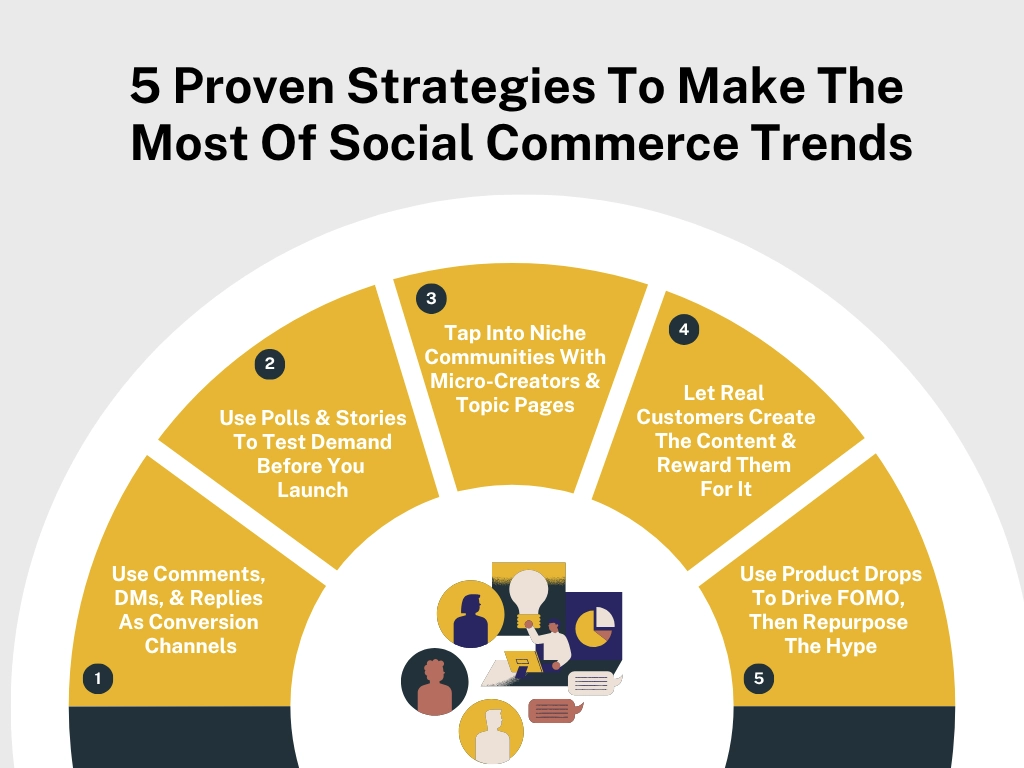
There are successful social commerce strategies that are working for many brands right now, and they all grow out of how social media usage is evolving. Let’s get into the good stuff.
1. Use Comments, DMs, & Replies As Conversion Channels
Here’s something nobody talks about enough: social commerce doesn’t stop at the post – it keeps going in the comments and private messages. Today, more social commerce purchases are starting in conversations than in the post itself.
What to do:
- Reply fast. Set up notifications or assign someone on your team to monitor comments and DMs in real time.
- Track response time so you know where conversations slow down and where buyers drop off. When teams can see how fast replies lead to conversions, the value of time tracking becomes clear.
- Pin high-intent questions and your answers – like “Is this good for oily skin?” – so others see them too.
- Save quick replies in Instagram and Facebook Shops for social commerce FAQs so you can respond quickly.
- Use reply-with-video (on TikTok) or DM replies (on IG) to turn product questions into short but personalized answers that also sell the product.
2. Use Polls & Stories To Test Demand Before You Launch
Interactive tools like polls, quizzes, emoji sliders, and question boxes aren’t just for customer engagement. They test interest before anything drops. That way, by the time something launches, people are already waiting to buy.
What to do:
- Use Instagram Stories to run polls, quizzes, or Q&As before you finalize a product or collection.
- Invite a small group of followers for moderated user testing. Listen to where they hesitate or get excited – it gives you clearer signals than poll taps alone.
- Post early concepts or product sketches and use emoji sliders to gauge hype.
- Create a simple countdown sticker for upcoming drops and see how many people turn on reminders.
- Screenshot and reshare the results. That social proof builds excitement before you even release anything.
3. Tap Into Niche Communities With Micro-Creators & Topic Pages
We are past the point where reach is everything. What is working now is hyper-targeted influence, especially from creators who own small but passionate followings in specific niches.
What to do:
- Find creators who talk about your category regularly, even if their target audience is small.
- Prioritize user engagement rate and comment quality over likes. Are followers asking questions? Tagging friends? Sharing the content?
- Let the creator pitch the product in their own voice. Give guidelines, not scripts.
- Ask for two versions of the content – one organic post and one you can turn into an ad or shop listing.
4. Let Real Customers Create The Content & Reward Them For It
The old way: you run an automated ad, and it may collect some user-generated content later.
The new way: your customers are the content team.
Right now, some of the highest-converting social commerce content is coming from regular buyers who just genuinely love a product and want to talk about it. And the smartest brands are using that energy of the global audience on purpose.
What to do:
- Set up an automated post-purchase email or DM asking buyers to share a photo or video using your product – with a reward.
- Repost that UGC in your Stories, product feeds, and shop tabs. Use it like a testimonial.
- Create a monthly theme (like “July glow-ups” or “Unboxing moments”) and feature real buyers who tag you.
- Use UGC clips in shoppable video content. Social commerce buyers trust content from other customers more than from brands.
5. Use Product Drops To Drive FOMO, Then Repurpose The Hype
This social media strategy works because it combines hype with long-term value. It is about turning the drop into ongoing social fuel.
What to do:
- Plan limited-time or limited-quantity drops with a clear backstory. Tell people why it is limited or what makes it special.
- Use social-first channels (email lists, IG Close Friends, SMS) to give early access.
- After the drop, turn the response into content – share screenshots of sold-out notifications or “I missed it!” comments to build anticipation for what is next.
- Ask buyers to tag you when their order arrives. Those unboxing moments become your next round of hype.
Conclusion
Let’s call a spade a spade – brands that don’t take social commerce trends seriously are already losing ground. So either your brand evolves with the evolving social commerce landscape, or you get filtered out, too. And remember, there is no waiting for the perfect strategy. The feed won’t wait. The customer won’t either. Aim to belong, not to “keep up.”
At Reliqus, we build eCommerce websites and digital marketing systems that help brands turn social commerce efforts into a convenient shopping journey and actual revenue.
Our team handles everything from eCommerce website development and UX design to SEO, social media marketing, content creation, and paid campaigns, so every part of your online presence works together toward the same goal: fostering brand loyalty and growth.
Get a free proposal from us, and we will show you exactly where you stand and what can be improved.

Burkhard Berger
He helps innovative B2B companies implement modern SEO strategies to scale their organic traffic to 1,000,000+ visitors per month. Curious about what your true traffic potential is?