
The best AI customer support agent depends on your existing helpdesk, customer communication channels and the types of requests you want to automate.
Intercom Fin is a strong overall choice for modern support teams, while Zendesk AI Agents suits businesses already using Zendesk. Salesforce Agentforce is built for Salesforce-based enterprises, Gorgias AI Agent specialises in ecommerce, and Retell AI focuses on phone support.
The most capable platforms go beyond answering frequently asked questions. They can access approved customer data, follow company procedures, perform actions, update connected systems and transfer complex cases to human representatives.
However, no AI agent should be deployed solely on the strength of a vendor demonstration. Support teams need to test answer accuracy, action completion, customer authentication, escalation and security before allowing an agent to handle live requests.
Best AI Customer Support Agents at a Glance
| AI customer support agent | Best for | Main channels | Pricing approach |
| Intercom Fin | Best overall for modern support teams | Chat, email, phone and supported integrations | Per successful outcome |
| Zendesk AI Agents | Businesses using Zendesk | Messaging, email, web forms and voice capabilities | Automated-resolution usage |
| Salesforce Agentforce | Salesforce-based enterprises | Digital service channels, CRM and contact-centre workflows | Credits, conversations or user licences |
| Ada | Multilingual enterprise support | Chat, email, voice, SMS, WhatsApp and social channels | Custom pricing |
| Decagon | Complex support workflows and testing | Chat, email and voice | Custom pricing |
| Sierra | Branded omnichannel enterprise support | Chat, SMS, WhatsApp, email and voice | Custom pricing |
| Forethought | Ticket automation and agent assistance | Helpdesk, chat, email and other support channels | Outcome-based or custom pricing |
| Freddy AI Agent | Freshdesk users and mid-market teams | Web, email and connected support channels | Platform subscription plus AI sessions |
| HubSpot Customer Agent | HubSpot CRM users | Live chat and email | HubSpot Credits |
| Gorgias AI Agent | Shopify and ecommerce brands | Email, chat and text-based channels | Per resolved interaction |
| Tidio Lyro | Small and medium businesses | Website chat and connected helpdesks | Plan- and usage-based |
| Jotform AI Agents | Form, appointment and intake workflows | Chat, voice, SMS, WhatsApp, email and social channels | Plan-based limits |
| Retell AI | Voice customer support | Phone and related messaging workflows | Per-minute usage |
Pricing and product information were reviewed on July 24, 2026. Software plans, usage allowances and features can change, so businesses should verify current terms directly with each provider before purchasing.
Our Top Recommendations
Best overall: Intercom Fin
Fin combines customer-facing automation, action-based procedures, testing tools, and support for businesses using either Intercom or selected external help desks.
Best for existing Zendesk teams: Zendesk AI Agents
Zendesk AI Agents are closely integrated with Zendesk ticketing, messaging and reporting, making them a logical option for teams that already manage support through the platform.
Best for Salesforce enterprises: Salesforce Agentforce
Agentforce can access Salesforce customer data, invoke approved workflows and transfer cases to human service representatives within the Salesforce environment.
Best for multilingual support: Ada
Ada supports customer service across multiple channels and 60 languages, making it suitable for international organisations with large support volumes.
Best for ecommerce: Gorgias AI Agent
Gorgias can use Shopify order, inventory, customer and product information to support both pre-purchase and post-purchase interactions.
Best for small businesses: Tidio Lyro
Lyro offers a comparatively accessible setup process and can learn from existing website and support content before transferring unsupported questions to a person.
Best for phone support: Retell AI
Retell AI is a voice-first platform for businesses that want an AI agent to answer calls, retrieve information, complete supported tasks and transfer callers.
How We Evaluated These Tools
Reliqus evaluated each platform using publicly available product information and official documentation. We considered:
- Ability to answer from approved knowledge sources
- Ability to perform actions in connected systems
- Chat, email, voice and messaging support
- Human escalation and conversation transfer
- CRM, helpdesk and ecommerce integrations
- Testing, monitoring and quality-assurance tools
- Multilingual capabilities
- Pricing transparency
- Suitability for different company sizes
- Data governance and security controls
Hands-on access varies significantly across this category. Some products offer public trials or self-service plans, while enterprise platforms may require a sales demonstration and implementation process.
Therefore, this article does not claim that Reliqus completed an identical benchmark test across all 13 products. Recommendations are based on documented capabilities, target users and product fit. Vendor-reported resolution rates and savings are not treated as guaranteed outcomes.
What Is an AI Customer Support Agent?
An AI customer support agent is a software system that communicates with customers and attempts to resolve service requests using approved business information, customer context and connected workflows.
A basic chatbot may answer a question or send a customer to a help article. A more capable AI agent may also:
- Identify what the customer is trying to accomplish
- Ask follow-up questions
- Retrieve order, account or subscription information
- Update records
- Process an approved return or cancellation
- Schedule an appointment
- Create or update a ticket
- Transfer the conversation to a human with context
Zendesk defines AI agents as autonomous systems that can understand complex requests, reason through multiple steps and execute actions across connected systems. Its AI agents currently support messaging, email, web forms and voice capabilities.
The ability to act is what separates many current AI agents from earlier scripted chatbots.
AI Agent vs Chatbot vs Copilot
These terms are often used interchangeably, but they describe different functions.
Customer service chatbot
A chatbot answers common questions, follows predefined flows or directs customers to relevant resources. Some modern chatbots use generative AI, but they may still have limited ability to complete tasks.
AI customer support agent
An AI agent attempts to resolve a request from beginning to end. It may access customer context, follow business rules, invoke authorised actions and determine when a human should take over.
Customer service copilot
A copilot assists a human support representative. It may summarise conversations, recommend responses, retrieve knowledge articles or suggest the next action.
Voice AI agent
A voice agent communicates with customers by telephone. It must handle speech recognition, interruptions, latency, call transfer, identity verification and background noise in addition to the normal challenges of text-based support.
Many platforms combine two or more of these functions.
The Best AI Customer Support Agents in 2026
1. Intercom Fin

Best for: Modern support teams wanting a capable agent with clear outcome-based pricing
Intercom Fin is an AI customer support agent that can operate within Intercom or alongside selected external help desks. It can answer customer questions, follow configured procedures, perform supported actions and transfer conversations to human representatives.
Fin’s current product includes tools for configuring agent behaviour, testing responses through simulations and analysing unsuccessful or escalated conversations. Businesses using another helpdesk can purchase Fin separately, although minimum commitments may apply.
Key features
- Support across email, chat, phone and connected channels
- Knowledge-based answers
- Configurable procedures
- Actions in external systems
- Simulated conversations for testing
- Performance insights
- Human handoffs
- External helpdesk integrations
Pricing
Intercom currently lists Fin at $0.99 per successful outcome. A resolution is generally counted when the customer does not request further help after Fin’s final answer. Other configured outcomes, such as a successful procedure handoff, may also be billable.
Outcome pricing can align cost with completed work, but teams should inspect exactly what the contract defines as a billable outcome.
Potential limitations
Fin may become expensive for businesses with very high support volume. The total cost also depends on whether the company uses Fin with Intercom’s helpdesk or connects it to another platform.
Its advertised resolution figures are based on Intercom’s own customer data and should not be assumed to apply to every business. Results depend heavily on knowledge quality, supported workflows and the complexity of customer requests.
Verdict
Fin is one of the strongest places to begin for teams that want a broadly capable customer agent without building a custom system. Its combination of knowledge management, procedures, testing and outcome-based pricing makes it suitable for both growing and established support operations.
2. Zendesk AI Agents
Best for: Businesses already using Zendesk for customer service
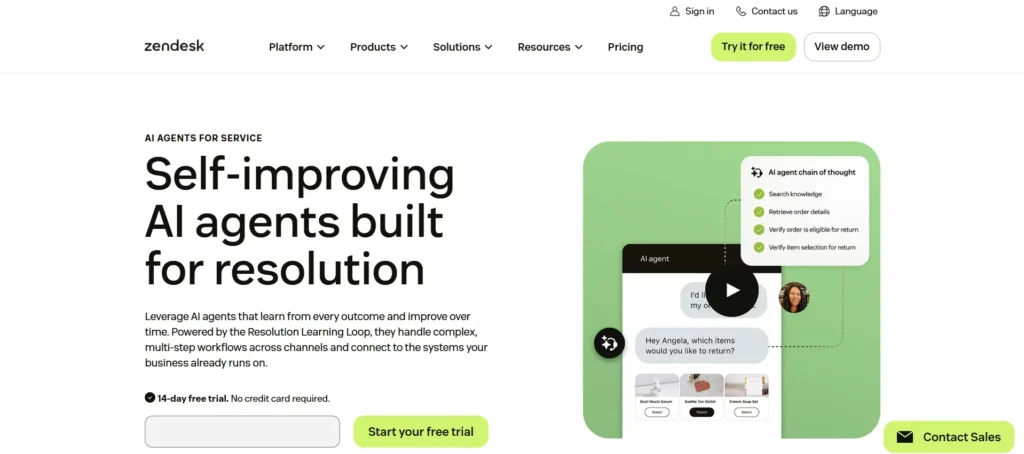
Zendesk AI Agents operate within Zendesk’s broader service platform. They can respond to requests, perform authorised actions and transfer unresolved cases to human representatives.
The platform supports customer interactions through messaging, email, API-connected forms and developing voice capabilities. Zendesk has also expanded its AI offering with more complex workflows and self-improving agent functionality.
Key features
- Native Zendesk ticket and conversation context
- Messaging and email automation
- Workflow execution
- Human handoffs
- Intent detection
- Reporting and resolution tracking
- Integration with Zendesk knowledge and service tools
- Agent-assistance features through Zendesk Copilot
Pricing
Zendesk measures AI agent usage through automated resolutions. An automated resolution generally occurs when the AI handles a customer request without escalating it to a human.
Zendesk introduced value-based resolution tiers in 2026, meaning automated resolutions may be grouped according to the type of value delivered. Businesses should review their allowance, tier definitions and possible overages before deployment.
Potential limitations
Zendesk is most compelling for organisations already invested in its service platform. Businesses using another helpdesk may need to perform migration or integration work.
Zendesk states that its agents can resolve up to 80% of customer interactions, but this is a vendor-reported upper figure rather than a result every customer should expect.
Verdict
Zendesk AI Agents are a practical choice for established Zendesk customers because the product integrates with existing tickets, knowledge, workflows, and agent processes.
3. Salesforce Agentforce for Service
Best for: Enterprises managing customer data and service workflows in Salesforce
Salesforce Agentforce allows organisations to build AI agents that use Salesforce data and approved business processes.
For customer service, an Agentforce agent can answer questions, access relevant customer records, update information, execute Salesforce flows and transfer conversations to service representatives. Salesforce positions its native connection with Service Cloud as a central advantage because customer context and agent actions remain within the Salesforce environment.
Key features
- Service Cloud integration
- CRM and customer-history access
- Salesforce Flow execution
- Case creation and updating
- Customer authentication options
- Digital-channel support
- Human-agent transfer
- Testing and monitoring tools
- Contact-centre and voice options
Pricing
Agentforce currently supports several pricing structures, including:
- Flex Credits
- Conversation-based consumption
- User-based licences
- Contact-centre add-ons
The appropriate model depends on whether the agent is customer-facing, employee-facing or integrated into a broader Salesforce deployment.
Potential limitations
Agentforce is a sophisticated enterprise system. Successful deployment may require Salesforce administration, clean CRM data, carefully designed workflows and implementation support.
Its pricing is also more complex than a single per-conversation fee.
Verdict
Agentforce is most suitable for enterprises that already rely on Salesforce and want AI-driven service automation grounded in CRM data, permissions, and workflows.
4. Ada
Best for: Multilingual enterprises operating across many customer channels
Ada provides an enterprise AI customer service platform covering voice, chat, email, messaging applications, SMS, in-app support, and social channels.
The platform uses a single reasoning layer across channels, enabling policies, procedures, and customer context to be applied more consistently. Ada also offers Playbooks for multistep processes and a Performance Center for monitoring and improving agent behaviour.
Key features
- Support for 60 languages
- Chat, email and voice automation
- WhatsApp, SMS and social messaging
- Multistep Playbooks
- Knowledge and policy controls
- Salesforce, Zendesk and Twilio connections
- APIs and software-development kits
- Performance monitoring
- Human handoffs
Pricing
Ada does not publish a simple standard subscription price. Access is generally consultation-led and suited to enterprise deployments.
Potential limitations
Ada may be unnecessarily complex for a small company that only needs a website FAQ agent.
Implementation quality depends on business systems, documented procedures, language requirements and the internal team responsible for ongoing improvement.
Verdict
Ada is a strong candidate for international organisations that need one support agent to operate across multiple channels and languages.
5. Decagon

Best for: Complex customer-service workflows requiring extensive testing and observability
Decagon provides AI agents across chat, email and voice. Its platform is designed for organisations that need agents to perform actions, maintain customer context and support more complex service processes.
A major differentiator is its focus on testing. Decagon offers simulated conversations, reasoning traceability, version management and experimentation tools that allow teams to test changes before and after release.
Key features
- Unified chat, email and voice
- Cross-channel customer context
- Connected-system actions
- Simulated customer conversations
- Step-by-step traceability
- Agent versioning
- A/B testing
- Performance analytics
- Workflow and policy controls
Pricing
Decagon uses custom enterprise pricing.
Potential limitations
Decagon is aimed primarily at companies with the resources to design, test, and manage an advanced customer service agent.
It may not suit a small business seeking a low-cost widget that can be installed in an afternoon.
Verdict
Decagon deserves consideration when testing, debugging, and continuous optimisation are as important as the initial automation capability.
6. Sierra

Best for: Enterprises wanting a highly branded omnichannel customer experience
Sierra allows businesses to deploy an AI agent across chat, SMS, WhatsApp, email and voice. The platform emphasises brand voice, customer memory, connected actions and a consistent experience across digital and telephone interactions.
Its current platform supports more than 50 languages and can expose different journeys, data and capabilities depending on the channel.
Key features
- Cross-channel support
- Voice AI
- Brand-voice controls
- Customer memory
- Action-based workflows
- Analytics and conversation exploration
- Human-agent assistance
- Multilingual support
- No-code and developer implementation options
Pricing
Sierra uses custom pricing based on the deployment.
Potential limitations
Sierra is primarily an enterprise product. Buyers may need a formal evaluation process to understand implementation requirements and total cost.
The breadth of its platform also means that its value will be greater for businesses that intend to automate substantial customer journeys rather than a narrow FAQ use case.
Verdict
Sierra is suitable for businesses that view the AI agent as a customer-facing extension of their brand rather than only a tool for reducing ticket volume.
7. Forethought
Best for: Ticket automation, routing, knowledge improvement and agent assistance
Forethought provides a multi-agent customer-service platform. Its tools cover customer-facing automation, ticket routing, human-agent assistance, quality assurance and support analytics.
The Solve agent handles customer issues, while Assist provides human representatives with suggested responses, summaries and relevant content inside the helpdesk. Discover analyses conversations to identify knowledge gaps and potential automation opportunities.
Key features
- Omnichannel AI support agent
- Ticket classification and routing
- Automated support workflows
- Human-agent assistance
- Conversation summaries
- Knowledge-gap detection
- AI quality assurance
- Helpdesk integrations
- Human escalation
Pricing
Forethought offers outcome-based and customised pricing, depending on the products and deployment.
Potential limitations
Forethought is best suited to organisations with a meaningful volume of tickets and historical support data.
Its own FAQ indicates that the platform performs most effectively with a substantial body of historical tickets and at least a few thousand monthly email or chat requests.
Verdict
Forethought is particularly useful for businesses that want to automate the complete support operation, including customer responses, ticket routing, knowledge improvement and human-agent productivity.
8. Freddy AI Agent by Freshworks
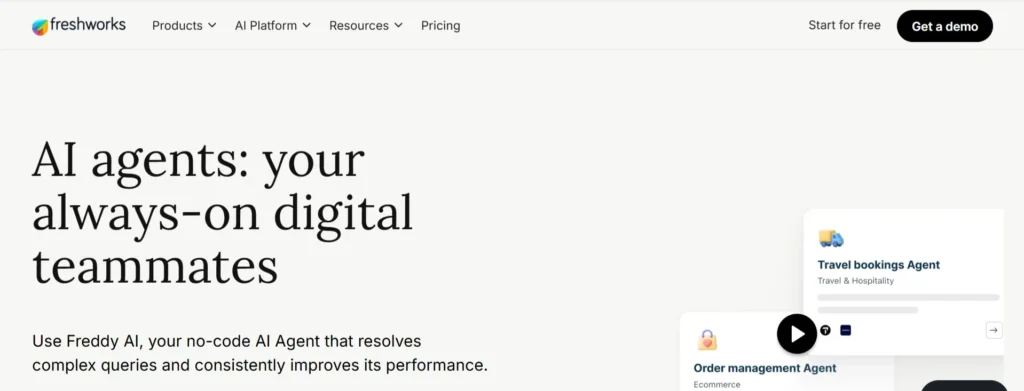
Best for: Freshdesk customers and mid-market teams wanting accessible AI automation
Freddy AI Agent is built into the Freshworks customer-service ecosystem. It can answer questions and connect with backend systems to perform actions such as processing refunds, updating orders, and changing subscription information.
Freshworks also distinguishes between Freddy AI Agent, which interacts directly with customers, and Freddy AI Copilot, which assists human service representatives.
Key features
- Freshdesk integration
- Knowledge-based answers
- Order and subscription actions
- Prebuilt vertical agents
- Custom agent creation
- Email automation
- Human handoffs
- AI performance monitoring
- Agent-assistance add-on
Pricing
Freshdesk’s current pricing includes an allowance of AI-agent sessions on selected plans. Additional sessions can be purchased in usage packages.
At the time of review, Freshworks listed the first 500 sessions as included on eligible plans and additional sessions at $49 per 100 sessions. These amounts may change.
Potential limitations
Freddy AI Agent offers the greatest advantage to businesses already using Freshdesk or another Freshworks product.
Businesses should carefully distinguish among the autonomous agent, the Copilot add-on, and other Freshworks AI features when estimating costs.
Verdict
Freddy AI Agent offers a relatively approachable entry point to action-based automation for Freshdesk customers and mid-market support teams.
9. HubSpot Customer Agent
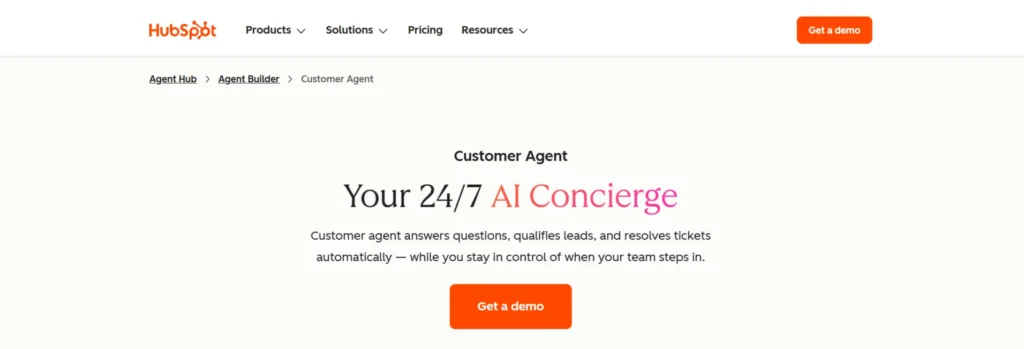
Best for: Businesses that manage customer conversations and CRM data in HubSpot
HubSpot’s Breeze Customer Agent can answer customer questions, qualify prospects, and resolve selected tickets using approved company content and CRM context.
The agent can currently be configured for live chat and email. It can use HubSpot brand-voice settings and be tested as though it were communicating with an existing CRM contact.
Key features
- HubSpot CRM context
- Live-chat support
- Email support
- Knowledge-based answers
- Lead qualification
- Meeting booking
- Ticket resolution
- Brand-voice controls
- Human escalation
Pricing
HubSpot Customer Agent uses HubSpot Credits. Professional and Enterprise editions include a monthly credit allocation, although usage requirements and credit rates may change.
Potential limitations
The credit model requires monitoring, particularly if customer volume fluctuates. The agent is most useful when a business already maintains its CRM, support content and customer communications within HubSpot.
Verdict
HubSpot Customer Agent is a logical choice for companies that want customer support, lead qualification and CRM context within one platform. If you’re already using HubSpot, our guide to the best AI tools that integrate with HubSpot explains which AI solutions work well alongside your CRM and support workflows.
10. Gorgias AI Agent
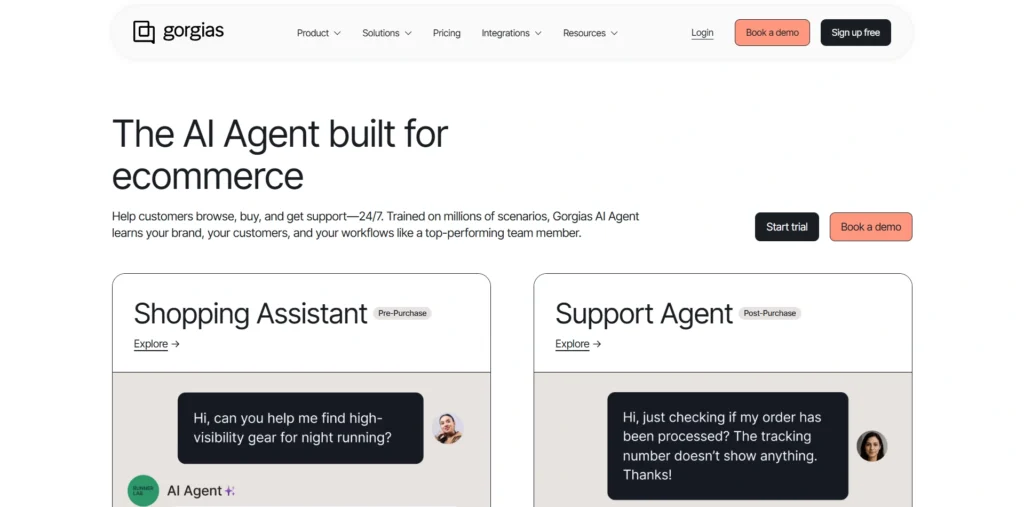
Best for: Shopify stores and ecommerce customer-service teams
Gorgias AI Agent is built specifically for ecommerce. It can use store information, product details, inventory, customer history and order data to answer pre-purchase and post-purchase questions.
The platform can assist shoppers with product selection and handle routine support requests, such as order tracking, returns, and frequently asked questions.
Key features
- Shopify integration
- Order and delivery information
- Return and cancellation workflows
- Product recommendations
- Discounts and upsells
- Email, chat, and text support
- Brand guidance
- Customer and inventory context
- Performance and conversion analytics
Pricing
Gorgias prices its AI Agent primarily based on the number of resolved interactions. Rates vary according to the selected plan, billing term and whether the business uses support-only or shopping-assistant functionality.
Potential limitations
Gorgias is deliberately specialised. A non-ecommerce company is unlikely to benefit from many of its strongest features.
Brands should also distinguish between customer-service outcomes and commercial outcomes when evaluating reported revenue or conversion improvements.
Verdict
Gorgias is one of the most relevant options for Shopify merchants that want an agent capable of supporting customers before and after a purchase. If you’re growing a Shopify store, you may also find our guide to the best Shopify apps for conversion growth useful for improving the overall customer experience.
11. Tidio Lyro
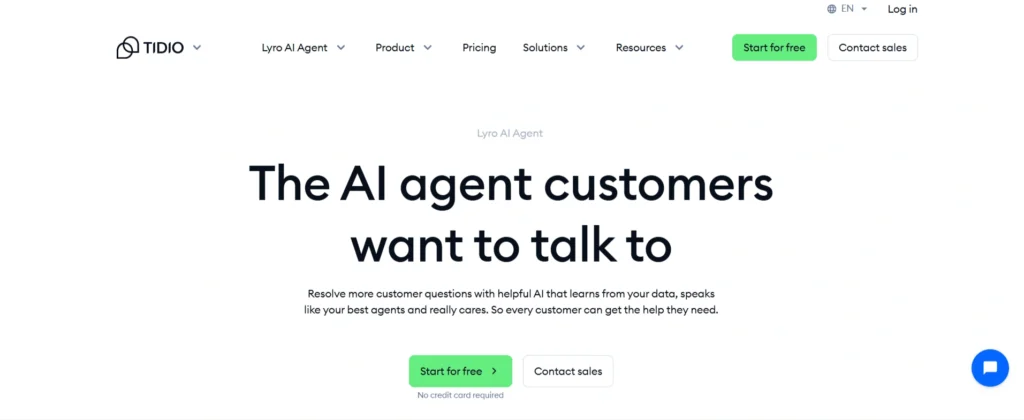
Best for: Small and medium businesses wanting a simpler starting point
Lyro is Tidio’s conversational AI customer-service agent. It can learn from existing website or help-centre content, respond to common questions and transfer unsupported requests to a human team.
Lyro can also connect with existing support platforms through Lyro Connect. Its current product supports customer interactions across more than 40 languages.
Key features
- Website-content ingestion
- Knowledge-based support
- Follow-up questions
- Image interpretation
- Human escalation
- Existing-helpdesk connections
- Action automation
- Multilingual conversations
- Small-business-focused setup
Pricing
Tidio offers plan- and usage-based access. Businesses should check the current allowance for Lyro conversations, available actions and connected channels.
Potential limitations
Lyro may not provide the same level of enterprise governance, workflow testing or cross-channel orchestration as platforms such as Ada, Decagon or Salesforce.
Tidio reports that customers automate an average of approximately 67% of inquiries, but this is a vendor figure rather than an expected result for every deployment.
Verdict
Lyro is a practical starting point for smaller companies that need more than a scripted chatbot but are not ready for a complex enterprise implementation.
12. Jotform AI Agents
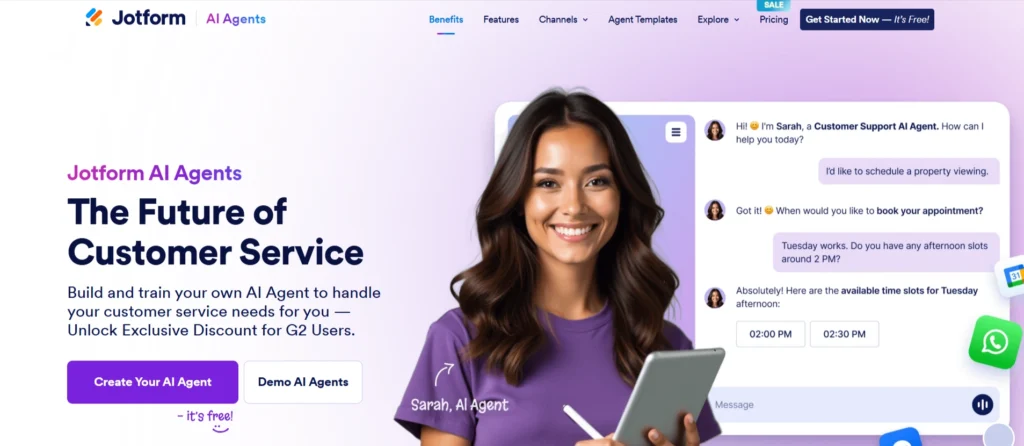
Best for: Guided intake, forms, appointments and task-specific service interactions
Jotform AI Agents can answer questions, collect information, complete forms, schedule appointments and guide customers through structured processes.
Agents can be deployed across chat, voice, SMS and other supported communication channels. Jotform also provides a large library of templates for industries and common business tasks.
Key features
- Forms converted into conversational agents
- Appointment scheduling
- Data collection
- Website chat
- Voice interactions
- SMS and messaging channels
- Agent personality and voice controls
- Conversation management
- Human escalation with context
Pricing
Jotform includes limited AI-agent usage in its Starter plan. At the time of review, the allowance included up to five agents, 100 monthly conversations and 50 minutes of monthly voice usage, among other limits.
Potential limitations
Jotform AI Agents are strongest for structured workflows such as intake, booking and form completion.
They should not be automatically treated as a complete substitute for an enterprise helpdesk that manages complex, long-running service cases.
Verdict
Jotform is an attractive option for businesses that want to turn forms and repeatable customer processes into conversational experiences without building an agent from scratch.
13. Retell AI
Best for: AI phone support and voice-first customer-service operations
Retell AI is a voice-agent platform for inbound and outbound telephone conversations. Businesses can build agents through a no-code dashboard or connect them through APIs.
A Retell agent can answer support questions, retrieve connected information, schedule appointments, perform supported actions, transfer calls and produce post-call data.
Key features
- Inbound and outbound calls
- Natural conversational voice
- Interruption handling
- Knowledge connections
- CRM and workflow integrations
- Appointment scheduling
- Call transfers
- Call summaries
- No-code builder and API access
- Usage-based pricing
Pricing
Retell lists usage-based pricing that generally ranges from approximately $0.07 to $0.31 per minute, depending on the models, voice services, telephony and additional features selected. Enterprise pricing is available for higher-volume or specialised deployments.
Potential limitations
Voice agents have operational challenges that do not exist in text support, including latency, accents, noisy environments, interruptions and authentication.
Per-minute costs can also become significant at high call volumes.
Verdict
Retell AI is best considered when telephone support is a central business requirement rather than an occasional secondary channel.
How AI Customer Support Agent Pricing Works
Comparing prices in this category is difficult because vendors charge for different units.
Per successful resolution or outcome
The business pays when the AI agent resolves a request without human intervention.
Used by platforms such as:
- Intercom Fin
- Zendesk
- Gorgias
This can align spending with value, but buyers must understand exactly what counts as a billable resolution.
Per conversation
The business pays when an agent completes or participates in a defined customer conversation.
The definition may be based on a time window, session or completed exchange.
Per AI session
The platform charges for each period of interaction between the customer and agent.
Freshworks uses an AI session model for select products and plans.
Per minute
Voice platforms commonly charge for every minute of telephone usage.
Additional costs may include:
- Speech recognition
- Text-to-speech models
- Language models
- Telephone numbers
- Carrier charges
- Call recording
- Concurrent-call capacity
Credit based
The platform assigns a credit value to AI actions or completed tasks.
Salesforce and HubSpot both offer forms of credit-based AI consumption.
Subscription plus usage
Some products require a helpdesk or platform subscription in addition to AI-agent usage charges.
When comparing quotes, calculate the estimated total monthly cost based on your actual:
- Conversation volume
- Resolution rate
- Call duration
- Seasonal peaks
- Human escalation rate
- Required integrations
- Platform licences
- Implementation support
How to Choose the Right AI Customer Support Agent
Start with your existing service stack
A native agent is often easier to implement when your organisation already uses the vendor’s CRM or helpdesk. Businesses using HubSpot may also benefit from combining customer support with AI-powered marketing automation. Explore our guide to AI marketing automation tools beyond HubSpot to see how support and marketing workflows can work together.
Examples include:
- Zendesk AI Agents for Zendesk
- Agentforce for Salesforce
- HubSpot Customer Agent for HubSpot
- Freddy AI Agent for Freshdesk
- Gorgias for Shopify-focused ecommerce support
Switching platforms solely to access an AI agent may create more work than connecting a compatible independent agent.
Identify the channels that matter
Do not pay for broad omnichannel support if customers only contact you through website chat and email.
Conversely, a website-only chatbot will not solve a support problem that is driven primarily by telephone calls or WhatsApp messages.
Separate answers from actions
Most tools can answer basic questions from a knowledge base.
Fewer can safely:
- Update an order
- Process a refund
- Cancel a subscription
- Verify identity
- Change an address
- Issue account credit
- Reschedule an appointment
Ask vendors to demonstrate the exact actions your team wants to automate.
Examine the human handoff
A successful handoff should transfer:
- Customer identity
- Conversation transcript
- Detected intent
- Actions already attempted
- Relevant account information
- Reason for escalation
The customer should not need to repeat the entire issue.
Review testing and monitoring tools
An AI agent will change as knowledge, integrations and underlying models change.
Look for:
- Pre-launch simulations
- Reusable test scenarios
- Failed-conversation analysis
- Response traceability
- Version control
- Quality scoring
- A/B testing
- Knowledge-gap reporting
- Rollback options
Evaluate security and permissions
An agent that can perform actions should not receive unlimited system access.
Use:
- Least-privilege permissions
- Customer authentication
- Approval requirements for sensitive actions
- Spending and refund limits
- Audit logs
- Data-retention controls
- Human escalation for high-risk cases
OWASP identifies prompt injection and excessive agency as important risks in LLM applications. Malicious or unusual customer input may attempt to override the agent’s instructions or cause the agent to perform an unauthorised action.
How to Implement an AI Customer Support Agent
1. Analyse current customer requests
Group tickets and conversations by:
- Topic
- Channel
- Volume
- Complexity
- Average handling time
- Escalation rate
- Required systems
- Business risk
Begin with frequent, low-risk requests.
2. Clean the knowledge base
Remove outdated, duplicated and conflicting information.
The AI agent cannot consistently provide correct answers when the business itself maintains multiple versions of the same policy.
3. Define the agent’s authority
Document what the agent may:
- Answer
- Change
- Approve
- Cancel
- Refund
- Escalate
Set clear financial, security and policy boundaries.
4. Connect only necessary systems
Give the agent access only to the information and actions required for the approved use cases.
Do not expose an entire CRM or internal database when the agent only needs order status and delivery information.
5. Build escalation rules
Escalation should be mandatory for issues involving:
- Account security
- Fraud
- Legal threats
- Vulnerable customers
- Large refunds
- Repeated failures
- Exceptions to policy
- Requests outside the agent’s authority
6. Test realistic conversations
Include:
- Clear questions
- Ambiguous requests
- Misspellings
- Angry customers
- Multiple questions in one message
- Conflicting information
- Attempts to bypass company policy
- Requests for another customer’s information
7. Launch a limited pilot
Start with a narrow channel, customer group or set of intents.
Review conversations daily before increasing the agent’s authority or traffic.
8. Measure resolution quality
Do not rely only on deflection.
Track:
- Correct resolution rate
- First-contact resolution
- Human escalation rate
- Repeat-contact rate
- Customer satisfaction
- Failed-action rate
- Unsupported-answer rate
- Average time to resolution
- Cost per successful resolution
9. Maintain human oversight
NIST’s AI Risk Management Framework recommends incorporating trustworthiness considerations throughout the design, deployment and evaluation of AI systems. For customer service, this means monitoring the agent post-launch rather than treating the implementation as a one-time software setup.
As AI support becomes part of day-to-day operations, many businesses also connect customer service with project management, internal communication and workflow automation. Our guide to building an AI-powered agency operating system using ClickUp, Slack and AI workflows shows how support teams can streamline internal processes alongside customer-facing automation.
Risks and Limitations of AI Customer Support Agents
Incorrect or invented answers
An agent may provide a plausible answer that is not supported by company policy or connected data.
Ground responses in approved sources and require escalation when evidence is insufficient.
Outdated knowledge
Old return policies, prices, or product instructions can lead to incorrect resolutions.
Assign responsibility for reviewing and updating every knowledge source.
Poorly controlled actions
An agent who can update accounts or issue refunds creates more value but also more risk.
Sensitive actions should require authentication, be subject to limits, and maintain audit records.
Prompt injection
A customer may attempt to persuade the agent to ignore instructions, reveal hidden information or perform an unauthorised action.
Prompt-injection testing should be part of deployment and ongoing quality assurance.
Privacy and data use
Customer conversations may contain contact details, payment issues, health information or other sensitive data.
Businesses should understand:
- What data the vendor stores
- How long it is retained
- Whether it is used for model training
- Which subprocessors receive it
- Where it is processed
- How deletion requests are handled
The FTC has warned AI providers to uphold their privacy and confidentiality commitments when customer data is used in AI systems.
Weak human escalation
Automation becomes frustrating when a customer cannot reach a person.
Provide a clear path to human assistance, particularly when the agent fails repeatedly or the customer explicitly requests a representative.
Unpredictable costs
Usage-based pricing can produce unexpected bills during seasonal peaks, incidents or product launches.
Model low, expected and high-volume scenarios before signing a long-term agreement.
Final Verdict
There is no single best AI customer support agent for every company.
Intercom Fin is a strong overall choice for modern support teams. Zendesk AI Agents are well suited to existing Zendesk environments, while Salesforce Agentforce is designed for enterprises that rely on Salesforce data and workflows.
Ada, Decagon and Sierra offer advanced enterprise capabilities for multilingual, omnichannel or complex support operations. Gorgias AI Agent is particularly relevant to ecommerce brands, while Tidio, Lyro and Jotform AI Agents provide more accessible starting points for smaller or workflow-specific deployments. Retell AI is the clearest specialist option when customer service happens primarily by phone.
The right choice should be based on more than a product demonstration.
Before purchasing, test whether the agent can:
- Answer accurately from your real knowledge sources.
- Complete the actions your customers request.
- Authenticate users before accessing sensitive information.
- Escalate cases with complete context.
- Resist attempts to override its instructions.
- Produce clear reports on failed and successful resolutions.
- Deliver predictable value at your actual support volume.
The best AI customer support agent is not necessarily the product with the highest advertised automation rate.
It is the product that can accurately, safely, and sustainably resolve your customers’ real problems.
Frequently Asked Questions
What is the best AI customer support agent?
Intercom Fin is one of the strongest overall options for modern support teams because it combines knowledge-based answers, workflows, testing, actions, and support for external help desks. Zendesk AI Agents are often the best fit for businesses already using Zendesk, while Salesforce Agentforce is designed for Salesforce-based enterprises. Gorgias focuses on ecommerce, and Retell AI specializes in AI voice support.
What is the difference between an AI agent and a chatbot?
A chatbot typically answers questions or follows predefined conversation flows. An AI agent can reason through multi-step requests, access approved business data, perform actions, and determine when to escalate a conversation to a human representative. Because vendors use these terms differently, it’s important to evaluate each platform’s capabilities rather than relying on the label alone.
Can AI agents resolve customer support tickets?
Yes. AI agents can answer customer questions, perform supported actions, and update or close tickets automatically. The quality of ticket resolution depends on the knowledge base, integrations, permissions, and escalation rules configured by the business.
Can an AI agent process refunds or cancellations?
Some AI customer support agents can process refunds, cancellations, and order changes when connected to the necessary business systems. These actions should always be protected by identity verification, company policies, spending limits, and audit logging.
Can AI agents answer customer phone calls?
Yes. Platforms such as Retell AI, Sierra, Ada, and some enterprise help desk solutions offer AI voice agent capabilities. Voice deployments require additional testing to ensure reliable performance, including latency, interruptions, accents, background noise, and call transfers.
Can an AI agent replace a customer service team?
AI agents can automate repetitive and well-defined support requests, but they are unlikely to replace human customer service teams entirely. Human representatives remain essential for complex issues, sensitive situations, relationship management, and decisions that require judgment.
Which AI customer support agent is best for Shopify?
Gorgias AI Agent is one of the strongest options for Shopify stores because it integrates with ecommerce data, including orders, inventory, customers, and products. Other AI support platforms also integrate with Shopify, so the right choice depends on your existing help desk and workflow requirements.
Which AI customer support agent is best for small businesses?
Tidio Lyro and Jotform AI Agents are both accessible options for small businesses. Lyro is well suited for website support and common customer questions, while Jotform AI Agents are better for forms, appointment scheduling, and structured customer intake.
Are there free AI customer support agents?
Some AI customer support platforms offer free plans, limited usage allowances, or time-limited trials. Keep in mind that some directories classify products as “free” simply because they offer a free trial rather than a permanently free plan. Before choosing a platform, verify the conversation limits, voice-minute allowances, watermarks, available integrations, and any commercial-use restrictions.
How much does an AI customer support agent cost?
Pricing varies by vendor and may be based on successful resolutions, conversations, sessions, voice minutes, AI credits, human agent seats, platform subscriptions, or custom enterprise agreements. When comparing platforms, calculate the total monthly cost based on your expected support volume rather than focusing solely on the advertised starting price.
Are AI customer support agents secure?
AI customer support agents can be deployed securely, but overall security depends on the vendor, integrations, configuration, and operational controls. Before granting an AI agent access to customer systems, review its access permissions, encryption, authentication methods, data retention policies, audit logs, subprocessors, and incident response procedures.