Plenty of store owners work on a few eCommerce SEO strategies, publish some product pages, then sit baffled when the organic traffic never comes. Ranking a store is nothing like ranking a blog. You have thousands of pages and buyers at different stages. Do it right, and you get traffic that turns into real revenue – not vanity visits.
And that is exactly what we are going to help you with. We will show you how an eCommerce SEO strategy differs from normal SEO, then the payoffs that matter. After that, the 10 strategies that actually print organic sales, plus the three mistakes bleeding your traffic dry.
What Is An eCommerce SEO Strategy?
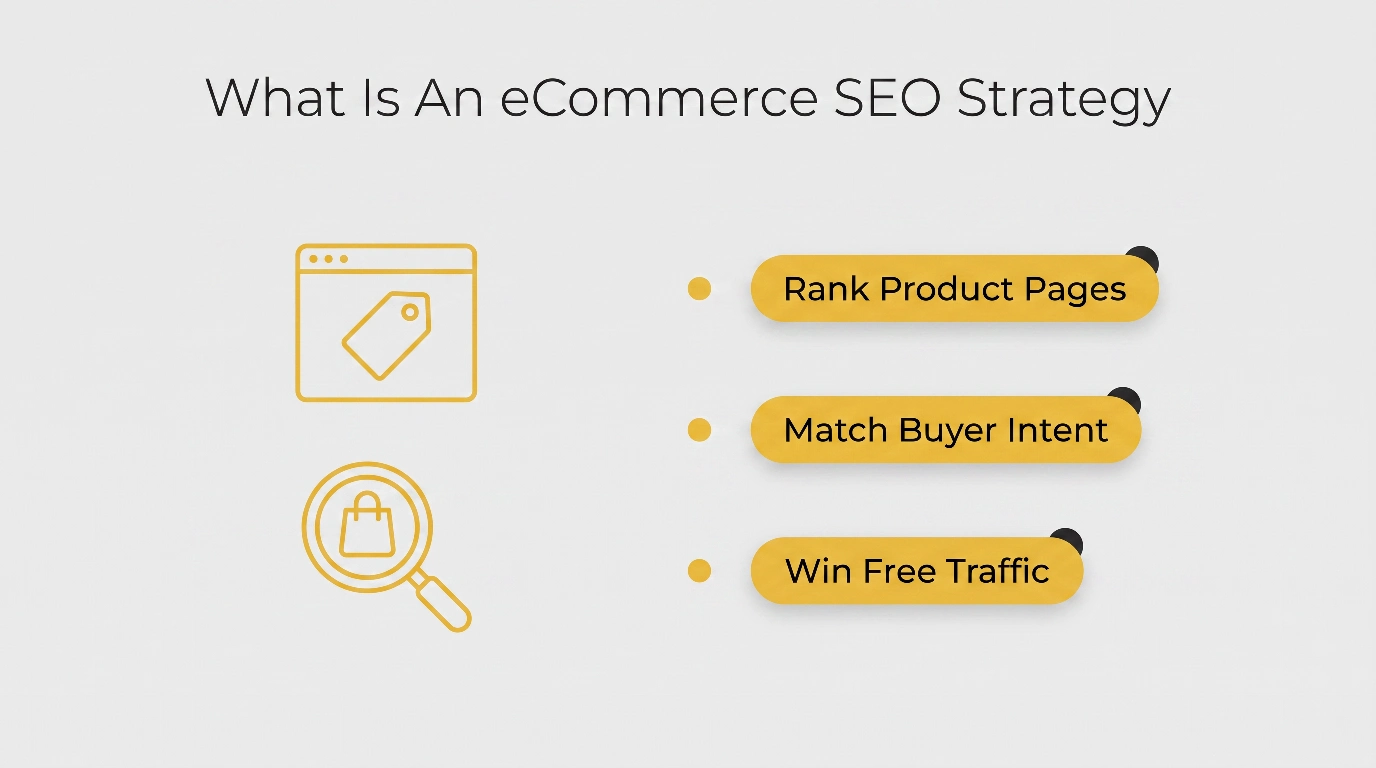
An eCommerce search engine optimization strategy is just your plan for getting product and category pages to show up when people search to buy. It is not about chasing one magic keyword. It is about making hundreds of pages easy to find and genuinely worth the click, so free traffic keeps arriving on pages built to sell.
What makes it its own beast is scale and intent. A blog wants readers. A store wants buyers with a card in hand. So instead of publishing endless articles, you are handling commercial pages and a tidy structure, plus the technical SEO that holds it all together.
A store might have 5,000 URLs, whereas a blog has 50. That scale is the whole opportunity… and the whole trap. Get the system right, and traffic picks up. Get it wrong, and thousands of weak pages bring your entire domain down with them.
eCommerce SEO vs Traditional SEO: Understanding The Key Differences
Doing SEO for a store is a genuinely different sport. Here’s where the two split on the things that count.
| Factors | eCommerce SEO | Traditional SEO |
| Primary pages | Product and category pages | Blog posts and info pages |
| Search intent | Mostly transactional, ready to buy | Mostly informational |
| Page volume | Thousands, many near-identical | Dozens of unique articles |
| Biggest technical risk | Duplicate and thin pages | Fewer duplication issues |
| Structured data | Product and review schema | Article and FAQ schema |
| Main success metric | Organic revenue and sales | Traffic and engagement |
| Content challenge | Unique copy for similar products | Original standalone articles |
| Ongoing work | New SKUs and stock changes | Periodic content updates |
What eCommerce SEO Strategies Can Do For Your Store: 4 Benefits
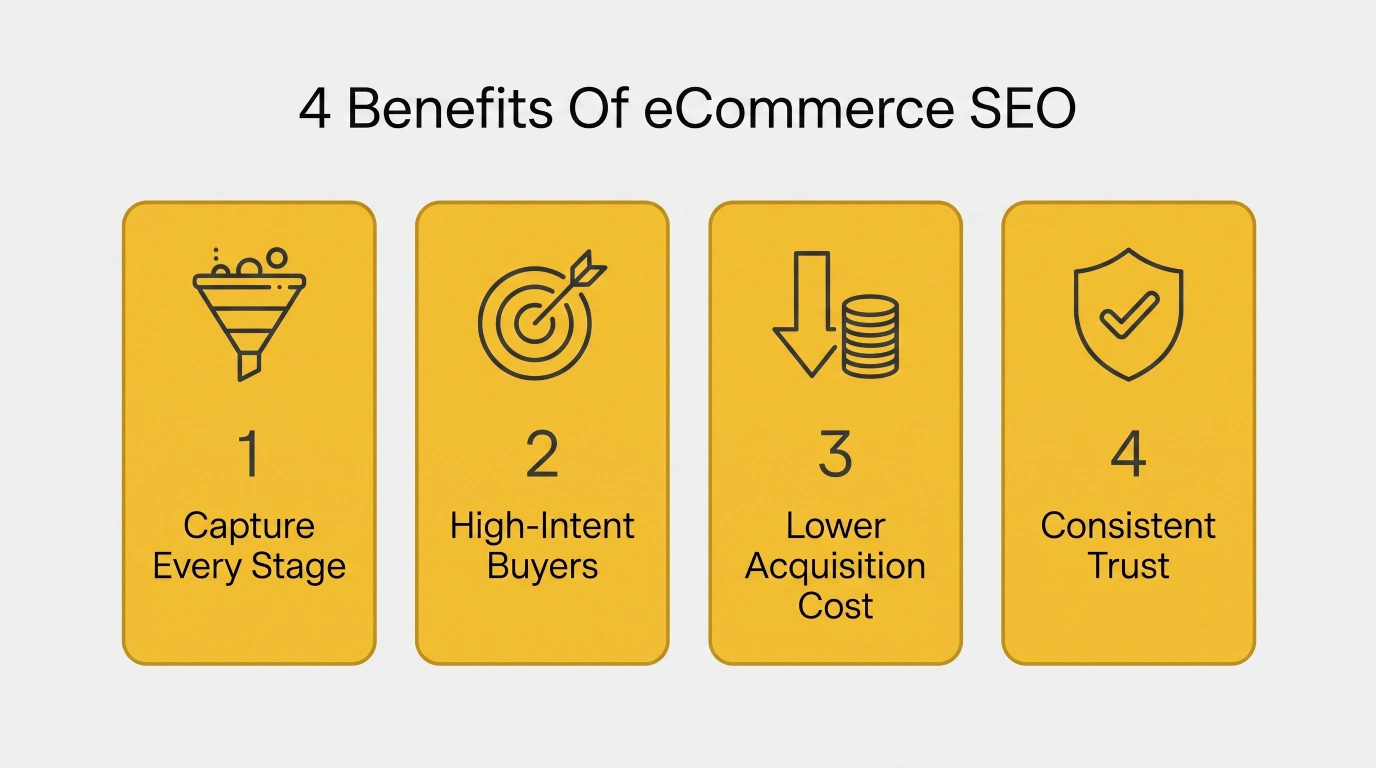
Before we get into the how, let’s talk about why any of this is worth your weekend. Four payoffs, and they all get bigger the longer you keep at it.
1. Capture Demand At Every Stage Of The Buying Journey
Nobody goes from “never heard of you” to “take my money” in a single search. People poke around, compare, then eventually buy. SEO lets you be there for all of it, with the right page for each moment. Paid ads mostly show up at the finish line. Organic walks the whole route, so you feel familiar with it by the time you are ready.
2. Bring In High-Intent Buyers Who Are Ready To Purchase
Some search traffic is basically gold: the potential customers typing the exact thing they want to buy. That is the crowd eCommerce SEO is built to win. And they convert way harder than social or display because the intent is obvious from what they typed. Organic still pulls 23.56% of all eCommerce traffic, much of it ready to check out.
3. Reduce Customer Acquisition Costs Over Time
Ads are a meter that never stops running. The second you stop paying, the traffic dies. Organic works the other way around. You do the work once, and a ranking page keeps sending buyers for months or even years without charging you per click. As that free traffic grows, your average cost to win a customer keeps sliding down.
4. Strengthen Trust Through Consistent Search Presence
There is something powerful about showing up over and over in search. When someone sees you rank for their problem, then again for the actual product, you stop being a random store and start being the name they trust. No single ad can buy that. And the store people trust is the one that gets both the click and the sale.
10 eCommerce SEO Strategies That Generate Consistent Organic Sales
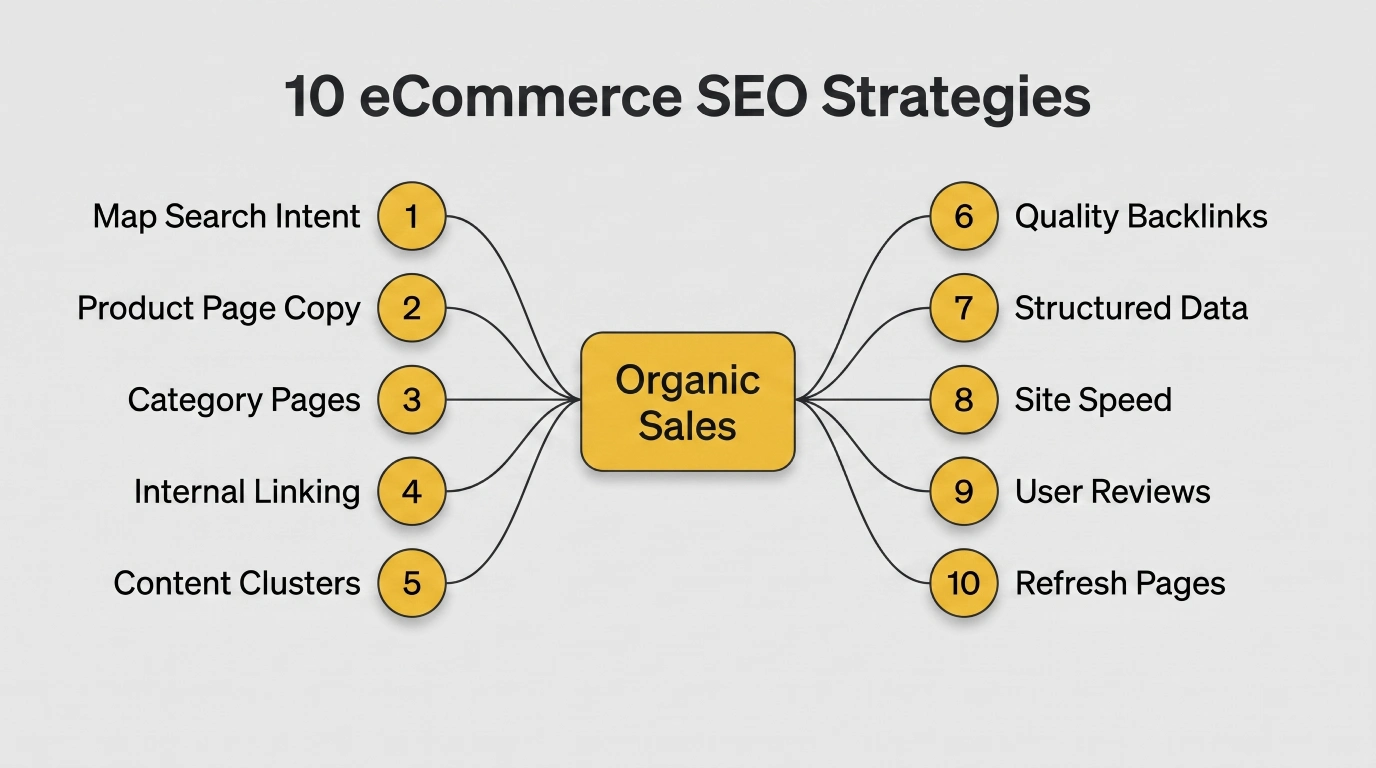
Alright, the main event. These 10 e-Commerce SEO strategies are what separate stores pulling six figures from organic and stores that never do. Each does its own job, so start with whichever one your eCommerce website is fumbling with the most.
1. Map Commercial Search Intent To Product And Category Pages
Aiming the wrong page at the wrong search is the fastest way to waste your SEO effort. Someone Googling “buy running shoes” wants to see a category full of options, not your 800-word blog post on running form. Search engines like Google just skip you when the web page doesn’t match what they meant, and any traffic that does come in bounces right off.
Do this properly with keyword research tools, and every other tactic on the list suddenly works harder. Ignore it, and you will waste hours on pages that were never going to sell, no matter how pretty you make them.
- Sort every keyword by intent before you decide which page should target it
- Send buy-now searches for commercial keywords to category and product pages, never to blog posts
- Give each primary keyword one home page so two never fight each other
- Google the term yourself first and see which page types already rank
2. Build SEO-Driven Product Pages With Unique Conversion Copy
Most product pages flop for two reasons. They paste the manufacturer’s description everyone else uses, so Google shrugs at the duplicate content. And they read like a spec sheet, so shoppers feel nothing and bounce.
That is why how you position and present the product matters as much as any keyword you add. Get the basics of on-page SEO right, and you help shoppers make a decision.
- Rewrite every product description in your own voice, not the maker’s boilerplate
- Lead with the benefit and who it is for, then get to the specs
- Write a unique title tag and meta description for every single product
- Answer the questions buyers always ask before purchase, right there on the page
3. Create Search-Optimized Category Pages That Capture Broad Demand
Category pages are the most slept-on asset in eCommerce SEO. They can rank for the big, fat head terms like “women’s trail shoes” that no single product will ever win, and they sit one click from checkout. But leave one as a bare wall of products with no words on it, and you have handed Google nothing to chew on.
- Add a genuine paragraph or two of real copy above the product grid
- Put the category’s head term in the H1 and the title tag
- Link out to your best sellers and closest subcategories from the page
- Point canonicals from filtered versions to the main category page you want indexed
The best way to see what a category page should do is to look at a page built around one buying query, even outside retail. A local HVAC company, of all things, does it really well.
Look at this page for AC installation services in Suwanee, GA. It doesn’t hide “AC install” inside some generic services page. The whole page is aimed at one search, headline and all: “Air Conditioning Installation in Suwanee, GA.” That is the exact-match head term, the same way your category H1 should just say “women’s trail shoes” and own it.
Then it actually helps the searcher. It lists the AC types and brands they fit, walks through the install process, and drops a BTU sizing rule right into the FAQ. That is the supporting copy a category page is almost always missing above its grid of products.
So that is the strategy for your own category pages. One clear head term in the H1 + real copy that helps someone actually decide + links out to your best products. Do that, and a category page starts hauling in the broad and high-volume searches your individual products can’t touch.
4. Implement Internal Linking That Pushes Authority To Revenue Pages
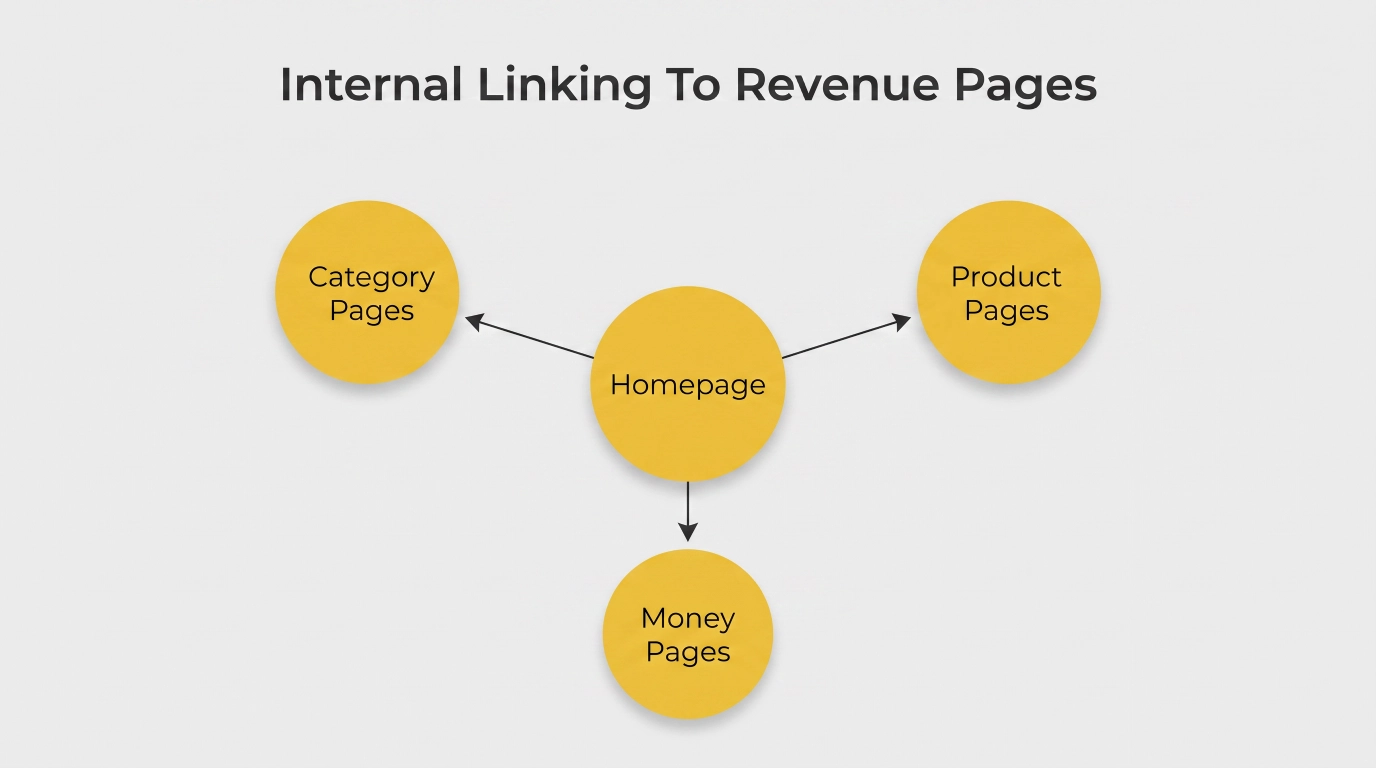
Every page you own carries a bit of ranking juice, and internal links decide where it ends up. Trouble is, most eCommerce stores let it all puddle on the homepage and the blog, while the product and category pages that pay the bills sit there starving. So your fluffy content ranks and your money pages don’t.
The fix costs nothing and usually lifts rankings you already have within a few weeks, no new content required. Link authority is the easiest win most online stores completely ignore.
- Link down from your strongest blog posts to the products they mention
- Write anchor text that names the target page’s keyword instead of “click here”
- Add related-product and related-category links to move ranking equity across the whole catalog
- Keep your key money pages within three clicks of the homepage, tops
5. Capture Long-Tail Keyword Traffic With Product-Led Content Clusters
Not everyone is ready to buy right away. Loads of searches are questions and comparisons, or “best X for Y” stuff your product pages can’t answer. Ignore those, and you are gifting that traffic to competitors and review blogs. Content clusters let you catch them first and keep them warm until they are ready to buy, then send them to the right product.
- Build a tight cluster of related guides around one core buying topic
- Link every supporting guide back to the money product or category page
- Use a keyword tool to find the comparison and question terms your product pages will never rank for
- Capture readers who aren’t ready to buy with a simple lead-capture form.
6. Earn High-Quality Backlinks From Relevant Sources
Google still counts links like votes. For competitive product terms, whoever has the stronger and more relevant links usually takes the top spot. The problem is that most eCommerce link building is spammy garbage that does nothing, or worse, earns you a penalty. A few real links from places your buyers read will beat a thousand junk directory listings.
- Publish original data or research that writers in your space want to cite
- Get honest reviews from creators and blogs your buyers already follow closely
- Find unlinked mentions of your brand online and ask them to link
- Aim some links at category pages, not just the homepage every time
7. Use Structured Data To Enhance Product Visibility In SERPs
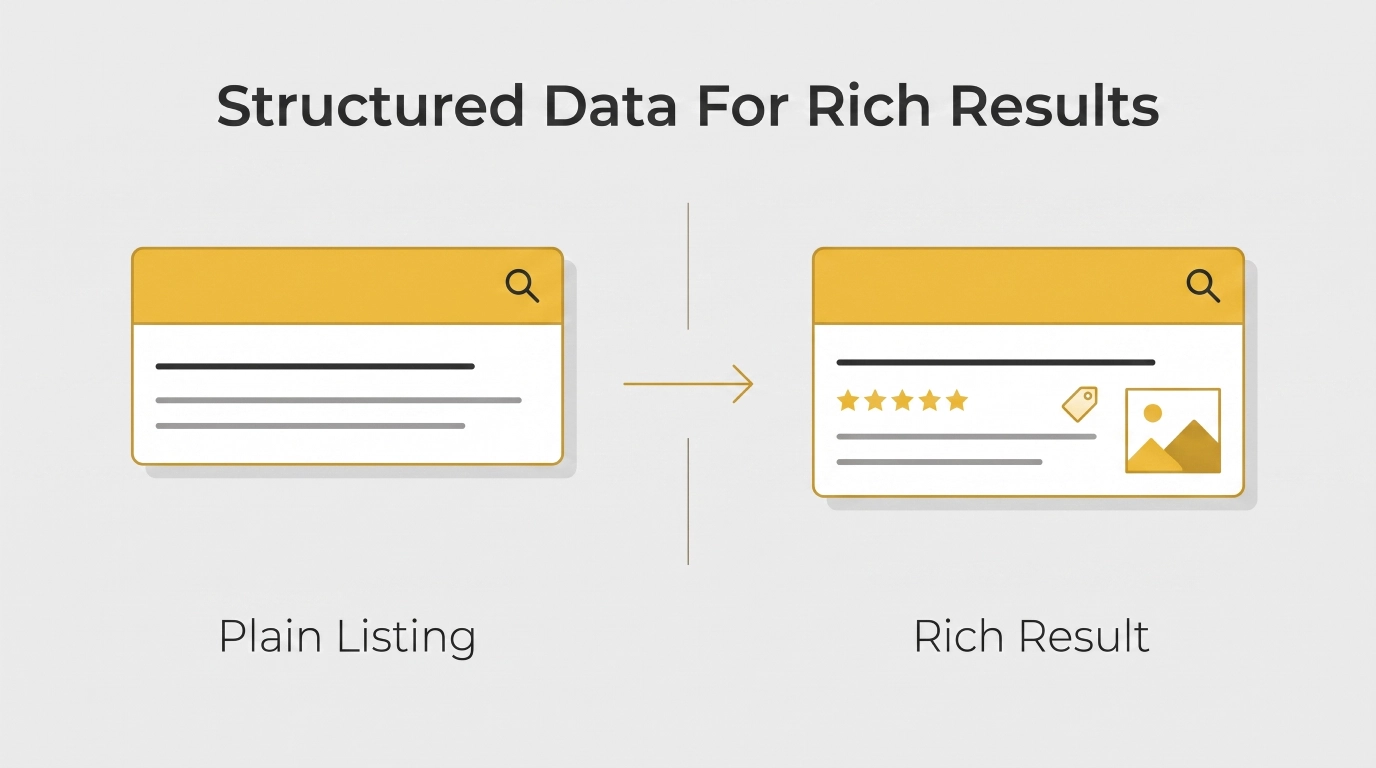
Structured data is basically you spelling out your page details so Google can build a fancier listing, the kind with star ratings and prices sitting right in the Google search results.
Two pages can rank in the same spot on search engine result pages (SERP) and look totally different when one has five gold stars and the other is a plain blue link. On a packed results page, those stars are usually what wins the click.
In fact, pages using schema markup get 20-40% higher click-through rates than plain ones, which, across a big catalog adds up to a mountain of free clicks.
- Add Product schema with live pricing and stock status to every product
- Mark up your reviews so the star ratings show up in results
- Run every markup through Google’s Rich Results Test before it goes live
- Add breadcrumb schema so your category path appears inside the listing itself
8. Optimize For Site Speed & Core Web Vitals On Storefront Pages
For an eCommerce site, page speed isn’t a nice extra. It is money. Product and category pages are heavy, stuffed with images and scripts, so they are the exact pages most likely to drag. A sluggish storefront costs you search engine rankings and sales at the same time, because Google scores page experience and shoppers have zero patience.
And the drop-off is savage. Yottaa’s 2025 index clocked 63% of visitors bouncing once a page pushes past four seconds. That is why site speed matters for SEO and UX, especially on product and category pages where every extra second can cost you both rankings and sales.
- Compress and lazy-load product images so they don’t block the first paint
- Cut the third-party scripts and apps that drag every page load down
- Stay quick with steady, hands-on performance upkeep running behind it
- Fix whatever Core Web Vitals Search Console flags, starting with your templates
9. Leverage User-Generated Content To Expand Coverage Of Relevant Keywords
Your customers describe products in the exact words other shoppers type into Google, and most e-Commerce sites just throw that gift in the bin. Reviews and buyer questions add fresh and one-of-a-kind content to your product pages without you lifting a finger. And they are full of long-tail phrases you would never dream up yourself.
Better yet, every new review keeps the page looking alive to Google. It is keyword growth that basically runs itself.
- Add a review system that drops real customer words onto every page
- Turn on a Q&A section to capture the exact phrasing buyers use
- Ask happy customers for detailed reviews with a short post-purchase email sequence
- Moderate every submission so spam never waters down the page’s real quality
10. Continuously Refresh Underperforming Pages Based On Search Data
Rankings aren’t something you fix once and leave alone. Pages that used to rank slowly slide as rivals catch up and search intent shifts. And most eCommerce businesses don’t notice until the sales drop.
The pages parked on page two are usually your biggest hidden goldmine, one update away from more traffic. Your own Google Search Console data points right at which ones to fix first. You can pair that data with Google Analytics or other SEO tools to know whether an update actually worked.
- Pull your page-two rankings first and rework those specific pages before anything else
- Rewrite titles and on-page copy to match how people actually search today
- Add fresh sections and update the internal links on your tired pages
- Let dependable workflow tools handle the repetitive rank and traffic tracking for you
3 eCommerce SEO Mistakes That Quietly Kill Organic Traffic
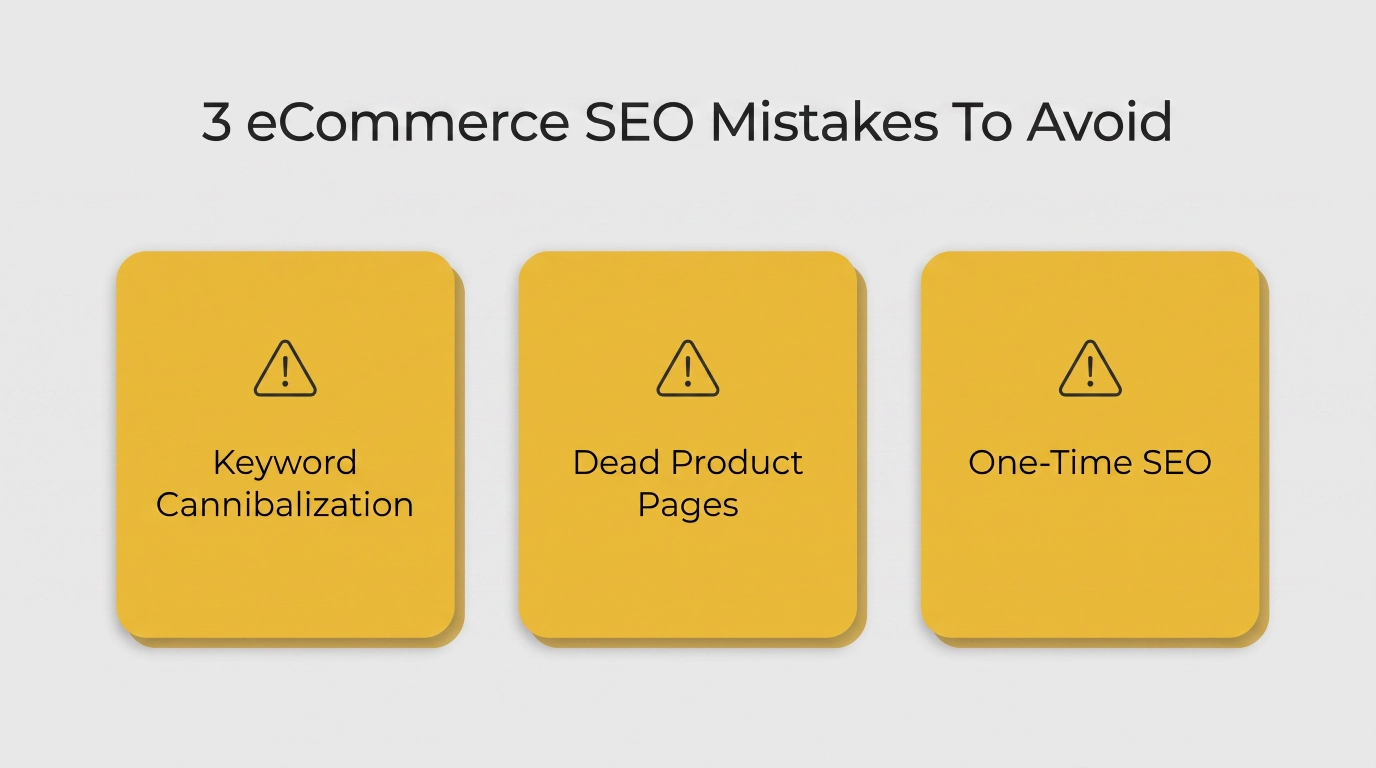
You can do everything above right and still lose traffic because of a few small mistakes. These three are the most common ones eCommerce store owners make.
1. Keyword Cannibalization
Cannibalization is when your own pages chase the same keyword and end up fighting each other instead of the competition. Google can’t tell which one you actually want ranked, so it splits the credit between them and usually ranks none of them well. On a big catalog, this happens constantly, especially with near-identical products and overlapping categories.
How to fix: Find every page going after the same term and crown one winner. Fold the others into it, or point them at a different keyword, and use canonicals or redirects so Google knows exactly which page counts.
2. Letting Out-Of-Stock And Discontinued Pages Rot
Things sell out. Products get discontinued. But their pages just stay there. Let them 404 or leave thousands of dead “out of stock” pages in the index, and you are basically telling Google the place is neglected. You also throw away the rankings those pages earned and send shoppers crashing into dead ends straight back to search.
How to fix: Keep temporarily sold-out pages live, with a restock date and a few alternatives. For products that are gone for good, 301-redirect the URL to the nearest category or replacement, so that ranking power carries over instead of evaporating.
3. Treating eCommerce SEO As A One-Time Project
The most expensive mistake is treating SEO like a one-off you finish at launch. A store is alive: new products drop and plugins update, and the whole thing slowly rots the moment nobody is watching. And the nastiest version of that is security because a store that was spotless on launch day can get compromised months later without a peep.
Hackers love online stores for the payment data, and a breach almost never announces itself. Someone gets malware onto the site or injects spam pages, and Google reacts fast, stamping a “this site may be hacked” warning on your listings or removing you from the index entirely. Months of organic growth can vanish in an afternoon.
That is where ongoing security monitoring becomes part of the SEO picture. For larger stores, managed detection and response (MXDR) can be worth considering. It covers continuous threat detection and response across an organization’s security environment, rather than treating website security as an isolated task.
That distinction matters when a store has payment systems, cloud services, employee accounts, third-party applications, and other infrastructure connected to the storefront.
You don’t necessarily need a managed service for every small store. But as the business grows and the cost of downtime or compromised data rises, having people and systems actively looking for threats becomes much easier to justify.
How to fix: Treat SEO as an ongoing program with an owner and a flow. Put technical and security monitoring on a schedule, and review performance every month so small problems stay small. And optimize new products the moment they launch, not months later.
Conclusion
eCommerce SEO strategies are an asset that compounds. You don’t need all 10 strategies at once, either. Pick the two or three plugging your biggest leak, do them properly, and let the traffic build. Six figures from organic isn’t luck. It is the boring fundamentals, done consistently.
This is the stuff we know inside out at Reliqus. We have spent 15 years building stores and the eCommerce SEO engines that feed them, tying rankings back to real revenue instead of vanity charts. If you would rather hand this off and get back to business, book a free consultation, and we will show you where your fastest wins are hiding.

Burkhard Berger
He helps innovative B2B companies implement modern SEO strategies to scale their organic traffic to 1,000,000+ visitors per month. Curious about what your true traffic potential is?