Customer retargeting used to be easy money. You dropped a cookie, and the sneakers someone eyed followed them around the internet until they caved. Heading into 2027, that trick is basically finished. Cookies are dying off, and the lazy old tactics stopped working once privacy rules grew teeth.
What replaced it is smarter and honestly more fun to run. You will get 11 strategies made for how people actually buy today, plus the mistakes still bleeding budgets dry. One thing first. None of it counts unless you can tie the spend back to real revenue, so keep that in mind throughout.
What Customer Retargeting Actually Means In 2027
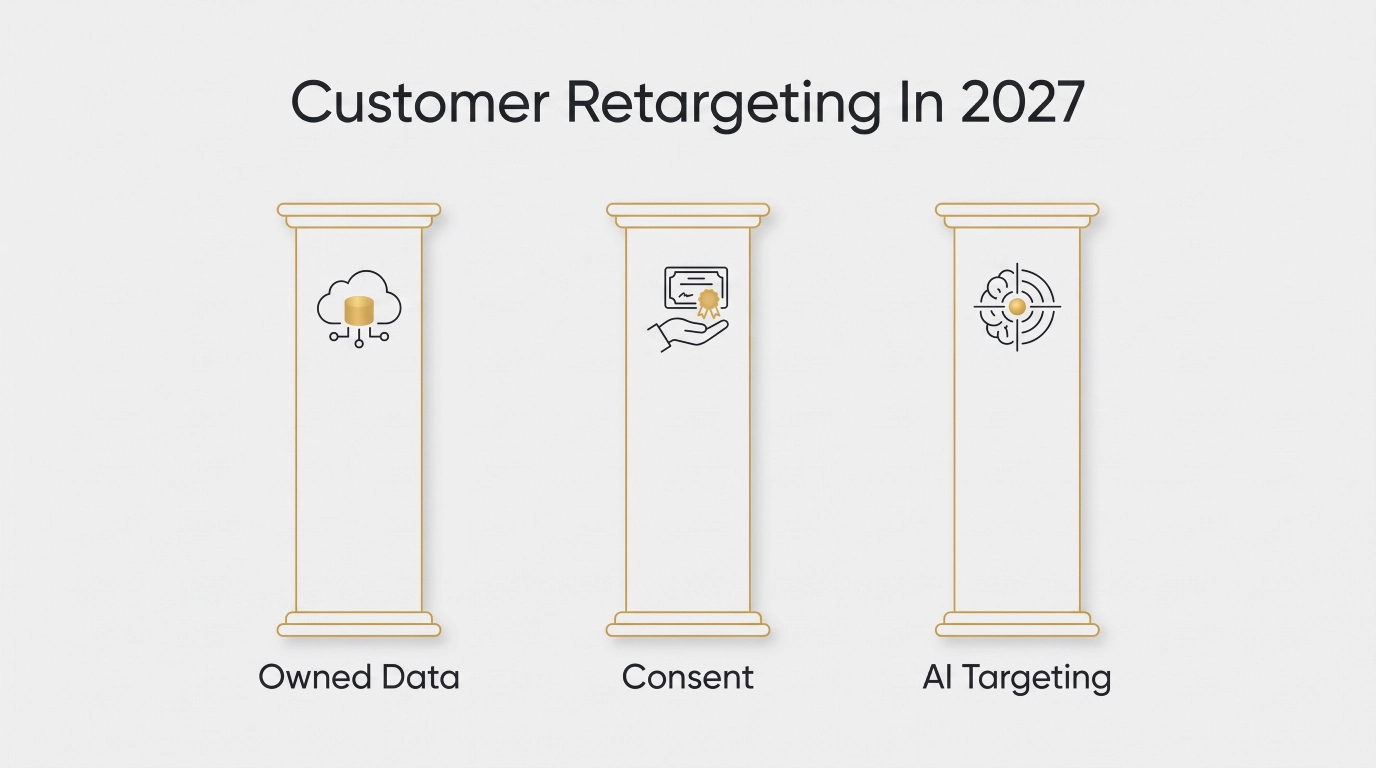
Quick reset before the strategies, because the meaning of customer retargeting genuinely changed. It is not chasing faceless browsers with banner ads.
Strip it back, and customer retargeting focuses on the same thing: reaching people who already showed interest and gently pulling them back to buy. That bit is timeless. What changed is the how. There is no free river of third-party cookies trailing everyone across the web now, so now you work with data people chose to give you.
Good news: it still pays off… big time. People you retarget are roughly 70% more likely to buy than someone meeting your brand cold. The difference now is that earning a spot in front of them takes a bit more than simple pixel-based retargeting.
| Retargeting Then (Pre-2025) | Retargeting In 2027 |
| Ran on third-party cookies | Runs on data people opted to share |
| Chased anonymous browsers | Reaches known, consenting customers |
| Lived on display banners | Shows up on TV, messaging, and retail apps |
| Guessed at who converted | Measured inside privacy-safe clean rooms |
11 Effective Customer Retargeting Strategies To Win Back Lost Customers
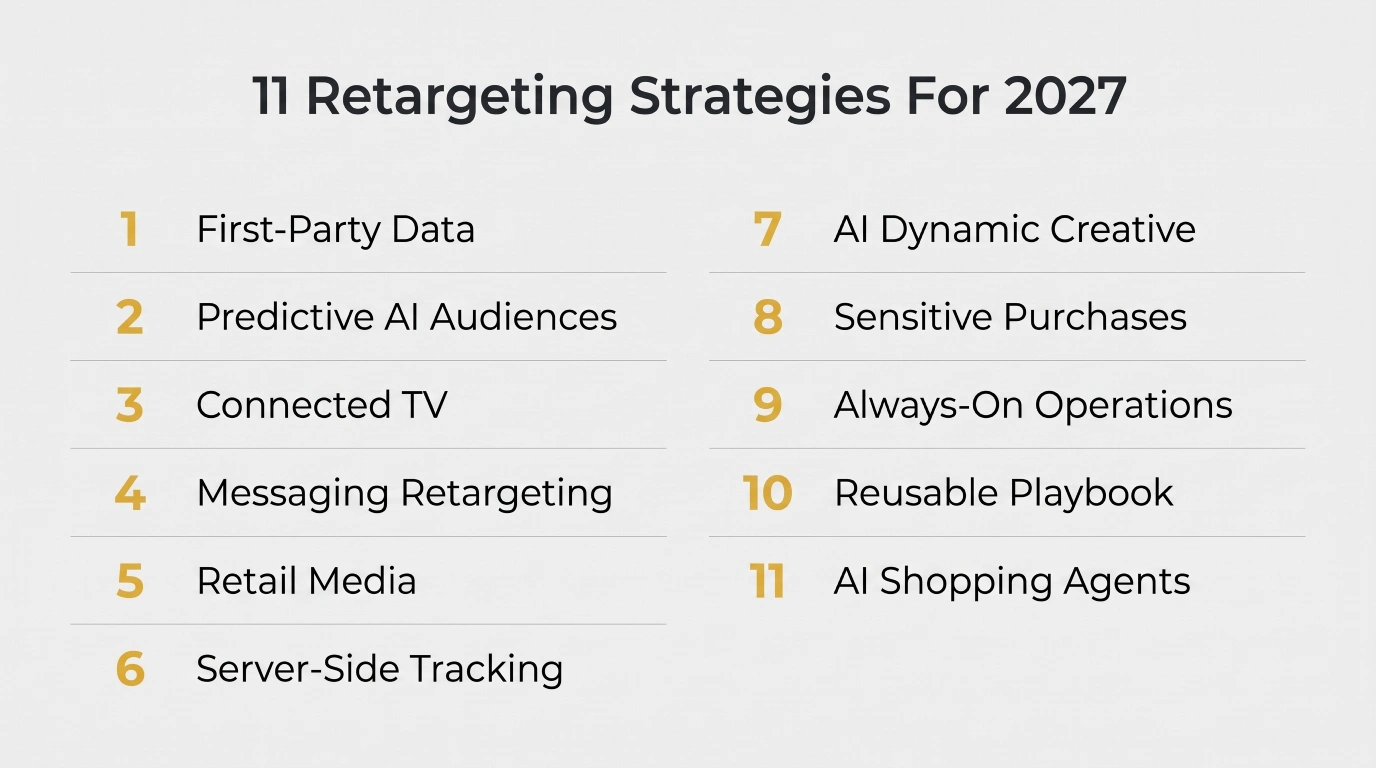
Okay, the good stuff. Eleven strategies built for 2027, each doing a different job. But don’t treat them as a checklist you march through in order.
1. Rebuild Ad Retargeting Campaigns On First-Party And Zero-Party Data
All your marketing efforts are built on this one. First-party data is what you collect yourself, straight from your online store and app. Zero-party data is what people willingly tell you, like a ticked box or a quick quiz.
In a cookieless world, that is pretty much all you have, so how well you gather it decides how far every ad campaign reaches. This matters across channels, from Google Ads to paid social media retargeting, because each one relies on reliable audience data.
- Add quizzes and preference centers that collect zero-party data right at signup
- Sync your website, app, and purchase data into one unified customer profile
- Ask for consent with a clear reason people actually want to accept
- Refresh audience segments daily so the most recent behavior drives your targeting
There is a bit nobody puts in the marketing deck, though. All that precious first-party data has to physically exist somewhere. Usually, that is a database your website, CRM, and your retargeting tools are all accessing at once.
The moment you run real-time retargeting efforts off it, that database is under real strain. When it lags or chokes mid-sale, your target audiences slip out of date, and your sharpest remarketing campaigns start firing at the wrong people.
Most marketing teams don’t have a database pro on the payroll, and honestly, they shouldn’t need one. But someone has to keep that thing quick and online as your data grows. That is the quiet job that database managed services take off your hands.
The payoff is easy to feel. A team watches the database day and night and tunes the slow parts, so nothing keels over when a launch spikes your traffic.
For your retargeting, that is the gap between a segment that is fresh and one that is a day behind. Someone who added to cart an hour ago sees your targeted ad this afternoon, not next Tuesday. Quick, healthy data underneath is the dull reason the flashy stuff on top actually works.
2. Target Predictive AI Audiences, Not Just “People Who Visited Your Website”
Old-school retargeting marketing strategy put everyone who hit a landing page into one bucket. Lazy, and it shows today. Predictive models look through hundreds of signals and rank who is genuinely about to buy, so you can back the people worth backing and quit wasting cash on tire-kickers who were never going to purchase.
The best part is that the tools finally caught up. Many AI marketing platforms score intent right out of the box now, so you don’t need a data science team hiding in the basement to run this.
- Feed the model real purchase history, not just last week’s page views
- Score every site visitor by their likelihood to buy, then bid your budget accordingly
- Suppress the low-probability users so search ad budget flows to people who actually convert
- Retrain the model every month as buying behavior and seasonality keep shifting
3. Retarget Across Connected TV And Streaming
Everyone ditched cable for streaming, and the ads went right with them. Now you can actually retarget a website visitor on their own TV.
Someone sees your product on their phone at lunch, then catches your ad on the big screen that night. It is the reach of TV with the aim of digital advertising. You can also extend the same audience strategy across social media platforms when the budget calls for it.
And the budgets are chasing those eyeballs hard. US connected-TV ad spend is headed for $37.95 billion in 2026, up 14.5% year over year. Nobody gets to call this a fringe channel now.
- Match your CRM list to CTV platforms so you reach logged-in households
- Keep the TV spots short, since retargeting viewers already know your brand
- Add a QR code or a simple URL viewers can act on immediately
- Cap frequency tightly so one household never sees the same spot repeatedly
4. Move Retargeting Into Messaging (RCS, WhatsApp, DMs)

Email campaigns are not dead, but the inbox is a war zone and open rates keep dropping. Attention has moved to messaging. With RCS standard on Android and WhatsApp nearly everywhere else, you can retarget a warm lead inside the same thread they already read.
Swap the plain blast for rich cards and buttons, and it is less a retargeting ad and more a nurture sequence that just happens to run in someone’s chats.
- Get explicit opt-in before messaging, or you will destroy your sender reputation
- Trigger each message off a real action like an abandoned checkout, within the hour
- Use rich cards with one clear button, not a wall of text
- Keep it human and let people reply to reach a real person
5. Retarget Inside Retail Media Networks
If you sell physical stuff, this is where your buyers already are. Retail media networks like Amazon and Walmart let you retarget shoppers right inside their apps, using what they have actually bought. You catch someone the second they are in spending mode, an inch from the buy button. That is about as close to the register as an ad can stand.
- Retarget lapsed buyers with the exact product they bought from you before
- Bid harder on shoppers who viewed the item but never added to cart
- Use sponsored ad placements to win back share from a specific rival brand
- Match the retail data with your own for a fuller picture of each potential customer
6. Go Privacy-Safe With Server-Side Tracking And Data Clean Rooms
Browsers kill trackers, and people bin cookie banners, so a large portion of your conversion data disappears before it reaches your ad platform. Server-side tracking patches that send data from your own server, not the shopper’s browser. Data clean rooms let you match list-based retargeting audiences with a partner without either side handing over raw records.
This isn’t a rounding error, either. Server-side setups claw back somewhere between 15% to 30% of the conversion signal that browser tracking now loses. That is real money reappearing in your reports.
- Move your retargeting pixels to server-side tagging, so browser blocks stop erasing data
- Use a data clean room to match audiences without sharing raw customer data
- Honor consent signals automatically so any opted-out user is never retargeted again
- Audit your data flows each quarter to stay ahead of new privacy rules
7. Let AI Generate And Rotate Creative For Dynamic Retargeting Ads Per Segment
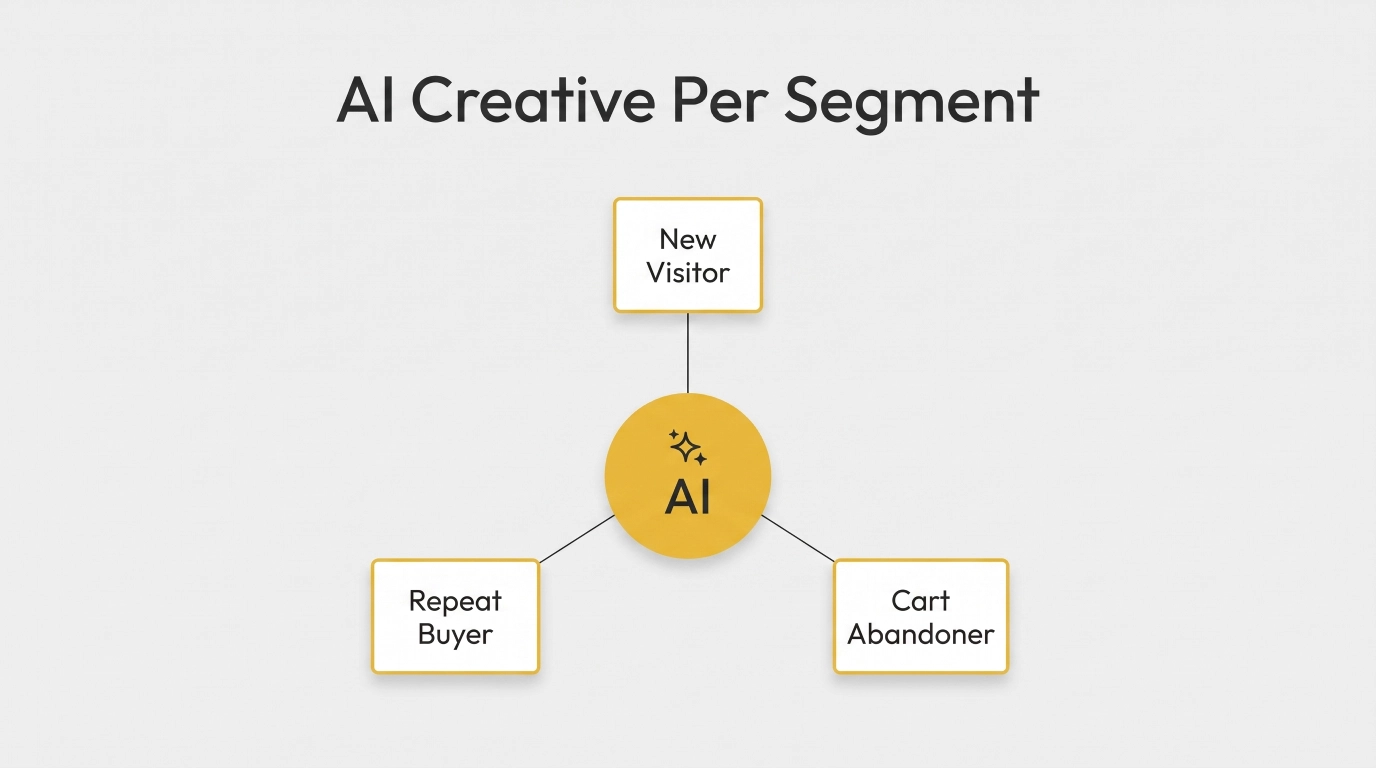
The sharpest audience on earth still dies on a dull ad. AI can create ads with dozens of variants tuned to each segment, then swap the tired ones the second they fade. A first-timer and a loyal repeat buyer see totally different messages, with nobody creating retargeting ad versions by hand. Creative stops being the thing that jams up everything else.
A lot of this runs through AI tools that handle the repetitive production now, which frees your people up for the ideas a machine still can’t have.
- Auto-generate distinct ad copy and imagery for every audience segment you run
- Let the system retire fatigued creative before its performance actually drops off
- Always keep a human reviewing AI output for brand tone and obvious errors
- Test whole message angles rather than just button colors to find real winners
8. Handle High-Stakes, Sensitive Purchases With A Lighter Touch
Not every purchase deserves the same hard push. Hammer a $30 gadget all you want and nobody blinks. Do that around something painful or deeply personal, and you come off as a vulture. For high-stakes and sensitive decisions, increasing frequency and waving discounts backfire. What works there is slow and respectful, built on trust instead of urgency.
Picture the rawest categories out there. Hiring a lawyer after losing a family member. Getting a scary diagnosis. Anything soaked in grief or fear. Someone in that headspace is not a warm lead for a ticking countdown. Retarget them clumsily, and you become the brand that stalked a person through the worst week of their life.
Look at how this wrongful death lawyer in Atlanta, Georgia carries itself. It leads with empathy and a track record instead of a pushy sell because the reader is grieving and wary. Their retargeting bind is cruel: the people who need them most are the ones you can least afford to bother.
So they change the whole approach. Instead of chasing with offers, they stay gently present with genuinely useful things. Think about what to expect from a claim or how long these cases really take. Frequency gets tuned down to a murmur. Every touch leads with reassurance and proof they have won before, never pressure.
Use that restraint any time your buyer is vulnerable. Healthcare and funeral services belong here, and so do addiction recovery or debt-relief brands. The payoff is real. You protect the trust that closes these deals, and you dodge the complaints, blocked ads, and aggressive retargeting invites.
- Cap frequency far lower here than you would for everyday consumer products
- Lead every ad with reassurance and proof of results, never a countdown offer
- Retarget with genuinely helpful content instead of aggressive product or service pitches
- Exclude anyone who signals distress or asks you to stop, without any delay
9. Run Ad Retargeting As An Always-On Operation, Not One-Off Retargeting Campaigns
Most teams still treat retargeting like a one-off advertising campaign you launch and leave unattended. That is a slow way to lose. Audiences shift daily, and creativity burns out within a week, all while the privacy rules keep moving under your feet.
Retargeting helps most when it stays active long enough, with one clear owner and a steady rhythm for refreshing segments and online advertising. Some of that repetition is a good fit for marketing automation, especially audience updates and routine checks.
- Assign one person clear retargeting ad goals and ownership of the entire always-on retargeting operation
- Set a fixed weekly cadence to refresh both your segments and your creative
- Log every test with its hypothesis so nobody repeats last quarter’s work
- Build a mandatory compliance check into the flow before any retargeting advertisement launches
The problem is, always-on turns into a morass fast. You have segments to refresh and creative stuck waiting for approval. Tests are running across four marketing channels, and a compliance check is breathing down every one of them.
Run all that off a spreadsheet and a group chat, and things start slipping through. A paid ad launches to the wrong audience. A test nobody bothered to write down gets run again three months later.
This is a workflow headache more than a marketing one, and it is worth fixing for real. Many teams run their retargeting on a work platform like monday.com, where every test and approval becomes a tracked card with an owner and a deadline.
The catch is setting it up to match how a marketing team really moves, which is fiddly and eats time you don’t have. That is exactly what partnering with monday.com experts solves. They build the boards, and approval flows around your actual process, so nothing goes out without the right sign-off.
What you get out of it is calm. You can glance at one board and see what is running and what has already been tested, so you stop relaunching last month’s audience by accident. Fewer fire drills and far less guessing about what is even out there right now.
10. Build A Reusable Framework And Creative-Template Library

Every retargeting team rebuilds the same system over and over. Same audience definitions and ad layouts, plus that “what worked last time” knowledge stuck in one head. The day that person leaves, it all vanishes. A shared framework and a stash of proven templates let anyone create a solid retargeting campaign from something, not a blank page.
The sticking point is where that library actually goes. A heap of docs and a shared drive turn into a junk drawer fast, and nobody keeps it up to date.
What you really want is a proper internal hub. Somewhere resources and templates stay organized, and a non-techie marketer can update them without filing a ticket. Building that from scratch is its own project that most teams start and never finish.
This is exactly what an intranet or internal portal was made for, and you don’t have to design one from nothing. Something like ShortPoint gives you SharePoint intranet templates for internal hubs, so you can stand up a tidy and searchable home for your retargeting resources in an afternoon rather than a whole quarter.
The payoff for retargeting is speed and consistency. A brand-new hire pulls a proven template and ships something on-brand within the hour. Your best ad structures get reused instead of being forgotten in someone’s downloads folder. And all that hard-won knowledge stops walking out the door when a person leaves, because it is right there waiting for the next campaign.
- Write down your winning audience segments so any teammate can rebuild them fast
- Save your top-performing ad layouts as templates the whole team can reuse.
- Keep one searchable hub for resources and brand assets everyone can reach
- Review and update the library every quarter so it never goes out of date
11. Get Ready For AI Shopping Agents That Browse For Your Customer
Most brands aren’t ready for this one. By 2027, a large number of people will let an AI agent shop for them. That changes normal retargeting, since you are not serving ads to a human thumbing a feed.
You might be persuading software or only reaching the person at the final yes. Whoever pays attention now gets a real head start. It also gives you another area to test alongside other marketing strategies, rather than replacing what already works.
- Keep product feeds structured and machine-readable so shopping agents can parse them
- Compete on clear specs and real reviews, the signals agents weigh most heavily
- Save retargeting spend for the human’s final approval moment, not the browsing agent
- Start testing now how your brand shows up inside major AI shopping assistants
3 Common Customer Retargeting Mistakes + How To Fix Them

Even smart retargeting work gets ruined by a few basic mistakes. These three turn up constantly, and each one is an easy fix once you spot it.
1. Treating The Customer Data Behind Retargeting As Someone Else’s Problem
Every single thing you just read runs on a growing mountain of personal customer data. Emails and order histories, plus the detailed behavior profiles your models feed on. Come 2027, that pile is a prime target, and a breach costs you far more than a fine.
The customers who trusted you enough to hand over their data watch it leak, and the program that data fueled dies the same afternoon. Yet most marketing teams wave security off as purely IT’s headache, and they never give it a second thought until it is too late.
How to Fix: Stop filing that customer data under “IT’s problem” and get real eyes on it. Most marketing teams can’t stand up a security operation on their own, and they really shouldn’t try to improvise it.
That is where a managed service like an agentic SOC from a security operations center becomes useful. In plain terms, it watches your systems day and night and closes the door on a breach before the data walks out. The AI grinds through the round-the-clock alert-sifting, and real analysts step in on the calls that actually matter.
For your retargeting, this is the whole ballgame. Every strategy on this page leans on first-party data, and it all leaks the moment that data does. Lock it down, and you hold onto two things at once. The raw material your retargeting runs on, and the customer trust that makes any of it work in the first place.
2. Still Retargeting People Who Already Bought
Nothing says “we have no idea who you are” like hitting someone with a specific ad for the thing they bought last week. It is everywhere, and it wastes marketing budget while annoying the very people who just paid you. You are literally paying to bug existing customers you already won, when that money could chase brand-new customers instead.
How to Fix: Build suppression lists and keep them fresh. Push your customer and recent-buyer lists into every advertising platform as exclusions, then auto-refresh them so a new buyer drops out within a day rather than a month. The only exception is a real upsell or refill, which deserves its own campaign rather than your generic retargeting.
3. Hammering The Same Creative Until It Annoys
Frequency is where good intentions curdle into resentment. The same ad in the same face 10 times a day doesn’t build familiarity. It builds a grudge. People start tying your brand to the thing that won’t leave them alone. Past a point, more impressions do damage, and hardly anyone bothers to set a ceiling.
How to Fix: Set hard frequency caps per person and per week, then actually hold to them across every channel. Pair that with a rule that benches any creative once its numbers dip, so people get something fresh instead of the same worn-out ad on repeat.
Conclusion
If one thread runs through all 11, it is that customer retargeting rewards respect. Respect for privacy and for the customer’s time and intelligence. The brands that come out ahead won’t be the loudest or most relentless. They will be the ones who use good data with a light hand and know when to ease off.
Working out where to start is the hard part, and it is the bit we love at Reliqus. We are a digital marketing and web crew that has built data-driven retargeting since 2010, always tying it to real revenue over vanity clicks. If you would rather not sort it out solo, book a free consultation and we will plan your first moves.

Burkhard Berger
He helps innovative B2B companies implement modern SEO strategies to scale their organic traffic to 1,000,000+ visitors per month. Curious about what your true traffic potential is?