You are getting leads. Ads are running, people are signing up, emails are coming in. But a week later, most of those people go completely quiet… and you never hear from them again. That is what happens without a lead nurturing strategy.
And that is exactly what we are going to fix here. We will show you 10 lead nurturing best practices that actually keep prospects moving toward a sale – plus a few red flags that tell you when your lead nurturing setup isn’t working. If your lead generation strategies are already bringing people in, this is the part that decides whether they buy or bounce.
What Is a Lead Nurturing Strategy?
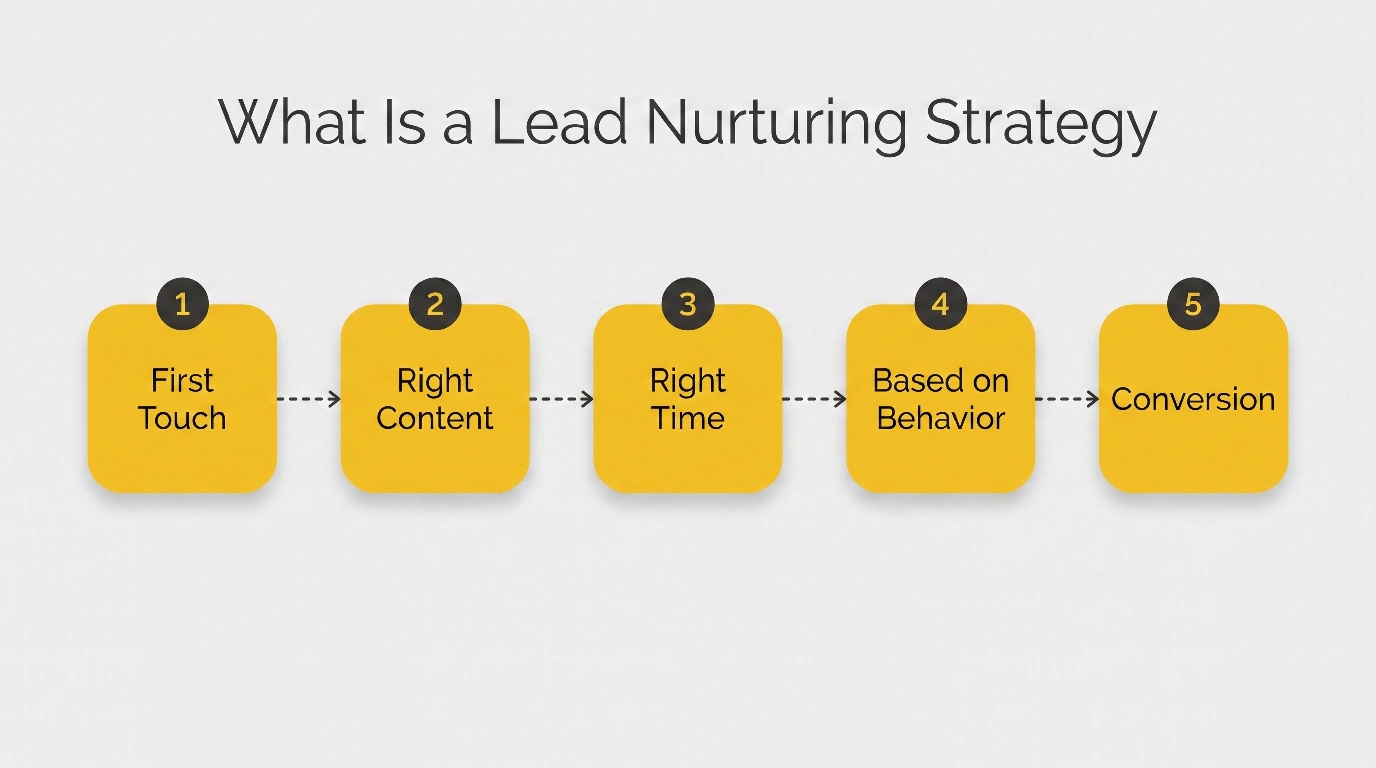
It is a system for staying in front of leads until they are ready to buy. Instead of emailing someone once and hoping they come back, you plan out what to send them and when based on what they have actually done on your site.
The lead nurturing process is really about staying useful until that buying moment arrives. Some leads need 30 days. Some need 90. A lead nurturing strategy keeps your business in their inbox during that entire window so they don’t forget about you and go with someone else.
What Separates a Lead Nurturing Strategy From Standard Sales Follow-Ups
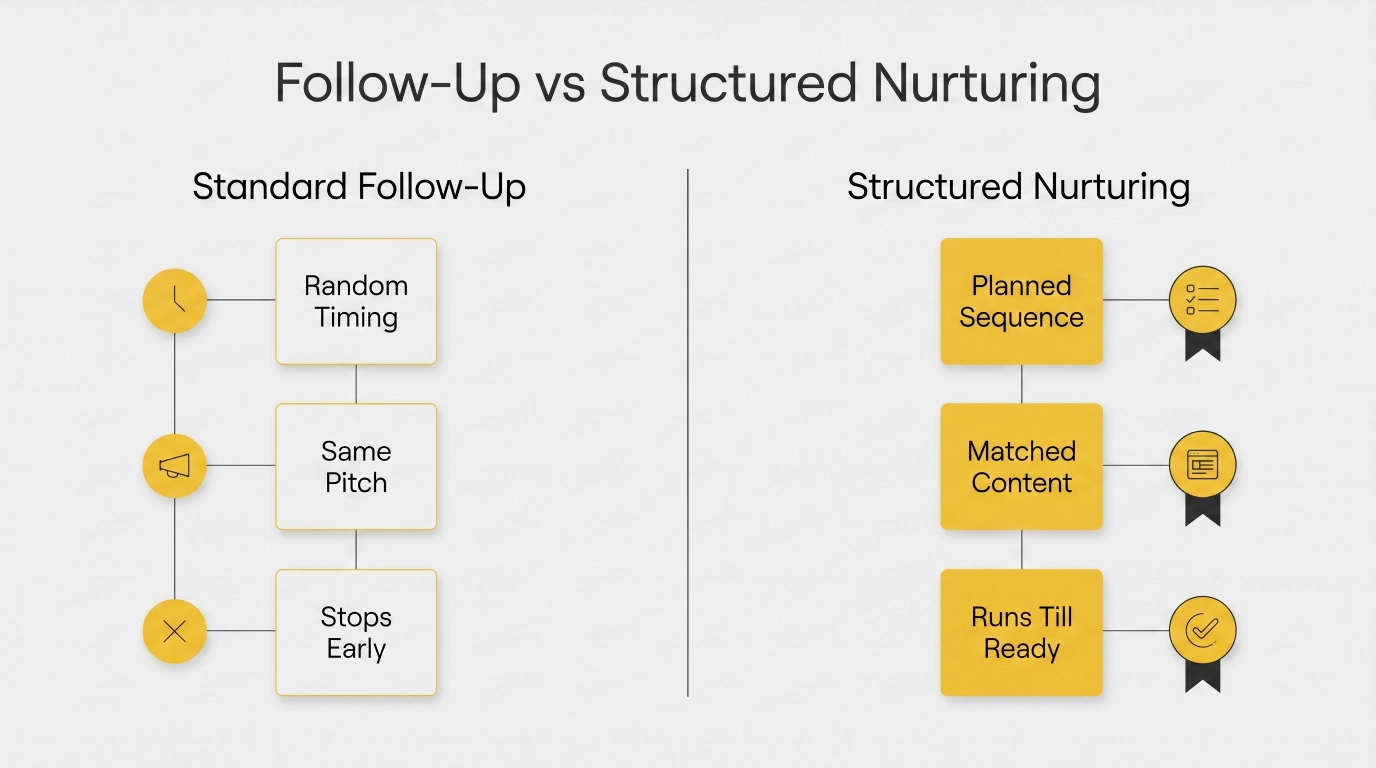
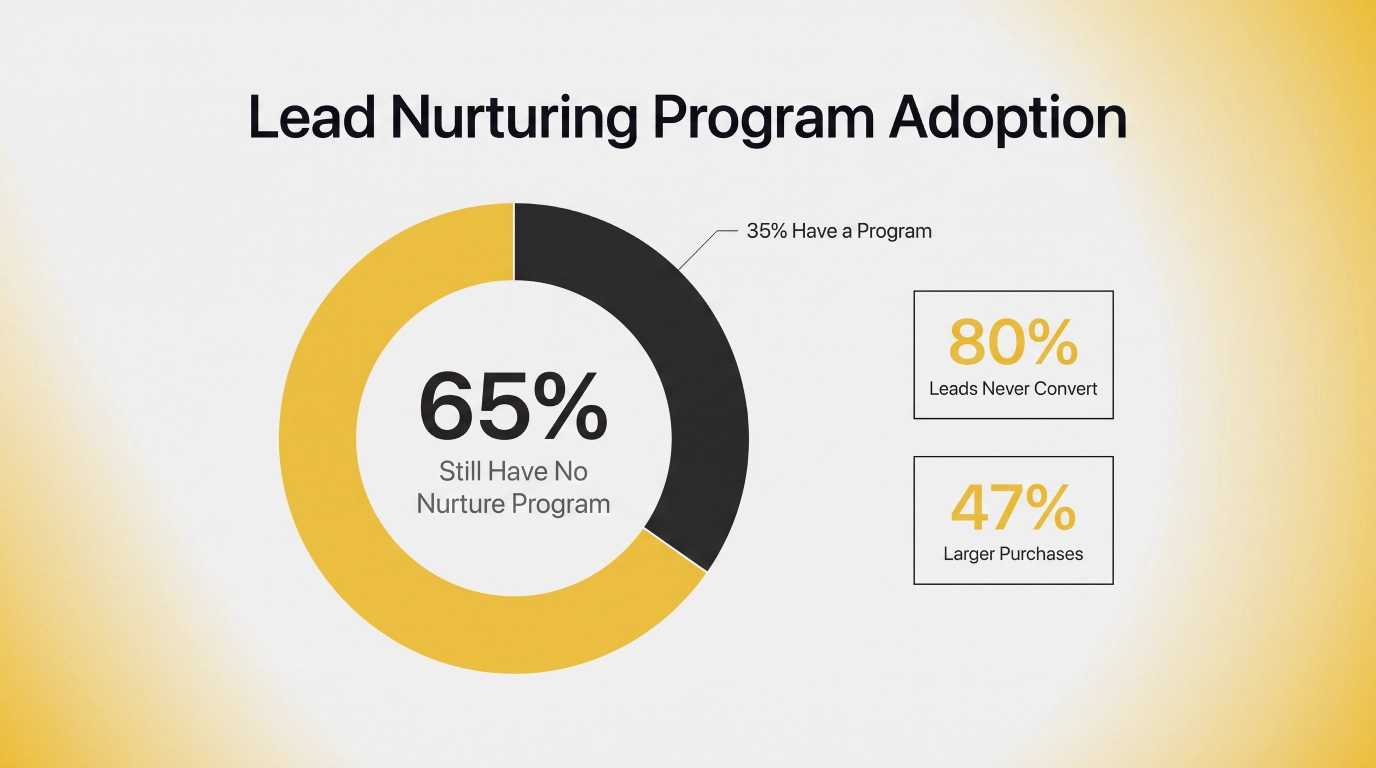
Every company follows up with leads in some way. But 65% of marketers still don’t have a nurturing program at all. Two-thirds of companies are just letting non-nurtured leads figure it out on their own.
And there is a big difference between “we call them twice and move on” and a structured lead nurturing strategy. Here’s how the two compare.
| Factor | Standard Follow-Up | Structured Nurturing |
| Timing | Random or when you remember | Planned sequence with set intervals |
| Content | Same pitch to everyone | Matched to buying stage and behavior |
| Goal | Close the deal now | Build trust until they’re ready |
| Channels | Phone or email only | Multiple channels working together |
| Personalization | First name in an email | Based on specific actions and interests |
| Tracking | Whether they replied or not | Lead scoring and stage movement data |
| Handoff to Sales | No defined point | Clear criteria for when marketing passes leads |
| Duration | A few attempts, then you move on | Continues until lead converts or disqualifies |
If your current process looks more like the left column, that is probably where most of your leads are dropping off.
Lead Generation vs Lead Qualification vs Lead Nurturing: Understanding the Key Differences
These three fix different pain points at different moments, and blurring them is why so much nurturing gets aimed at people who were never going to buy. Here’s where a lead nurturing strategy fits against the other two.
| Aspect | Lead Generation | Lead Qualification | Lead Nurturing |
| Goal | Attract new contacts | Judge fit and intent | Build readiness to buy |
| Core Question | Who are they | Are they worth pursuing | Are they ready yet |
| Funnel Stage | Top of funnel/Awareness stage | The filtering stage | Middle to late sales funnel |
| Owned By | Mostly marketing | Sales and marketing teams | Marketing, then sales |
| Typical Work | Ads and content offers | Scoring and discovery calls | Sequences and tailored follow-up |
| Output | Raw, unsorted leads | Marketing qualified leads | Sales-ready, warmed leads |
| Measured By | Lead volume and cost | Qualification accuracy | Conversion and pipeline speed |
| If Skipped | Pipeline runs dry | Sales chases bad fits | Warm leads go cold |
The thing to hold onto is that nurturing only works on leads that generation actually brought in and qualification judged worth your time. Skip either step, and you will spend weeks warming up a list that was never going to convert anyway.
How to Create a Lead Nurturing That Moves Leads From Interest to Revenue: 10 Best Practices
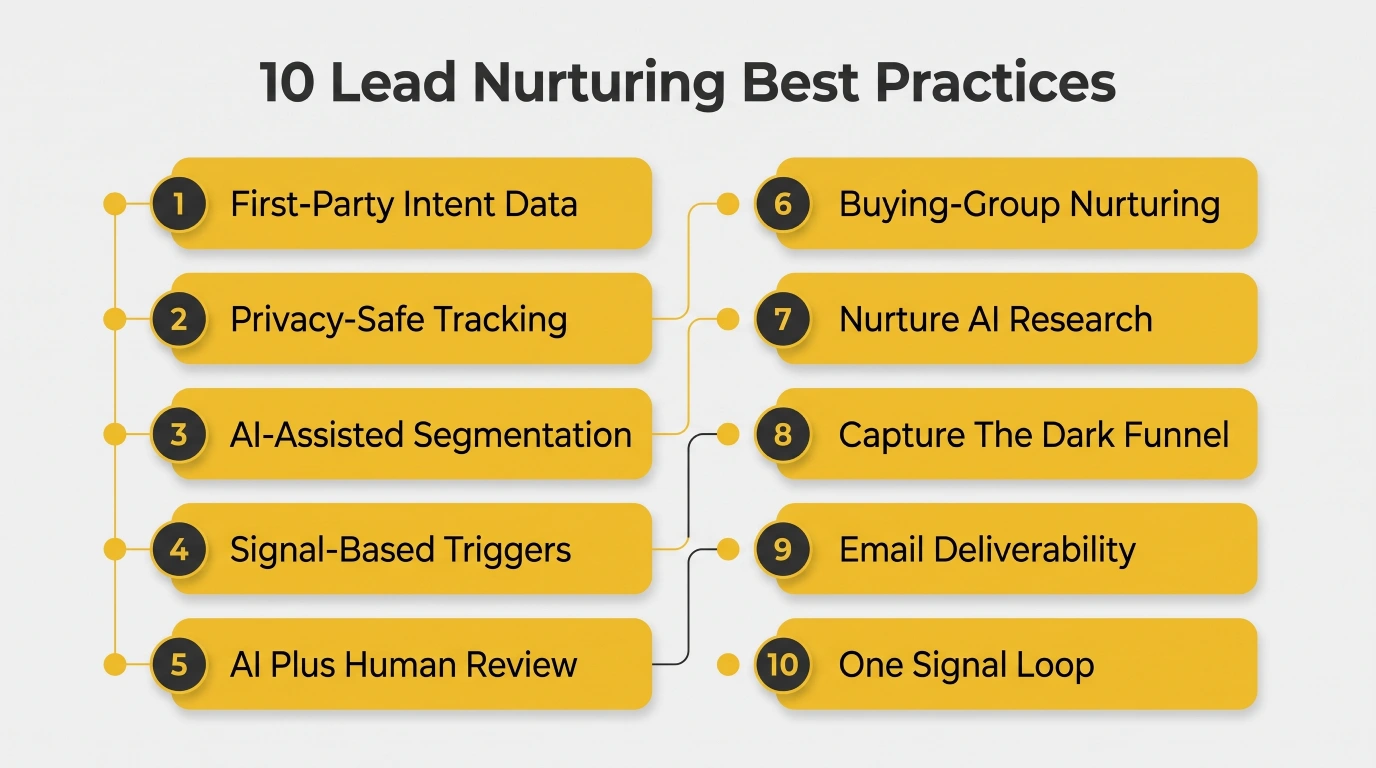
The basics of nurturing haven’t changed all that much. What has changed is the ground underneath them. Buyers do their homework on their own terms now, mostly in private, and a growing share of it runs through AI before you ever enter the picture.
Forrester puts a number on it: 89% of B2B buyers now use generative AI for self-guided research. That one change is why the list below looks pretty different from the lead nurturing tactics that were floating around three years ago.
1. Build Your Lead Nurturing on First-Party Intent Data
First-party data is what you gather yourself, like how a lead behaves on your site and whatever they tell you outright. With third-party tracking dead, it is the only source for personalization you can still count on. The best kind is what people volunteer, since a lead who tells you what they want removes the assumptions.
- Add a short preference quiz at signup that captures declared interests right away.
- Store every on-site action against the lead record, not just static form fields.
- Ask one new profiling question at each interaction instead of one long form.
- Let leads update their own preferences so your data stays current over time.
Consumer subscription brands had to deal with this years before most B2B teams felt it. Their whole model rests on getting that first delivery right for a person they have never met. Guess wrong, and the paying customer bails inside a month. Once third-party data dried up, buying their way to a decent guess stopped being an option.
So the strongest ones just started asking. Look at how the fragrance service Scentbird brings a new member on board. Before a single thing ships, a short scent quiz asks about the moods and styles someone leans toward, and those answers build a starting profile on day one. Nothing goes out blind.
From there it keeps learning. Every fragrance a member rates feeds that profile. So next month’s picks get sharper, and members drag the scents they want into a queue they can reshuffle whenever their taste moves. That is a steady drip of preferences people hand over willingly, gathered without tailing anyone across the web.
That is an effective lead nurturing strategy running on first-party data, plain and simple. Give someone an easy and genuinely useful reason to tell you what they care about, then read every click and rating afterward as another clue. The quiz isn’t a cute onboarding step. It is the base the whole nurture program stands on.
2. Track Buyer Signals the Privacy-Safe, Cookieless Way
There is no point collecting first-party data if you are not allowed to use it. Third-party cookies are gone, and privacy rules mean you now need permission before collecting much of anything. Privacy-safe tracking lets you read behavior through your own channels, with permission, instead of trailing people around the internet. It outlasts whatever tracking came before it, too.
- Move tracking server-side so data collection does not depend on browser cookies.
- Ask for consent in plain language and record exactly what each lead agreed to.
- Rely on your own site and email data instead of bought third-party audiences.
- Set data retention limits so you are not holding information you no longer need.
3. Segment Leads With AI by Real-Time Behavior, Not Job Title
The old way to segment was to sort people by fixed traits – their industry, their job title, how big their company is. That tells you who someone is, not whether they are anywhere close to buying. AI segmentation groups leads by what they are doing instead and reshuffles those groups on its own as the behavior shifts underneath them.
And it pays off – 93% of marketers say personalization improves the leads or purchases they get. Doing it by hand doesn’t scale, which is why the newer AI marketing automation software now re-sorts your audience the moment someone’s behavior changes.
- Group leads by recent actions and refresh those groups automatically as behavior changes.
- Build your lead scoring strategy around strong actions like demo requests over passive page views.
- Feed the model outcomes so it learns which lead behaviors actually precede a sale.
- Review the AI’s segments monthly and correct any grouping that looks off.
Health and wellness brands have a sorting problem most industries never face. Two customers can look identical on paper, down to the same age and income, yet want completely different things. One is studying for exams. Another wants to stay sharp at 60. Send them the same message, and both tune out.
You can see one answer to that on Mind Lab Pro‘s site. Rather than leading with the product, it splits its audience by goal and hands each group its own benefits and proof. A student cramming for exams reads about recall and focus; the active 60-year-old reads about memory and everyday mental clarity instead.
For nurturing, that sorting is the whole strategy. The moment a visitor shows interest in one of those goals, every email and offer that follows can address that exact goal. It is the same job AI segmentation does automatically – work out what someone genuinely cares about, then stop sending them things meant for somebody else.
4. Trigger Every Message From a Buying Signal, Not a Calendar
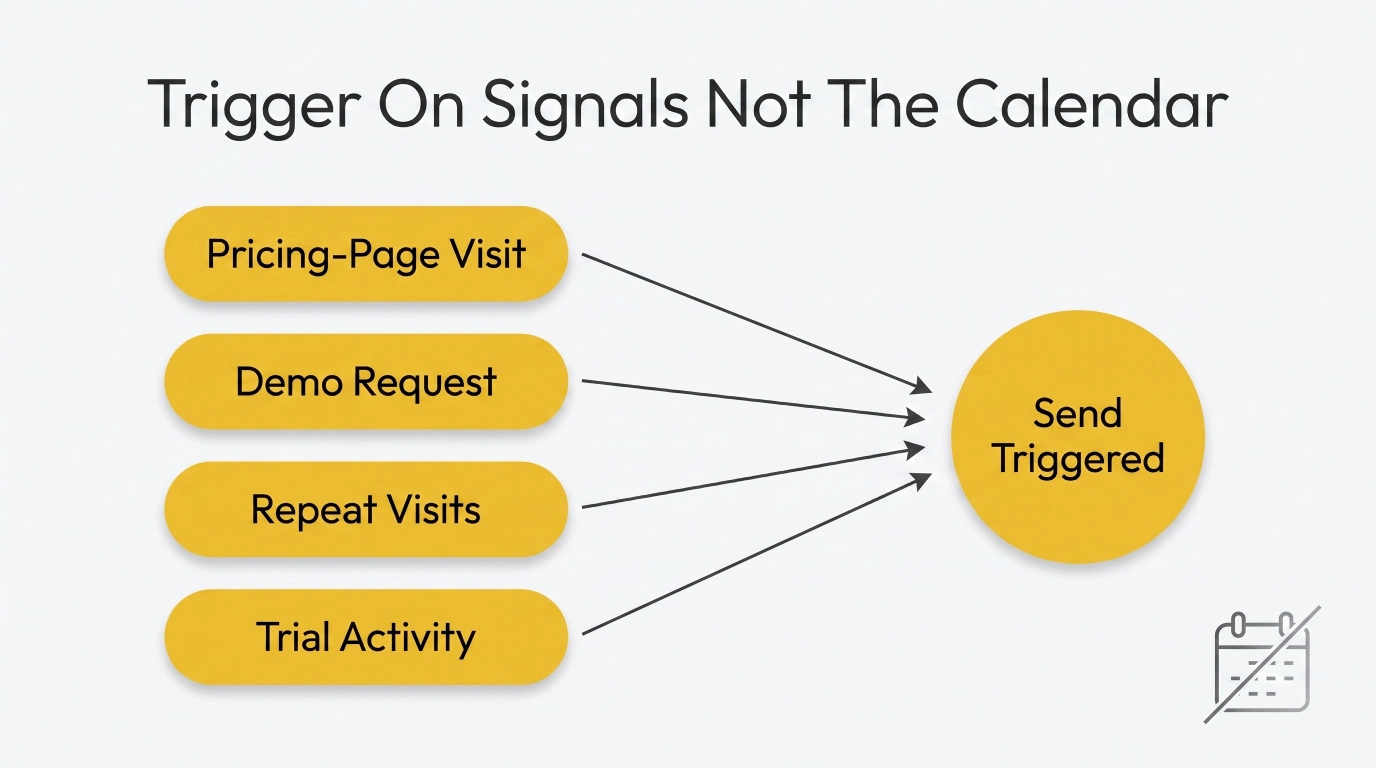
A calendar sequence fires email three on day seven, whether the lead cares that day or not. A signal-based one holds off until the lead actually does something that shows interest, then answers that. The trigger is the action itself, not a date somebody locked in months ago and forgot about.
Not that every signal deserves equal weight. An email open barely registers, since it can fire from a preview pane or a bot that never touched a keyboard. A pricing-page visit or a demo request is a far louder sign that someone’s seriously weighing you up.
This matters more than it used to – 61% of B2B buyers now prefer a rep-free buying experience, so they won’t tell a sales rep where they stand. You read it from what they do instead. The AI SDR tools built for this watch those actions and fire the right follow-up in seconds.
- Fire a relevant follow-up within minutes of a pricing-page visit or demo request.
- Rank signals by intent strength and let the strongest ones jump the queue.
- Treat repeat visits and trial activity as triggers, not email opens alone.
- Pause a sequence the moment a lead’s signals go quiet for a while.
Consumable brands feel this more keenly than anyone. When someone buys a product that runs out, the biggest moment in the whole relationship is the day they run out. Miss it, and they will reorder from whoever is easiest. A generic “we miss you” three weeks too late does absolutely nothing.
A product page like this nootropic pre-workout supplement shows how predictable that moment can be. One container holds exactly 20 servings, so a regular user’s run-out date isn’t a guess. It is arithmetic. The page leans into that too, putting a monthly or four-month subscription beside the one-time option, paced to how fast the powder goes.
That is signal-based nurturing. The strongest trigger isn’t a marketing calendar. It is the customer’s own supply running low. Whether you push a reorder or offer a subscription, the message works because it turns up right when the need comes back, not on some arbitrary day 30. That timing is what creates an effective lead nurturing campaign.
5. Personalize With AI, but Keep a Human Reviewing Every Send
AI can customize messages at a scale no human team could match. Left to itself, it sends confident nonsense and treats a hot lead like one that went cold months ago. The fix isn’t to switch it off. It is to let AI draft and scale while a person owns the final call. That is what an effective lead nurturing program should do: scale the work without losing judgment.
- Let AI draft every message, but have a person approve the high-value sends.
- Set clear rules for what AI can send alone and what needs sign-off.
- Spot-check a sample of AI-written messages each week for tone and factual accuracy.
- Route any complaint or sensitive reply straight to a human, not the bot.
6. Nurture the Whole Buying Committee, Not a Single Contact
In most B2B deals, the person who fills in your form isn’t the one who signs off. There is a technical evaluator picking at details and a finance approver worried about the number… and often the end users too. Nurture only your known contact, and everyone else stays cold, so the sales process stalls where you can’t see it.
- Map the roles in a typical deal and build a content track for each.
- Send finance approvers cost and ROI material, not the deep technical content.
- Ask your known contact who else is involved, then nurture them too.
- Score the whole account’s engagement, not just one person’s clicks and visits.
7. Show Up in the AI Research Buyers Do Before They Reach You
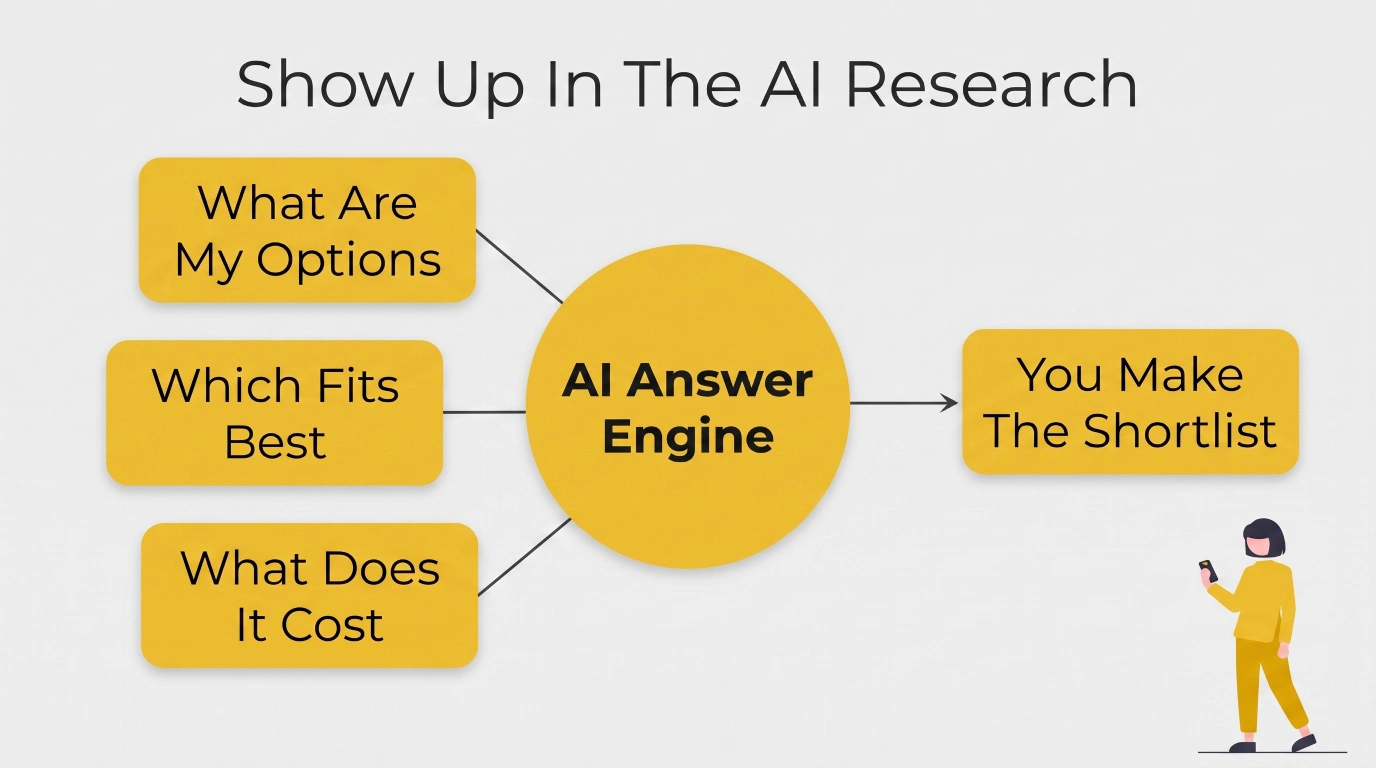
By the time a potential customer reaches out, they have usually done most of the research on their own, more and more of it through AI. If your answers aren’t part of that research, you aren’t on the shortlist.
Nurturing now starts well before anyone tells you who they are, back in the questions people type into a machine. And you need to show up at different points in the buyer’s journey.
- Publish plain answers to the exact questions buyers type into AI tools.
- Structure pages with clear headings and FAQs so AI engines can quote them.
- Answer pricing and qualification questions openly instead of hiding them behind a form.
- Track which self-serve pages a lead reads before they ever contact you.
Some purchases are almost pure research before a single conversation. High-stakes professional services are the clearest case, like law and medicine, or anything where the decision is heavy and personal. Nobody picks up the phone first. They spend days working out whether they even have a situation worth pursuing, and what chasing it might cost them.
The Finch McCranie medical malpractice attorney page is written for exactly that person, the one still researching rather than ready to sign. It describes what counts as malpractice and the evidence a claim needs. It is upfront about the contingency model, and honest about the deadlines that can end a case early.
The value is that AI can pick up and surface this kind of information when someone asks those questions during their research. They give AI systems useful material to draw from when building an answer.
So instead of trying to compete with the AI answer, the goal is to make your pages the source that helps shape it – and puts your firm in front of someone before they are ready to make contact. That makes it useful beyond content marketing and into broader sales and marketing strategies.
8. Capture the Dark-Funnel Buyers Your CRM Never Sees
A lot of buying interest never touches a form. People read your social media posts and ask around in private communities. They watch a video or mention you in a group chat you will never see. Your CRM records none of it, so these buyers look like strangers the day they finally appear. That whole invisible stretch is the dark funnel.
- Publish relevant content built to be shared, so it travels where forms cannot reach.
- Add a simple self-identify option, like a low-friction poll or interactive tool.
- Ask new leads how they first heard about you to reveal hidden channels.
- Retarget engaged anonymous visitors so you nurture demand before a form exists.
Some businesses have it even harder here because their best marketing isn’t online at all. For trades like commercial construction and landscape design whose finished work stands out in the physical world, the spark of interest is usually someone standing in front of a completed project.
A regional facilities manager notices how a property looks and thinks, I want that for ours. None of that curiosity ever touches your site, let alone a form. So in these trades, the thing that nurtures isn’t a drip campaign. It is a public, browsable body of proof that keeps working while you sleep.
A firm like this outdoor lighting services company leans on a deep gallery of finished commercial and estate projects. It is the kind of work a hotel manager or an HOA board can scroll through and picture on their own property, without speaking to a salesperson first.
That gallery is dark-funnel nurturing made physical. A commercial prospect sees a lit property in person, looks the company up, then spends 20 minutes browsing projects like their own. All of that warming-up happens before any form exists, carried by people who shared a photo or forwarded a link.
For any business whose results are visible in the world, the strategy is the same. Put your proof somewhere it can be found and passed around because in these niches the portfolio is the nurture sequence.
9. Adapt to the New 2026 Email Deliverability and Sender Rules
None of it counts if the lead nurturing emails never reach the inbox. Mailbox providers now expect proper sender authentication and a real one-click unsubscribe in every message. They also watch how often people mark you as spam; one bad run drops you to spam. A program can seem active in the dashboard while barely reaching anyone.
- Authenticate your domain fully so mailbox providers trust every message you send.
- Include a genuine one-click unsubscribe link in every single nurturing email you send.
- Watch your spam-complaint rate and pull back the moment it starts climbing.
- Remove unengaged addresses regularly so a bad list does not sink deliverability.
10. Connect Your CRM, Ad Platforms, and Sales Tools Into One Signal Loop
Most lead nurturing efforts run on data scattered everywhere. Your CRM holds one piece of a lead’s intent, and your ad platform and sales calls each hold another, with none of them comparing notes. So you react to one weak ping from a single tool instead of the whole story. The most successful lead nurturing campaigns do not rely on one signal alone.
- Sync your CRM and ad platform so both act on the same lead records.
- Pipe sales-call outcomes back into marketing so scoring reflects what actually closed.
- Route every captured signal into one shared record instead of separate tool silos.
- Audit your tool integrations each quarter so no signal source drops out unnoticed.
3 Signs Your Lead Nurturing Strategy Needs a Reset
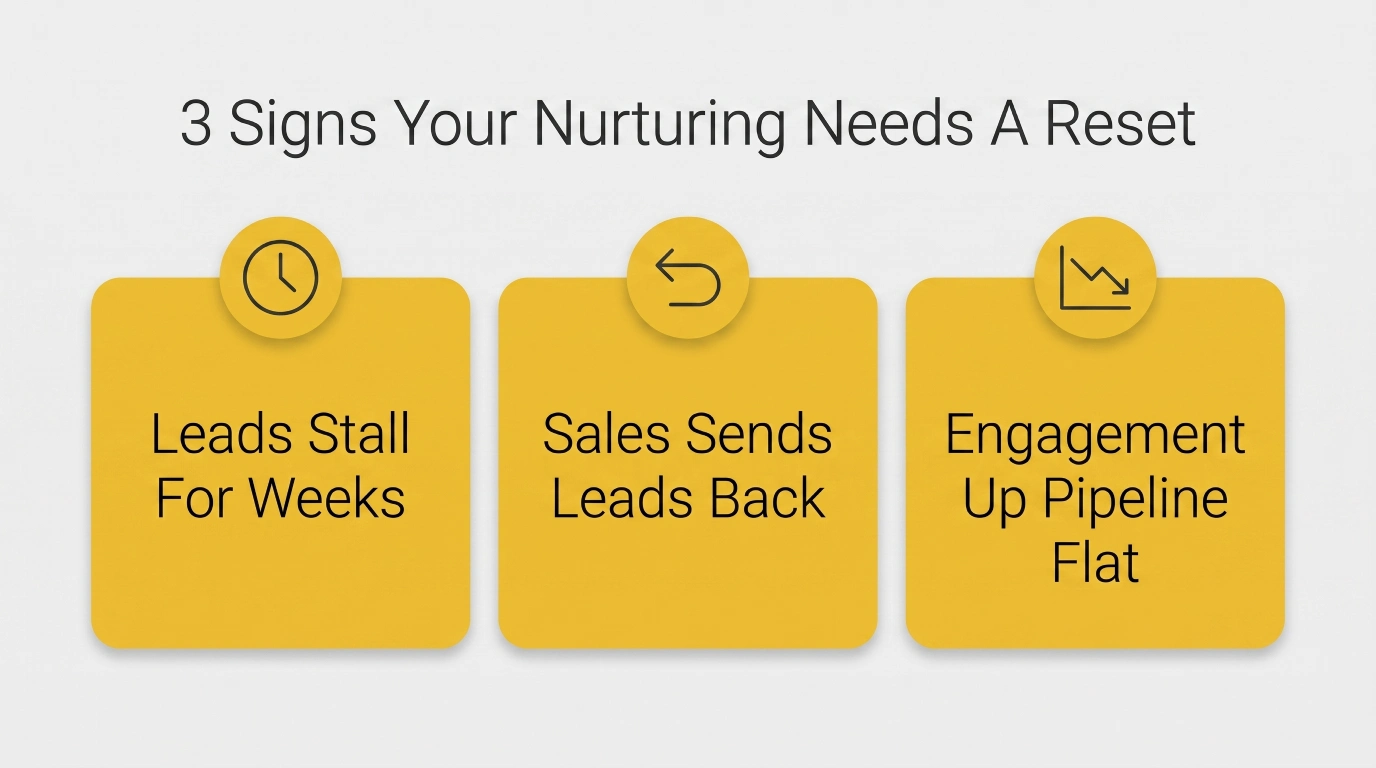
Even a strong setup weakens over time. These are the signs telling you the current approach is getting in the way of lead nurturing success and is due for a real rework.
1. Leads Stall at the Same Stage for Weeks
When leads park at one stage for weeks and won’t budge, the content for that stage is falling short. This is rarely a scoring issue. The messaging just isn’t giving anyone a reason to take the next step. Go read what that stage actually sends, and ask yourself whether it answers the question a lead has right there.
2. Sales Keeps Sending Your Leads Back
If sales keeps bouncing more and more leads you hand over, your handoff criteria and the signals behind them are off. Pick the kickback rate that would worry you (many teams get twitchy around a third) and treat crossing it as your cue to review. Then pull those rejected leads and find the pattern in how they behaved beforehand.
3. Engagement Looks Fine, but the Pipeline Doesn’t Move
This one hides in plain sight. Opens and clicks look healthy, so the whole thing seems to be working, yet meetings and revenue stay flat. Nearly always, it means you are rewarding the wrong signal. An attribution model that connects nurturing to revenue shows you which touches genuinely move deals, so you can quit celebrating activity that never becomes pipeline.
Conclusion
The best lead nurturing strategy in 2026 isn’t the one with the most automation. It is the one that reads real intent and knows when to bring a human back in. Don’t launch all 10 at once. Pick the two that plug your biggest leak, usually data and signals, then add the rest over time.
We are Reliqus. Since 2010, we have run SEO and content programs right next to the paid campaigns that feed them, on one stubborn rule: if it doesn’t help your business grow, it doesn’t matter. When your leads keep going cold before they buy, we build and run the engine that fixes it. Book a free consultation now.
Frequently Asked Questions
How long does a lead nurturing strategy take to show results?
It really depends on your sales cycle, so think in months rather than days. A short eCommerce cycle might show movement within a few weeks. A long B2B deal could easily take a full quarter or two before nurtured leads start converting. Whatever you change, give it at least one complete sales cycle before you decide it worked.
How often should you contact a lead while nurturing them?
There is no magic number here. Let the lead’s own activity set the pace, leaning in when they are engaging and backing right off when they go quiet. Start somewhere that feels helpful rather than pushy, then adjust based on your reply and unsubscribe rates. The right flow is whatever your particular target audience will actually put up with.
When should you stop nurturing a lead?
Stop when someone has shown no real activity anywhere for a long stretch or the moment they ask you to. Before you drop them, it is worth one last re-engagement message. If that gets you nothing back, move them out of the active sequence, so both your data and your sender reputation stay clean.
Does lead nurturing work for B2C and eCommerce, or just B2B?
Both, though they look pretty different in practice. B2C and eCommerce nurturing moves faster and focuses hard on repeat purchases and timing. B2B is slower and pulls more people into every deal. The heart of it holds either way. Stay useful and relevant until the buyer is genuinely ready to move.
Can you run lead nurturing without a big team or budget?
Definitely. A small team can run a sharp program with one decent automation tool and a clear plan for who gets what. Start with a single behavior-triggered sequence aimed at your best leads, prove it earns its place, then build out from there. Enterprise software is not the price of entry.

Burkhard Berger
He helps innovative B2B companies implement modern SEO strategies to scale their organic traffic to 1,000,000+ visitors per month. Curious about what your true traffic potential is?